


Brazil’s Supreme Court schedules public hearing on provisional betting ban for 3 November

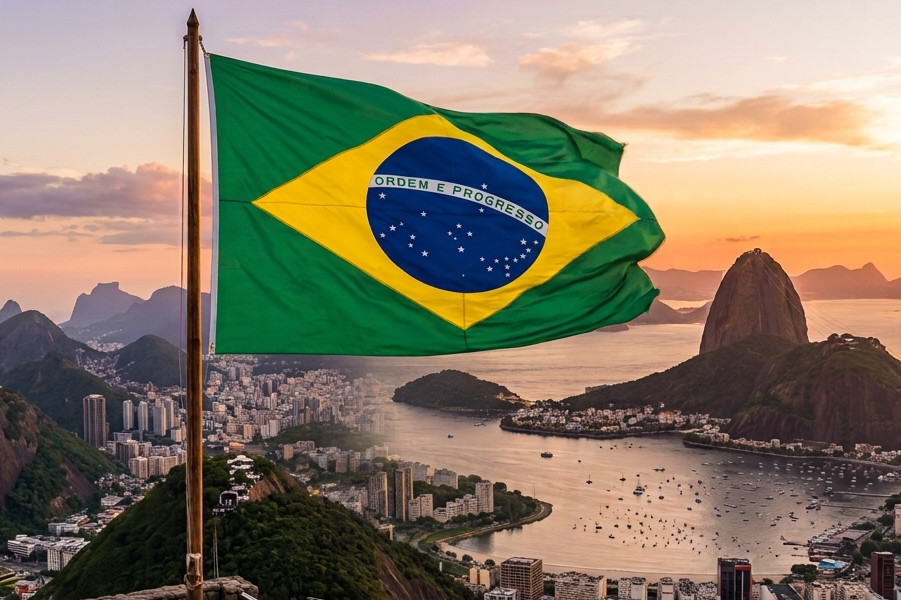
A public audience to discuss the impact of Brazil’s provisional ban on betting has been scheduled for 3 November by Brazil’s Federal Supreme Court (STF), according to a notice by the STF on Tuesday.
Justic Luiz Fux has set the date, for 10am local time.

The meeting comes after Brazil’s National Association of Games and Lotteries (ANJL) argued that the measure could be unconstitutional, requesting the immediate suspension of the provisional measure and requesting that the STF recognize the legality of the laws regulating betting in the country.
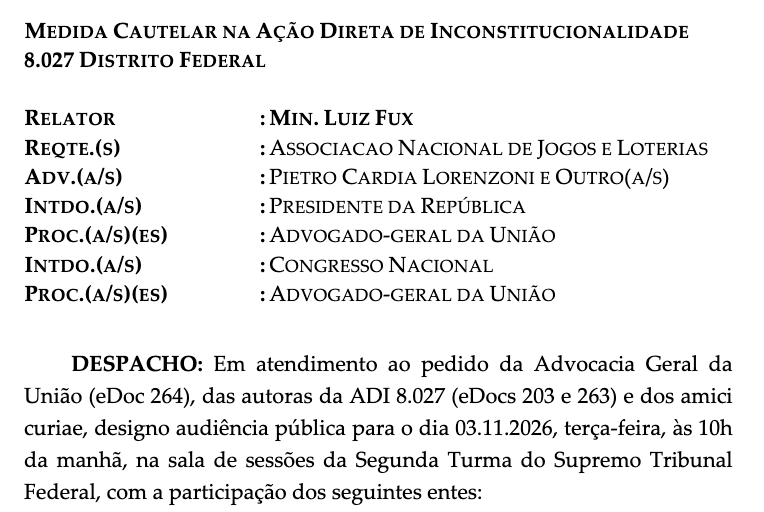
The ANJL joins 26 institutions and entities for the audience, including the Brazilian Institute for Responsible Gaming (IBJR), the National Confederation of Goods, Services and Tourism (CNC), the Brazilian National Confederation of Industry (CNI), Brazil’s Ministry of Finance and the Attorney General’s Office (AGU).
Various representatives of football clubs, including Flamengo, Fluminense, Botafogo, Cruzeiro, São Paulo, Corinthians, Ponte Preta, Vitória, Guarani e Portuguesa are expected to join, along with the Brazilian Football Confederation (CBF).

The sudden decision to ban betting in Brazil caused massive backlash in the igaming and sports betting world after being signed on 25 September and giving operators only until 6 October to shutter their sites.
While initial expectations were for licensed betting to rapidly shift to offshore sites, recent data from Blask indicate that offshore demand had actually dropped to below the pre-ban level and that “offshore brands are left with a smaller version of the volume they had before.”
The provisional ban was led by Luiz Inácio Lula da Silva ahead of the presidential elections, which saw the official elected yet again for a term starting 5 January next year. Lula’s opponent, Flávio Bolsonaro, had also supported banning online casino gaming but maintaining sports betting. Following his loss, Bolsonaro has reportedly fled to the United States.

The provisional measure to ban all betting still requires approval from congress, with the decision labelled as “institutional self-sabotage” by analysts at Blask, noting that the nation is shuttering a US$6.6 billion GGR industry.
“Licensing moved Brazil’s market onshore, and the ban sends it back offshore,” the report highlighted early this month.

Dig Deeper
Related stories
 2026/09/27: Brazil bans all sports betting and online casino gaming
 2026/08/25: Total Philippines gambling ad ban seen handing market back to illegal operators, data from five countries show
 2026/10/09: Stake granted preliminary injunction to temporarily continue operating in Brazil
 2026/09/28: DigiPlus complying with Brazil provisional igaming ban, says situation is “not final”
2026/09/27: Brazil bans all sports betting and online casino gaming
2026/08/25: Total Philippines gambling ad ban seen handing market back to illegal operators, data from five countries show
2026/10/09: Stake granted preliminary injunction to temporarily continue operating in Brazil
2026/09/28: DigiPlus complying with Brazil provisional igaming ban, says situation is “not final”
The Backstory
A regulated market reversed in weeks
Brazil’s Supreme Federal Court hearing will test the legal and economic limits of one of the most abrupt gambling policy reversals in a major regulated market. The provisional measure signed by President Luiz Inácio Lula da Silva on Sept. 25 shut down sports betting and online casino gaming nationwide, only months after Brazil’s federal fixed-odds betting regime became fully operational.
The measure took immediate legal effect, though it still needs congressional approval to remain in force. It barred the operation, offering, intermediation and advertising of fixed-odds betting in both physical and online channels, covering sports betting and online games. It also applied to state and Federal District authorizations, a point that broadened the measure’s impact beyond federally licensed operators.
Under the timetable set by the government, operators had to stop accepting deposits and new bets upon publication. Platforms could remain accessible only until 11:59 p.m. on Oct. 5 to allow customers to withdraw funds. From Oct. 6, betting websites and apps were required to become inaccessible in Brazil, with open wagers canceled and refunded if outcomes had not yet been determined. The framework was detailed in the provisional measure banning sports betting and online casino gaming.
The speed of the transition gave the industry little room to adapt. Existing authorizations were set to expire 30 days after publication, operators were told they would not recover authorization fees or receive compensation for the market closure and financial institutions were restricted from processing betting transactions except for wind-down and refunds.
From channelization to closure
The ban reversed a policy model built around channelization: moving bettors from offshore or unlicensed sites into a supervised market. Brazil’s regulated framework had been designed to bring fixed-odds betting onshore under the Secretariat of Prizes and Betting within the Ministry of Finance, with licensing, advertising controls, tax collection and consumer protections replacing a fragmented gray market.
Industry groups warned before and after the measure that banning licensed operators would not extinguish demand. Instead, they argued, it would return customers to illegal platforms outside Brazilian enforcement, payment controls and responsible-gaming requirements. The National Association of Games and Lotteries said more than 30 million bettors could be pushed toward illegal operators.
The challenge is not theoretical. Brazilian authorities were already blocking large numbers of unauthorized domains before the ban. According to earlier reporting, Brazil blocked 66,482 domains linked to unauthorized betting platforms between January 2025 and September 2026, while the ANJL identified 6,409 illegal domains operating in a single week in September. Those figures showed the illegal market remained resilient even while licensing was active.
The government response included creating an Interinstitutional Committee for the Oversight of Illegal Fixed-Odds Betting Operations and Advertising, coordinated by the Chief of Staff’s Office. That structure signaled that Brasília expected enforcement pressure to intensify after the authorized market closed. The dispute now before the high court is whether the state can lawfully dismantle the licensed sector so quickly while claiming it can contain the illicit one.
Courts become the first battleground
The Supreme Court hearing follows early litigation from operators and trade groups seeking to slow or overturn the measure. The ANJL has argued the provisional ban could be unconstitutional and has asked the court to suspend it immediately and recognize the legality of Brazil’s betting laws.
Operators also moved through lower courts. Stake Brazil obtained a preliminary injunction from the São Paulo Federal Court allowing it to continue operating temporarily until Oct. 25. The court did not grant Stake’s request to operate until Dec. 31, 2029, but it found the government could not impose the full effects of closure without a reasonable deadline. The decision, described in Stake’s preliminary injunction to continue operating in Brazil, was framed as a conservative measure to prevent immediate and potentially irreversible harm.
The Attorney General’s Office said it would appeal, underscoring the government’s interest in preserving the measure’s timetable. The litigation also exposed a central weakness in the ban’s rollout: It collapses commercial rights granted under the licensing regime while giving operators days, rather than months, to return funds, cancel bets, unwind sponsorships and remove advertising.
Brazilian provisional measures are designed for urgency. They have an initial validity of 60 days and may be extended for another 60 days if Congress has not completed its vote. But that legislative clock is longer than the operational shutdown imposed on betting companies, creating a gap between political review and market impact.
Operators manage exposure and refunds
For licensed and newly expanding companies, the measure triggered immediate compliance work. DigiPlus, the Philippine-listed operator behind BingoPlus, said it was complying with the government’s directive while describing the situation as “not final.” The company emphasized customer withdrawals and fund returns as its priority and said it did not expect a material impact on its overall financial or operating position.
DigiPlus had been expanding in Brazil and had joined the Brazilian Institute for Responsible Gaming in July, presenting its entry as part of a compliant, responsible-gaming strategy. Its response, covered in DigiPlus’ statement on Brazil’s provisional ban, captured the uncertainty facing operators that had invested in licensing, local partnerships and brand building under a federal regime the government then moved to extinguish.
The financial stakes extend beyond operators. License fees, taxes, sponsorships, media spend and sports partnerships had developed around the regulated model. The measure’s refusal to refund authorization fees or compensate investments sharpened the legal questions likely to surface at the Supreme Court hearing. Companies can comply with shutdown rules while still arguing that the state impaired vested rights or violated principles of proportionality and legal certainty.
Payment systems also sit at the center of the transition. By cutting off betting transactions except for refunds and wind-down activity, the government sought to prevent continued wagering through licensed channels. But the same restrictions may increase the attractiveness of offshore operators using alternative payment rails, crypto or informal intermediaries.
Football’s stake in the policy fight
Brazilian football is one of the most visible constituencies affected by the ban. Clubs had become major beneficiaries of betting sponsorships, while the sport’s integrity agenda had increasingly relied on data partnerships and monitoring systems connected to a regulated betting environment.
The Brazilian Football Confederation is among the entities expected at the Supreme Court hearing, along with representatives of clubs including Flamengo, Fluminense, Botafogo, Cruzeiro, São Paulo, Corinthians, Ponte Preta, Vitória, Guarani and Portuguesa. Their presence reflects both commercial exposure and concern over what happens to betting activity when it moves away from identifiable, licensed operators.
The CBF had recently extended its collaboration with Sportradar to monitor more than 8,200 men’s and women’s matches a year across national championships. That partnership, described in Brazilian football’s expanded match-fixing monitoring deal with Sportradar, came after data showed a 48% fall in suspicious cases in Brazil. The integrity gains were tied to surveillance, cooperation and visibility.
A prohibition does not remove the risk of match-fixing. It can make betting flows harder to observe if volume migrates to offshore sites beyond Brazilian reporting duties. That is why clubs and integrity monitors have a stake in whether the court treats the ban as a permissible public-health intervention or an overbroad measure that undermines the tools regulators need to detect suspicious activity.
A wider lesson on bans and illegal demand
Brazil’s fight echoes debates in other markets over whether prohibitions protect consumers or strengthen illegal operators. In the Philippines, a proposed total gambling advertising ban has drawn warnings that licensed operators would lose visibility while offshore sites continued to reach players through social media, influencers and private channels. Analysis of that proposal found that advertising bans in several countries were followed by growth in illegal gambling, a pattern explored in the Philippines gambling advertising ban analysis.
The comparison is not exact: Brazil’s measure goes further by banning the core betting activity, not only advertising. But the policy dilemma is similar. Licensed operators are easiest to restrict because they have local entities, bank accounts, employees and permits to lose. Illegal operators are harder to reach because they can change domains, shift payment methods and operate beyond domestic enforcement.
Data cited after the Brazilian ban suggested offshore demand did not immediately surge as expected and may have dropped below pre-ban levels. That could reflect short-term disruption, uncertainty or bettors waiting for legal and political clarity. The longer-term question is whether demand stays suppressed or reappears through unlicensed platforms once the regulated market’s brands, payment channels and sponsorships disappear.
The Supreme Court hearing is therefore about more than the fate of a provisional measure. It will frame how Brazil balances public concern about gambling harm against the legal stability of a market it recently authorized. If the court allows the ban to proceed without changes, Congress and regulators will still face the challenge of policing demand they can no longer supervise through licensed operators. If the court suspends or narrows the measure, Brazil may return to the harder work of tightening regulation rather than abolishing the market.
