


Blask Index: Brazil’s igaming ban didn’t translate into offshore growth

Analysts at Blask have indicated that the election of Luiz Inácio Lula da Silva as Brazil’s next president means that “igaming will be offshore in the country for a long time,” but found that his igaming ban hasn’t immediately caused a rise in offshore demand.
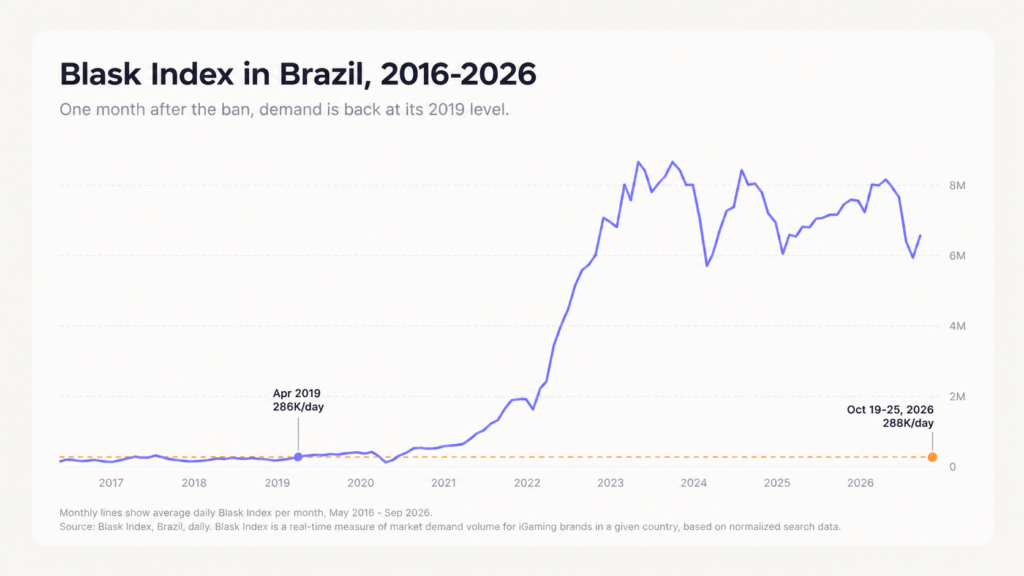
Data released on Monday indicate that Lula’s decision to ban igaming in the country, including sports betting, caused a 96% drop in its Blask Index for Brazil – which measures market demand volume for igaming based on normalized search data.

The index fell from an average of 7.26 million before the ban to just 288,000, however the data revealed that “the drop did not turn into offshore growth.”
However, “the decline came in stages,” with a jump in the index to 8.06 million on 26 September, the day after the provisional measure was signed. The index fell to 1.3 million by 1 October and in the first week after licensed sites went offline on 6 October, demand for licensed brands fell 88% to 846,000 a day. The index covered licensed brands in Brazil until 12 October, only covering offshore brands afterwards.
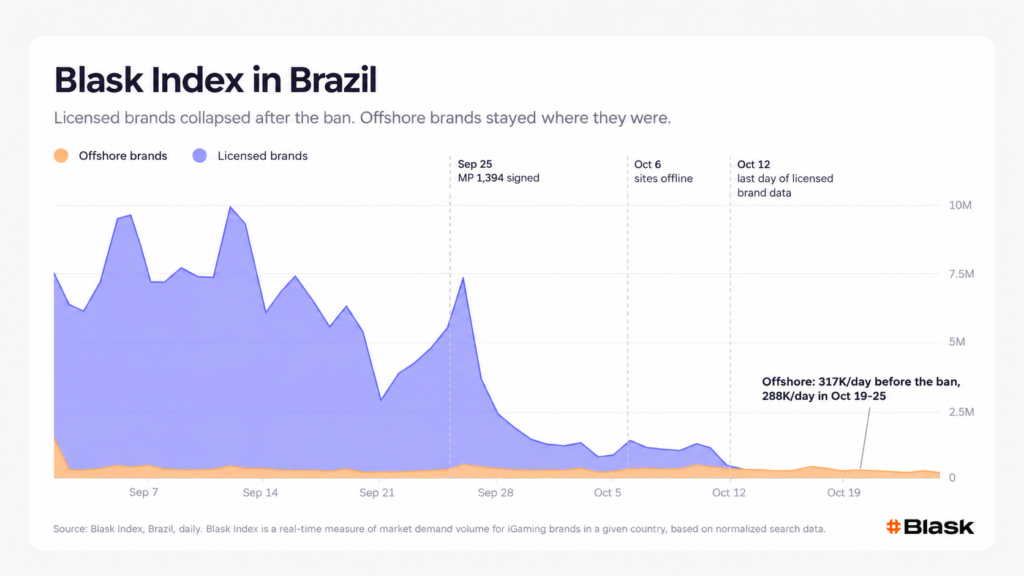
During the first week without licensed sites – 6-11 October, offshore demand climbed 22% to 385,000 a day, before dropping below the pre-ban level. Howver, “within that group, demand concentrated. The largest offshore brand grew 5.3 times from its September average and now accounts for 29% of all tracked demand in Brazil. Two smaller brands grew roughly fourfold. The brand that led the offshore segment before the ban lost 70%.”

The group highlights that “Before the ban, licensed brands held about 96% of Brazil’s Blask Index and offshore brands about 4%. The licensed share has gone, and offshore brands are left with a smaller version of the volume they had before.”

Dig Deeper
Related stories
 2026/10/20: Blask: Philippines tops Index in September, surpassing Brazil, after 87% yearly increase in search demand
 2026/08/25: Total Philippines gambling ad ban seen handing market back to illegal operators, data from five countries show
 2026/09/24: Brazil: Lula and Bolsonaro call for online betting ban ahead of presidential election
 2026/10/25: Lula appointed Brazil’s next president, igaming future in question
2026/10/20: Blask: Philippines tops Index in September, surpassing Brazil, after 87% yearly increase in search demand
2026/08/25: Total Philippines gambling ad ban seen handing market back to illegal operators, data from five countries show
2026/09/24: Brazil: Lula and Bolsonaro call for online betting ban ahead of presidential election
2026/10/25: Lula appointed Brazil’s next president, igaming future in question
The Backstory
Brazil’s ban tests a core assumption about offshore demand
Brazil’s abrupt turn against regulated online betting has become a test case for one of the industry’s most common warnings: that shutting legal operators would quickly push players offshore. The latest Blask data complicate that argument. Its index for Brazil fell 96% after President Luiz Inácio Lula da Silva’s provisional measure, from an average of 7.26 million before the ban to 288,000, while offshore demand rose briefly and then slipped below its pre-ban level.
That does not mean the illegal market has disappeared. It means a licensed market that had dominated search demand went dark faster than offshore brands could replace it. Before the ban, licensed operators accounted for about 96% of Brazil’s Blask Index. After authorized sites went offline Oct. 6, Blask’s tracking covered only offshore brands. In that narrower pool, demand became more concentrated, with the largest offshore brand growing more than fivefold from its September average and taking 29% of all tracked demand.
The distinction matters for policy and valuation. A legal shutdown can sharply reduce visible search demand while still creating an opening for unlicensed sites. It can also depress recorded activity without proving a comparable decline in gambling itself. Brazil is now the clearest live market for that distinction, because the country had only recently brought a large betting economy onshore before moving to unwind it.
A political race turned regulation into prohibition
The policy reversal built through Brazil’s presidential campaign, when both major candidates moved against online betting. Lula and Flávio Bolsonaro each backed curbs, though with different emphases, as gambling became a visible political issue. In late September, both Lula and Bolsonaro called for online betting restrictions ahead of the election, citing public concern over addiction, household finances and the scale of participation.
Those politics gave the ban a broad electoral base. A Bloomberg-commissioned AtlasIntel poll cited in the earlier report found 75% of Brazilian voters supported a ban on online betting, while Finance Ministry figures showed 25 million Brazilians had placed wagers in 2025. Online casinos were especially exposed, with estimates that they represented 70% to 80% of licensed operators’ revenue.
Lula’s victory then changed the probability that the temporary order would become lasting policy. After the election, Lula’s return to the presidency put Brazil’s igaming future in question, with his provisional measure expected to remain in force if approved by Congress. The measure sent sites and apps offline Oct. 6 and put licenses on course for cancellation, creating uncertainty for operators that had paid heavily to enter the regulated market.
Congress still has a role, and amendments have pointed in several directions. Some seek to preserve sports betting while ending online casino. Others would allow licensed operators in both betting and slots to continue while targeting unlicensed offshore sites. Still others support a full ban with stronger sanctions and payment blocking. But the political center of gravity shifted toward prohibition once both presidential camps accepted that anti-gambling sentiment had become an election issue.
Blask’s earlier warning was about channelization
The current Blask numbers follow an earlier warning from the analytics firm that Brazil risked undermining its own regulatory gains. In a report comparing Brazil with India, Blask described the shutdown as “institutional self-sabotage” in Brazil’s igaming market, saying the country was shuttering a $6.6 billion gross gaming revenue industry and eliminating about $1.8 billion in federal tax.
That report framed the issue as channelization, the share of gambling activity captured by licensed operators rather than illegal sites. Brazil had moved a large market onshore through licensing, taxation and brand authorization. The ban reversed that framework, creating a legal void in which previously licensed customers either stopped searching, delayed activity or moved toward offshore alternatives.
Blask’s earlier data showed licensed-brand searches falling sharply in the first week after the shutdown, while offshore brands declined less and therefore gained share. The new reading extends that analysis: offshore demand did not surge as a whole, but the disappearance of licensed demand left a smaller, more concentrated offshore market. The largest offshore brands became more visible not because Brazil’s total betting interest expanded, but because the regulated segment vanished from the dataset.
That pattern cuts both ways in the policy debate. Supporters of prohibition can point to the collapse in demand as evidence that aggressive action suppresses market activity. Critics can argue that the fall reflects the removal of visible, taxable, regulated brands rather than a durable decline in gambling appetite. The answer will depend on whether dormant players remain inactive or reappear through mirrors, international sites and informal marketing channels over time.
The Philippines shows the other side of the policy choice
Brazil’s contraction also changed the global demand map. In September, before the full effect of the October shutdown appeared, the Philippines overtook Brazil in the Blask Index, after an 87% annual increase in search demand. Brazil’s search demand fell 31% year over year, while the Philippines rose 8% month on month.
The comparison is imperfect but instructive. Blask noted that Brazil still had a higher projected revenue benchmark than the Philippines in September, and licensed operators accounted for 97% of Brazil’s figure compared with 62% in the Philippines. In other words, Brazil’s market remained more monetized and more heavily licensed even as search demand slipped. The Philippines, meanwhile, showed faster growth in public interest but a lower licensed share.
That split underscores why regulators focus on channelization rather than demand alone. High search demand can include both regulated and unregulated activity. High licensed share gives the state more leverage over payments, identity checks, advertising standards, dispute resolution and tax collection. Brazil’s ban attacked the visible market directly, while the Philippines has been debating how to keep players inside the licensed system without allowing unchecked promotion.
The Philippines debate is especially relevant because it shows how advertising policy can affect market structure. A total advertising ban may reduce the visibility of legal brands, but illegal operators that already disregard local rules may continue to reach consumers through social media, messaging apps and offshore domains. Brazil’s data now provide a fresh case study for that risk, even if the immediate offshore jump was smaller than expected.
Advertising, enforcement and the illegal-market risk
The Philippines has become the main regional example of a government trying to balance growth, public harm and enforcement. A recent analysis by CiG contributor Tonet Quiogue argued that a total Philippines gambling advertising ban could hand market share back to illegal operators. The article cited experience in Italy, Belgium, France, the Netherlands and the United Kingdom to argue that bans on licensed advertising often leave offshore operators with a relative advantage.
The logic is straightforward. Licensed operators can be fined, suspended, required to verify customers and forced to follow advertising rules. Illegal operators cannot be disciplined in the same way if they sit outside the jurisdiction. If legal brands lose the ability to market, the remaining promotion may come disproportionately from sites that do not pay tax, do not honor self-exclusion and do not submit games or payments to regulatory oversight.
Brazil’s early experience does not show a simple flood offshore. But it does show the fragility of a newly regulated market when political pressure turns against it. Search demand for legal operators can collapse almost overnight. Offshore demand may not immediately fill the gap in aggregate, but the brands best positioned to capture displaced users can gain share quickly. For governments, the stakes are not only tax revenue and operator value. They are also the ability to see the market, police it and separate lawful products from illegal substitutes.
That is why Brazil’s next phase will be watched beyond Latin America. If Congress preserves the ban, regulators will learn whether a large online betting population remains suppressed or gradually migrates to offshore sites. If lawmakers carve out sports betting or rebuild licensing, they will have to decide whether canceled licenses, lost investment and shaken operator confidence can be repaired. Either outcome will shape how other markets assess the trade-off between prohibition, regulation and the harder task of keeping gambling inside a system the state can control.