


US Senate postpones Clarity Act vote until September

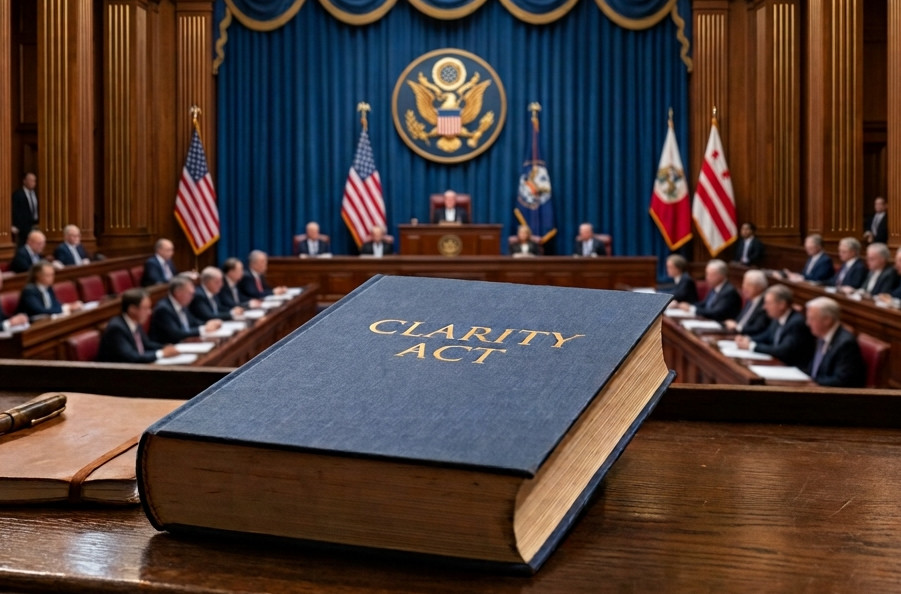
The US Senate has postponed a procedural vote on the Digital Asset Market Clarity Act, delaying progress on legislation that would establish a regulatory framework for cryptocurrencies and digital assets.
According to The Block, Senate Majority Leader John Thune said the vote will take place after lawmakers return from their August recess in September.

The Senate is scheduled to leave Washington on 7 August and return in mid-September, leaving lawmakers several more weeks to attempt to secure the 60 votes required to advance the legislation before attention turns to the November midterm elections.
Democratic lawmakers have been reluctant to support a vote on the bill due to concerns over its potential political implications ahead of the elections.
If approved by the Senate, the bill would return to the House for another vote before potentially reaching US President Donald Trump.

Numerous issues remain under negotiation, including rules covering rewards linked to stablecoins, proposed ethics restrictions on public officials involved in crypto, and disagreements over whether the bill gives regulators and law enforcement adequate powers to tackle unlawful financial activity.
The delay has led the cryptocurrency industry to urge lawmakers to finalize an agreement ahead of the September vote.
Cody Carbone, CEO of the trade association the Digital Chamber, said discussions will continue during the recess. Ji Hun Kim – the CEO of the global alliance Crypto Council for Innovation – added the organization would continue working with Senators and the Administration, according to reports.

Beyond the cryptocurrency industry, the Clarity Act debate has also drawn attention from the US gaming industry due to its potential impact on prediction markets.
US lawmakers and tribal gaming representatives have pushed for changes to the Clarity Act to prevent prediction market platforms from offering sports-related contracts outside of existing state and tribal gaming regulations.
The outcome of the debate could influence how the platforms operate in the US, as regulators and gambling industry groups continue to question whether sports-related prediction market contracts should fall under existing gambling frameworks or not.

Dig Deeper
Related stories
 2026/08/05: Tribal gaming groups seek changes to Clarity Act over prediction markets
 2026/02/17: Online casino bill narrowly passes Virginia Senate
 2025/06/05: Rhode Island lawmakers prepare to vote on gambling bills as legislative deadline nears
 2026/01/14: Wisconsin mobile sports betting vote regains momentum among lawmakers
2026/08/05: Tribal gaming groups seek changes to Clarity Act over prediction markets
2026/02/17: Online casino bill narrowly passes Virginia Senate
2025/06/05: Rhode Island lawmakers prepare to vote on gambling bills as legislative deadline nears
2026/01/14: Wisconsin mobile sports betting vote regains momentum among lawmakers
The Backstory
Crypto bill enters the fall with gaming questions unresolved
The Senate’s decision to push a procedural vote on the Digital Asset Market Clarity Act into September gives lawmakers more time to settle a broader fight over digital-asset oversight, but it also extends uncertainty for the gambling industry. What began as a cryptocurrency market-structure bill has become a vehicle for a separate dispute over whether sports-related prediction contracts should be treated as financial products or as gambling.
The delay matters because the bill is close enough to a Senate test vote to force a reckoning, but still unsettled on issues that cut across agency jurisdiction, tribal sovereignty and state gambling authority. Prediction market operators have argued their contracts fall under federal commodities oversight. State regulators, tribal gaming groups and sportsbook interests have warned that allowing sports-event contracts to operate under that framework could create a parallel betting market outside systems built through state legislation and tribal compacts.
That tension is why gaming groups have watched the Clarity Act as closely as many crypto firms. The measure is designed to clarify which federal agencies oversee digital assets, but its treatment of event contracts could determine whether sports outcomes can be offered nationwide through federally regulated platforms rather than through state-licensed sportsbooks or tribal gaming channels.
Tribes press Congress to protect compacted gambling rights
The most direct challenge came from tribal gaming representatives and lawmakers who sought changes to the Clarity Act before the Senate vote was postponed. At a Senate Indian Affairs Committee roundtable, tribal leaders urged Congress to make clear that sports betting and casino gambling remain subject to state and tribal regulation rather than being swept into the Commodity Futures Trading Commission’s remit.
That push, detailed in tribal gaming groups’ request for Clarity Act changes over prediction markets, reflects a long-running concern that federal financial-market rules could undercut the Indian Gaming Regulatory Act and tribal-state compacts. Those compacts often determine where gambling can occur, how revenue is shared and what exclusivity protections tribes receive in exchange for payments or other obligations.
Sen. Tina Smith proposed language intended to prevent the Commodity Exchange Act from overriding the Indian Gaming Regulatory Act or existing tribal agreements. The proposal was aimed less at blocking digital-asset legislation than at preventing a jurisdictional loophole. If sports contracts are classified chiefly as commodities, tribes fear operators could offer products that resemble bets on games without negotiating compacts, securing state licenses or following responsible-gaming rules attached to regulated gambling markets.
The stakes are not abstract. Prediction market platforms such as Kalshi and Polymarket have expanded interest in contracts tied to real-world events. Sports outcomes are among the most commercially sensitive categories because they overlap directly with the product sportsbooks sell. The question for Congress is whether the form of the transaction — a contract traded on an exchange — should determine its regulator, or whether the substance of the product — wagering on a game result — should control.
State debates show why jurisdiction is central
The Clarity Act fight is unfolding as states continue to build gambling markets one bill at a time, often with narrow votes and careful compromises. Virginia’s recent debate over iGaming showed how contested expansion remains even when supporters can point to substantial revenue projections. Virginia’s online casino bill narrowly passed the Senate only after an initial defeat and a motion to reconsider, underscoring how little room lawmakers had to maneuver.
The Virginia proposal would authorize internet casino games such as blackjack and slots beginning July 1, 2027. Supporters cited estimates of $4.1 billion in online gaming net revenue over five years and $1.1 billion for the commonwealth, including money directed to education, gambling regulation and problem-gambling treatment. Opponents focused on the social cost of putting casino games on mobile phones at all hours.
That debate helps explain why state and tribal stakeholders are wary of prediction markets. States that legalize betting and online casino products typically attach tax rates, licensing standards, advertising rules, geolocation controls and responsible-gambling mandates. Those policy choices are politically difficult and often tailored to local markets. A federal path for sports-event contracts could bypass or weaken that structure, reducing the value of state licenses and compact rights while shifting consumer protections to a different regulatory model.
For the gaming industry, the issue is not simply whether prediction markets should exist. It is whether they compete under the same rules as sportsbooks and casinos. A platform able to offer sports contracts nationally under federal oversight could have cost, tax and market-access advantages over operators that secured state approvals and built compliance systems jurisdiction by jurisdiction.
Rhode Island and Wisconsin highlight different expansion models
Recent state-level sports betting debates also show how varied the U.S. market remains. In Rhode Island, lawmakers weighed bills that could open the state’s sports betting system beyond the incumbent digital sportsbook arrangement while also increasing penalties for underage online gambling. The package, described as Rhode Island lawmakers prepared to vote on gambling bills, reflected two priorities often paired in expansion debates: more competition and tighter enforcement.
Rhode Island’s discussion centered in part on the expiration of IGT’s exclusive digital sportsbook contract in November 2026. Opening the market to major operators such as DraftKings or FanDuel would be a state policy choice about competition, licensing and market design. The underage-gambling penalty bill showed the other side of that choice: If access broadens, lawmakers typically seek stronger safeguards around who can participate and who can be punished for enabling illegal play.
Wisconsin has taken a different route, with mobile sports betting tied to tribal casinos and compact-based authority. Lawmakers first revived momentum for a bill that would allow tribes to offer mobile wagering by redefining where a bet is placed. That proposal, covered in Wisconsin’s renewed push for mobile sports betting, was framed by supporters as a way for tribes to compete against offshore gambling and prediction markets already reaching state residents.
The bill later advanced further than many expected. Wisconsin’s online sports betting bill headed to Gov. Tony Evers after Senate passage despite opposition from some lawmakers, public polling against legalization and objections from sportsbook interests. The measure mirrored Florida’s tribal-centered model, though concerns persisted over whether all tribes supported the approach and whether compact amendments would create broader consequences.
Prediction markets become the common pressure point
Across those state debates, prediction markets have become a recurring reference point. In Wisconsin, supporters cited prediction markets and offshore operators as evidence that prohibition or in-person-only rules do not keep online wagering from consumers. In Congress, the same products are cited by tribal and gaming interests as a reason federal law must not unintentionally authorize sports betting outside gambling frameworks.
That dual role makes the policy problem harder. Prediction markets can be used as an argument for legalization because they show demand exists beyond current state systems. They can also be used as an argument for tighter boundaries because they may blur the line between financial risk and gambling risk. The Clarity Act now sits at that intersection.
The Senate delay gives negotiators a window to address those concerns before the next procedural vote. Crypto firms want legal certainty after years of fragmented enforcement and agency disputes. Tribal governments want assurance that digital-asset legislation will not erode compacted gaming rights. State regulators and licensed operators want to avoid a market in which sports-event contracts compete with sportsbooks without equivalent taxes, licensing fees or consumer protections.
If lawmakers resolve the prediction-market language, the Clarity Act could move forward as a digital-asset bill with clearer gambling carveouts. If they do not, the September vote may become a proxy fight over who controls the next phase of U.S. sports wagering: federal commodities regulators, state gaming agencies, tribal governments or some combination of all three.
