


US Democrats try to block CFTC funding supporting prediction market cases

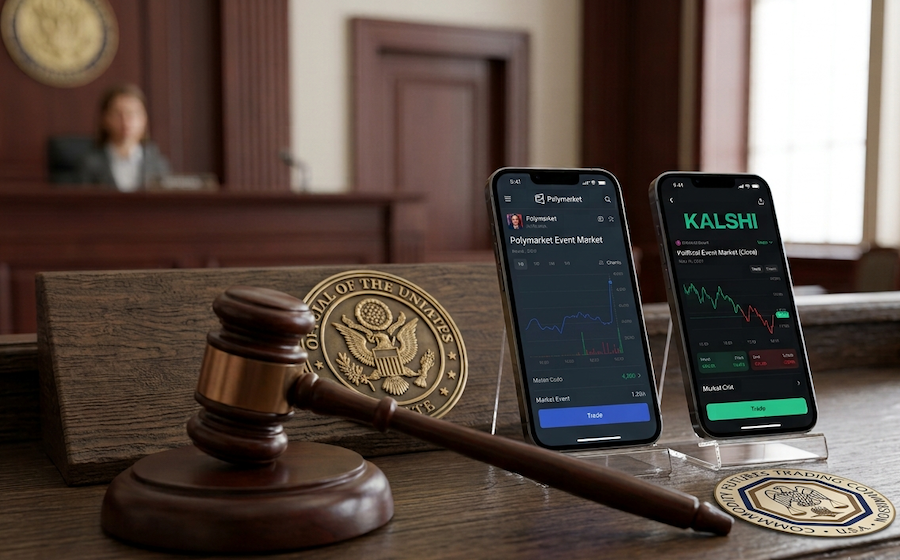
Two US Democratic Senators are trying to block the Commodity Futures Trading Commission (CFTC) from using federal funds to challenge state and tribal enforcement of gambling laws against online prediction markets.
In a letter to the Senate Appropriations Subcommittee on Financial Services and General Government, Senators Richard Blumenthal and Jeff Merkley and 15 others asked that funding restrictions be included in the CFTC’s budget, limiting its ability to finance litigation against state regulators going after prediction market operators.

This approach differs from previous Democratic proposals on the issue, such as the STOP Corrupt Bets Act introduced by Merkley and Representative Jamie Raskin in March. The act aimed to prohibit event contracts linked to sports, elections and government actions.
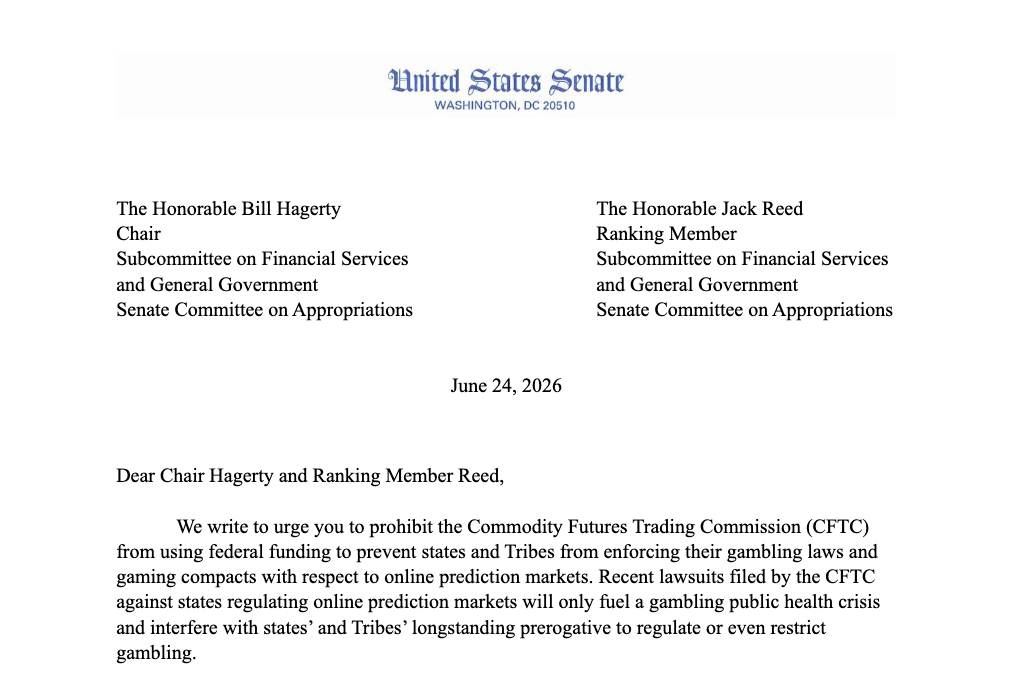
The latest letter does not propose a ban on specific products, instead focusing on limiting funding for enforcement-related proceedings.
In the letter, the senators described the CFTC’s actions as “a campaign of litigation and intimidation” and warned that it could become “an instrument and enabler of online prediction markets’ efforts to bypass states’ consumer protections.”

The letter also referenced tribal interests and disputes involving tribal gaming compacts and state gambling laws, noting “recent lawsuits filed by the CFTC against states regulating online prediction markets will only fuel a gambling public health crisis and interfere with states’ and Tribes’ longstanding prerogative to regulate or even restrict gambling.”
Signatories include senators from states that have both active gambling markets or legal disputes involving the CFTC, including Nevada, Connecticut, Illinois, New Mexico, Colorado, Hawaii, Minnesota, California, and Rhode Island.
Disagreements abound in the US over how prediction markets should be regulated, with the CFTC bringing legal action against several states, including Wisconsin and New Mexico, after state authorities sought to apply gambling laws to prediction market platforms.

Dig Deeper
Related stories
 2026/03/26: Second bill banning sports betting on prediction platforms introduced
2026/05/01: Democrats urge CFTC to increase oversight over prediction markets
2026/03/26: Second bill banning sports betting on prediction platforms introduced
2026/05/01: Democrats urge CFTC to increase oversight over prediction markets
 2026/07/15: Indian Gaming Association takes prediction market fight to Washington, D.C.
 2025/05/31: Prediction markets are gaming’s next big shortcut to 50-state access
2026/03/26: Second bill banning sports betting on prediction platforms introduced
2026/05/01: Democrats urge CFTC to increase oversight over prediction markets
2026/07/15: Indian Gaming Association takes prediction market fight to Washington, D.C.
2025/05/31: Prediction markets are gaming’s next big shortcut to 50-state access
The Backstory
Capitol Hill shifts from product bans to budget pressure
The latest Democratic effort to rein in prediction markets marks a tactical shift in a fight that has moved quickly from abstract questions about derivatives law to a direct clash over federal power, gambling regulation and state sovereignty. Rather than seeking only to ban certain contracts, the senators are now trying to restrict the Commodity Futures Trading Commission’s ability to spend money on litigation that would shield prediction market operators from state and tribal gambling enforcement.
That approach builds on earlier pressure from Democratic lawmakers who urged the CFTC to write tougher rules for the sector. In a prior letter, a group led by Sen. Jeff Merkley of Oregon called on the agency to address what they described as weakening integrity at platforms such as Kalshi and Polymarket, including risks tied to insider trading, corruption and markets linked to elections, military actions, government decisions and sports. The latest funding push narrows the target: not merely what contracts should be allowed, but whether the CFTC should use federal resources to preempt state regulators that treat those contracts as gambling.
The distinction matters because prediction markets have expanded beyond niche political forecasting into sports, public affairs and other high-volume event trading. Platforms argue they operate under the Commodity Exchange Act and federal derivatives oversight. State officials counter that many of the same products look and function like unlicensed sports wagering or election betting, areas traditionally governed by state gambling laws and, in some cases, tribal compacts.
Federal lawsuits have turned the CFTC into the central battlefield
The CFTC’s posture hardened as states began issuing cease-and-desist orders, bringing lawsuits and threatening penalties against prediction market operators. The agency and the Justice Department recently moved to block Arizona from enforcing gambling laws against Kalshi, arguing in court that sports-related event contracts should be treated as federally regulated financial derivatives rather than gambling. That filing framed the dispute as a question of federal jurisdiction: if the contracts are swaps or trades under the Commodity Exchange Act, state authority may be limited.
Arizona has been among the most aggressive states. Regulators there pursued enforcement against Kalshi and the state became the first to file criminal charges alongside civil complaints. Arizona officials have argued that markets tied to sports outcomes are effectively wagers and therefore must comply with state licensing, consumer protection and gaming integrity rules. Kalshi sued to stop the state from shutting down its operations, and the CFTC’s intervention raised the stakes by placing the federal regulator directly opposite state gambling authorities.
Similar conflicts have emerged elsewhere. The CFTC also sued Kentucky after state officials sought to impose penalties and a 14.25% excise tax on transaction fees from prediction market operators. Kentucky Attorney General Russell Coleman separately sued Kalshi, Polymarket and affiliates, describing the platforms as illegal sportsbooks. The CFTC said Kentucky’s actions threatened federally regulated markets and described its lawsuit as part of an effort to protect federal interests. The agency has taken comparable action against Minnesota, Illinois and Rhode Island, creating the pattern that Democratic senators now describe as federal intimidation of state enforcement.
States see gambling; platforms see derivatives
The legal divide is rooted in the dual identity of event contracts. To platforms and their investors, they are exchange-traded instruments that let users take positions on measurable outcomes. To gambling regulators, contracts on the winner of a game, an election result or a public official’s action can resemble bets dressed in financial-market language.
That ambiguity has become more consequential as sports-related markets grow. In Nevada, regulators have said sports event contracts constitute wagering even when listed on federally regulated exchanges. New Jersey, Massachusetts and other states have also scrutinized Kalshi’s sports offerings. Those state positions threaten a business model that depends on national access and uniform rules rather than the state-by-state licensing structure used by sportsbooks.
For the CFTC, the issue is also institutional. If state gambling regulators can shut down or tax federally listed event contracts, the value of federal exchange registration could be weakened. If the CFTC’s view prevails, prediction market platforms may gain a path to operate nationally without securing traditional sports betting licenses in every state. That would alter the competitive landscape for licensed sportsbooks, tribes and state lotteries, while inviting more firms to seek CFTC-regulated status.
Public skepticism adds political fuel
The political risks are sharpened by public unease, especially around election markets. A POLITICO/Public First poll found that 44% of U.S. adults believe betting on election outcomes should be unlawful, while concern also extended to contracts tied to presidential statements, public figures and pardon decisions. Younger adults showed more interest, with 12% of respondents ages 18 to 34 saying they had placed bets on prediction markets, compared with 6% of adults overall.
The polling helps explain why Democrats have focused not only on consumer protection but also on the integrity of democratic institutions. Election-linked markets have expanded since a 2024 federal court ruling enabled broader political contracts after earlier CFTC resistance. Trading volumes have grown rapidly, with nearly $700 million traded on markets tied to the 2028 U.S. presidential election across Kalshi and Polymarket’s international platforms. Bloomberg analysts have projected that political contracts could reach $266 billion in trading volume by 2030.
For lawmakers, that trajectory raises questions about whether prediction markets could influence campaigns, incentivize manipulation or create financial stakes in government decisions. For market advocates, the same growth shows demand for tools that aggregate information and express expectations. The budget-language strategy reflects a political judgment that Congress may be more likely to curb the CFTC’s litigation role than to immediately settle the broader question of whether sports or election event contracts should be banned.
New entrants are following the federal license path
The stakes are increasing because more companies are positioning themselves around the CFTC framework. Kraken’s $100 million acquisition of CFTC-licensed Small Exchange signaled the crypto exchange’s interest in building a U.S.-native derivatives and prediction markets business under federal oversight. The deal gives Kraken a designated contract market structure at a time when federal licensing is becoming a strategic asset for companies seeking legitimacy in event trading.
Other operators are making similar moves. PrizePicks secured National Futures Association approval through a subsidiary as it explores a prediction offering. Sports betting exchange RSBIX applied to become a designated contract market, reviving an effort to list sports event contracts. These developments show that the dispute is not limited to Kalshi or Polymarket. A broader group of crypto, fantasy sports and betting-adjacent firms is testing whether derivatives regulation can provide a national route into products that state gambling regulators may otherwise restrict.
That momentum helps explain why state and tribal interests are pressing Congress. If federally regulated event markets can operate nationwide, they could bypass licensing fees, tax regimes and compact arrangements that underpin state gambling systems. If states win, the market may fragment or be forced into the same compliance model as sports betting. The Senate funding proposal therefore sits at the intersection of appropriations, financial regulation and gambling law. It is a bid to slow the CFTC’s courtroom offensive while Congress, regulators and judges determine who controls one of the fastest-growing corners of U.S. wagering and derivatives markets.
