


Democrats urge CFTC to increase oversight over prediction markets


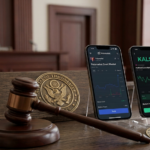
A group of Democratic lawmakers, led by Oregon Sen. Jeff Merkley, sent a letter to the Commodity Futures Trading Commission on Thursday urging it to exercise its authority and impose greater oversight of prediction markets.
The letter called on the federal agency to address “the rapid erosion of integrity” within prediction market platforms like Kalshi and Polymarket, according to CNBC.

The lawmakers wrote, “We strongly encourage you to use your authority to preserve the intent of prediction markets, and congressional intent behind the Commodity Exchange Act, by issuing a rule that prevents insider trading and corruption in the market and prohibits event contracts on the outcome of elections, war and military actions in the US or abroad, sports, and government actions without a valid economic hedging interest.”
The letter was signed by other Democratic Senators, including Connecticut Sen. Richard Blumenthal, Rhode Island Sen. Sheldon Whitehouse, and Maryland Sens. Chris Van Hollen and Jamie Raskin.
It urges the federal derivatives regulator to issue rules that will prevent insider trading and corruption, and prohibit facilitating event contracts on outcomes of elections, military actions, government actions, and sports.

Dig Deeper
Related stories
 2026/06/29: US Democrats try to block CFTC funding supporting prediction market cases
 2026/03/26: Second bill banning sports betting on prediction platforms introduced
 2025/10/17: Kraken eyes prediction market launch with acquisition of CFTC-licensed Small Exchange
 2026/03/24: Bipartisan Senate bill aims to prohibit sports betting on prediction markets
2026/06/29: US Democrats try to block CFTC funding supporting prediction market cases
2026/03/26: Second bill banning sports betting on prediction platforms introduced
2025/10/17: Kraken eyes prediction market launch with acquisition of CFTC-licensed Small Exchange
2026/03/24: Bipartisan Senate bill aims to prohibit sports betting on prediction markets
The Backstory
How a regulatory gray zone grew into a political fight
Democratic lawmakers’ push for tougher oversight comes after two years of rapid expansion in federally supervised event-contract markets and escalating clashes over who regulates them. Under the Commodity Exchange Act, the Commodity Futures Trading Commission oversees swaps and designated contract markets. That framework allowed prediction platforms to list contracts tied to real-world outcomes while arguing they serve hedging and information functions. The CFTC has increasingly asserted that authority. In a recent filing, the agency moved to shore up its turf with an amicus brief in a Ninth Circuit case, part of a broader stance that prediction markets fall under its remit, not state gambling regulators. CFTC Chairman Michael Selig also argued in an op-ed and public statements that event contracts “serve legitimate economic functions.” Coverage of that posture, including the agency’s brief and Selig’s remarks, appears in reporting on how the regulator aims to defend federal jurisdiction and keep these products inside derivatives law rather than gambling statutes, as detailed in CFTC files amicus brief to keep prediction markets federally regulated.
Sports integrity concerns widen the policy aperture
While the legal boundaries hardened, the question of market scope—especially sports—ignited pushback from the NCAA and major leagues. NCAA President Charlie Baker urged the CFTC to suspend college sports prediction markets until “a more robust system with appropriate safeguards is in place,” warning of threats to student-athlete welfare and competitive integrity. Baker’s letter cited the sector’s growth and flagged proposed markets that could influence athlete behavior, including transfer-portal related contracts, in NCAA President calls for CFTC suspension of college sports prediction markets. Professional leagues followed. The NBA told acting CFTC leadership that the proliferation of season and game outcomes was a precursor to a wave of proposition-style markets tied to officiating and injuries, which it views as riskier for integrity than state-regulated sportsbook wagering. The league requested a chance to shape any future guardrails should the CFTC allow the markets to continue, according to NBA expresses concerns over sports prediction integrity to CFTC.
Traditional gaming lobbies seek congressional lines in the sand
The casino industry sees sports event contracts as a direct encroachment on state-licensed sportsbooks. The American Gaming Association and the Indian Gaming Association urged Congress to clarify that these contracts are indistinguishable from sports betting and should not slip through a commodities-law loophole. Their letter argued that the CFTC’s inaction allowed rapid expansion from single-game outcomes to multi-leg “parlay”-style offerings, with more sensitive markets on the horizon. The groups also tied the issue to broader crypto market-structure legislation, arguing that without explicit statutory limits, trading venues could offer wagering-like products under derivatives branding. They pointed to a controversial geopolitical contract as evidence of lines crossed and noted the CFTC chair’s stated reluctance to unilaterally rein in sports contracts absent congressional direction. The industry’s case for federal legislation is summarized in AGA and IGA urge Congress to address sports event contracts.
Platforms push boundaries as states and courts push back
Operators have tested how far event contracts can go under federal rules. Kalshi’s foray into sports catalyzed confrontations with multiple state regulators that argued the products amounted to unlicensed betting within their borders. One skirmish in Tennessee produced a preliminary injunction allowing operations to continue while litigation proceeds, a sign of the unsettled legal terrain. The friction has widened to questions about whether state gambling prohibitions can reach federally regulated derivatives platforms. The CFTC’s amicus brief and public messaging—backing its exclusive jurisdiction and promising to defend exchanges against state-level bans—were meant to signal resolve and offer legal cover, according to CFTC files amicus brief to keep prediction markets federally regulated. At the same time, opponents have zeroed in on features like transfer-portal markets as crosses into integrity-sensitive zones, as outlined in Baker’s appeal to the CFTC and the NBA’s warning letter. The regulatory stalemate has compounded pressure on Washington to draw clearer lines.
Crypto and exchanges crowd in, raising the stakes
Rising institutional interest underscores how much money and market infrastructure now sits behind event contracts. Kraken’s $100 million acquisition of CFTC-licensed Small Exchange gives the crypto firm a federally regulated foothold to roll out U.S.-native derivatives and potentially prediction products. The move follows applications and approvals by other players seeking CFTC or National Futures Association credentials to offer onshore event or performance-based markets, from new sports exchanges to daily fantasy operators pursuing adjacent products. Those efforts are cataloged in Kraken eyes prediction market launch with acquisition of CFTC-licensed Small Exchange. The Nevada Gaming Control Board, among other state authorities, has said it views sports event contracts as wagering even if listed on federally supervised exchanges, a position that sets up more venue fights unless Congress clarifies treatment. The capital commitment and the number of entrants make a retreat unlikely, but they also make harmonized rules more urgent to avoid regulatory arbitrage.
Why the Hill is the next battleground
The competing pressures have converged into a call for federal action. Trade groups want Congress to lock in that sports event contracts belong under gambling laws, not derivatives rules. Leagues and the NCAA want immediate brakes on sensitive markets and stronger integrity safeguards, preferably before any broader legalization under the commodities umbrella. The CFTC has signaled it will defend its jurisdiction and sees economic value in event contracts, but it has also acknowledged it would follow any new congressional mandate. That dynamic is reflected across recent coverage: the regulator’s legal moves to affirm federal primacy, the NCAA’s plea for a pause in college markets, the NBA’s push for tighter controls, and industry lobbying for statutory clarity through crypto market-structure and anti-wagering provisions. Together, they set the backdrop for today’s Democratic letter and indicate where the debate heads next: toward rules that either sharply limit—or formalize under stricter guardrails—the future of prediction markets tied to elections, policy and sports.
