


Spotify removes streams due to prediction market-purposed manipulation

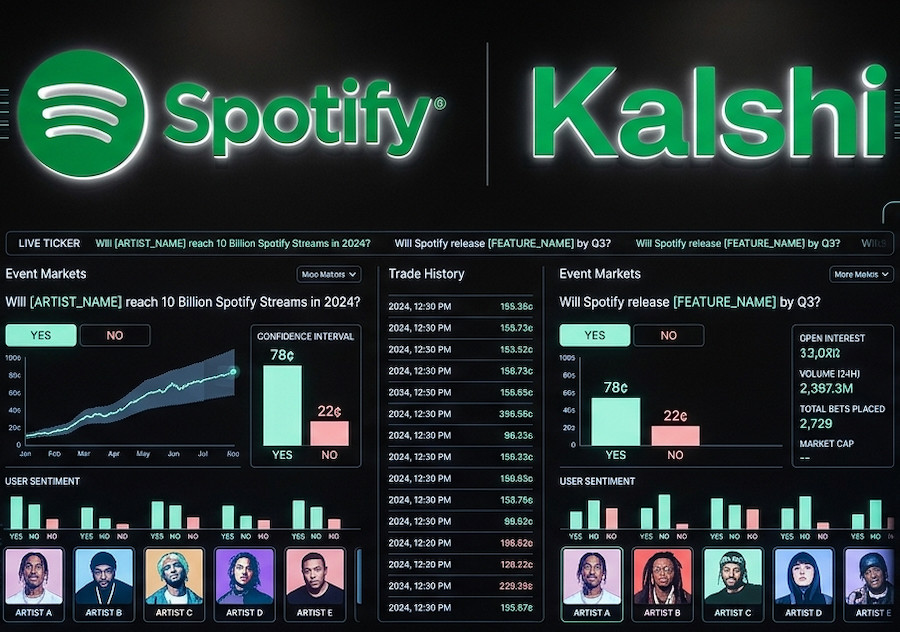
Spotify has removed streams from its website after identifying that a song was being boosted in order to win a contract on prediction market Kalshi.
According to reports, the song Earrings by musician Malcolm Todd was the target of the activity, with the track rising approximately 70% overnight, reaching the top of Spotify’s US streaming chart. Spotify has since removed streams of the song that it believes were not generated by genuine listeners.

In response to the change, a Spotify spokesperson said, “All streaming services face ever-changing stream manipulation. Spotify has best in class detection and mitigation practices for manipulated streams, and we don’t pay out associated royalties.”
A Kalshi spokesperson confirmed to CBS News that the platform is communicating with Spotify while the investigation is ongoing.
The incident has contributed to a wider discussion about the oversight and market integrity of prediction markets, with critics arguing that the platforms may be vulnerable to manipulation if people can influence an event or access non-public information before making trades.

Earlier this year, authorities arrested a US special operations soldier who was involved in the January mission to capture Venezuelan President Nicolás Maduro, on allegations that he used classified information to place bets on the operation.
The incident also contributes to the ongoing debate on how prediction markets are classified and regulated in the US, where they fall under the oversight of the Commodity Futures Trading Commission (CFTC).
Several state regulators have taken action against prediction market platforms, arguing that they are operating as unlicensed gambling products under state law.

Dig Deeper
Related stories
 2026/05/03: PAGCOR releases new regulatory framework governing live-dealer studios streaming
 2026/02/25: Kalshi removes affiliate badges from X as platform cracks down on gambling-related advertising
 2025/02/03: Monumental Sports Network adds wagering via Play Anywhere and BetMGM partnership
 2025/10/24: NHL signs multi-year deals with Kalshi and Polymarket
2026/05/03: PAGCOR releases new regulatory framework governing live-dealer studios streaming
2026/02/25: Kalshi removes affiliate badges from X as platform cracks down on gambling-related advertising
2025/02/03: Monumental Sports Network adds wagering via Play Anywhere and BetMGM partnership
2025/10/24: NHL signs multi-year deals with Kalshi and Polymarket
The Backstory
Manipulation claim puts market design under scrutiny
Spotify’s removal of streams tied to a Kalshi contract pushes prediction markets into a more difficult phase of their rapid expansion: the question of whether traders can influence the real-world events on which contracts are based. The incident, involving activity around Malcolm Todd’s “Earrings,” is not only a platform-integrity issue for Spotify. It also tests the premise that event contracts can function as neutral financial instruments when the underlying outcome may be affected by coordinated behavior, inside information or incentives created by the market itself.
Prediction markets have long argued that trading can aggregate information and produce useful signals about future events. That argument is harder to sustain when the event is not a distant election or macroeconomic figure but a measurable digital result that can potentially be moved by relatively small groups. Music streams, social engagement, rankings and other platform metrics are vulnerable to manipulation in ways that regulated financial benchmarks are designed to resist. Spotify said it removed streams it considered non-genuine, while Kalshi said it was communicating with the company during the investigation.
The episode arrives as regulators, lawmakers and state officials are already debating whether platforms such as Kalshi should be treated primarily as federally regulated exchanges or as gambling operators subject to state law. That classification fight has become the central question shaping the sector’s future.
A federal framework collides with state gambling law
Kalshi is regulated by the Commodity Futures Trading Commission, giving it a federal hook that traditional sportsbooks do not have. The company and other prediction market operators have leaned heavily on that status when defending event contracts against state enforcement actions. State regulators and attorneys general, however, have argued that sports and other event-based contracts often resemble wagers, regardless of the federal wrapper.
That clash escalated when the CFTC sued Kentucky over efforts to block prediction markets. The state had moved against operators through lawsuits and a 14.25% excise tax on transaction fees. Kentucky Attorney General Russell Coleman also filed cases alleging that Kalshi and Polymarket were offering illegal gambling products, describing them as unlawful sportsbooks. The CFTC responded by defending its jurisdiction, saying Kentucky’s actions threatened federally regulated markets.
Kentucky was not alone. Similar disputes emerged in Minnesota, Illinois and Rhode Island, while Nevada also took action against Kalshi. The pattern shows how prediction markets have become a test of preemption: whether federal commodities law can override state gambling restrictions when a contract’s economic function overlaps with betting. If federal courts side with the CFTC and operators, prediction markets could expand rapidly across categories that states have traditionally controlled. If states prevail, platforms may face a patchwork of licensing demands, enforcement actions and product bans.
Kalshi’s sports push blurred a key distinction
The regulatory fight has been sharpened by Kalshi’s own marketing and staffing language. The company has sought to differentiate itself from sportsbooks, saying it operates an exchange for event contracts rather than a gambling business. Yet sports have become a major growth area for prediction markets, and public-facing language has sometimes made that distinction harder to maintain.
Kalshi drew attention after it removed “sportsbook” references from a job listing following online scrutiny. The listing for a sports operations role had sought candidates with experience in sportsbooks and knowledge of sportsbook nuances before the terms were revised to “sports market operations” and “sports market nuances.” The edits were reported after users noted the inconsistency with Kalshi’s position that it is not part of the gambling industry.
The company has also used marketing phrases that tracked betting language, including sports-focused calls to action. While such terms may help consumers understand the product, they can undermine legal arguments that prediction markets are fundamentally distinct from wagering. That tension matters because state regulators often focus not only on product structure but also on how it is presented, promoted and consumed.
Sports contracts also raise market-integrity questions similar to those now facing the Spotify-linked contract. Athletic events, lineups, injuries and officiating decisions have long been surrounded by safeguards because of betting risk. Prediction markets entering that terrain inherit those concerns while operating under a different regulatory architecture.
Public unease adds political pressure
The industry’s legal arguments are unfolding against a backdrop of public skepticism. A POLITICO/Public First poll found broad resistance to election betting, with 44% of U.S. adults saying wagers on election outcomes should be unlawful. Younger adults were more open to the activity, but overall interest remained limited. The findings, covered in a report on U.S. adults’ opposition to election betting on prediction markets, highlight the political sensitivity of contracts tied to civic life.
Election markets have been among the most visible examples of prediction market growth. After a 2024 federal court ruling enabled expanded election contracts following previous CFTC resistance, political markets broadened to cover elections, government appointments and other public decisions. Trading volume has increased sharply, and analysts have projected major long-term growth if platforms are allowed to keep listing political contracts.
The Spotify incident broadens the concern beyond elections. Critics have warned that markets tied to public statements, pardons, appointments, entertainment charts or platform metrics may create incentives for manipulation or for trading on information unavailable to the public. The more prediction markets move from broad, hard-to-manipulate events into narrower outcomes, the more they invite scrutiny over whether the market is measuring probability or helping create the result.
Washington’s posture could determine the industry’s ceiling
The CFTC’s approach is especially consequential because it is both regulator and, in recent disputes, defender of federal jurisdiction. Leadership at the agency will shape whether event contracts are encouraged as innovative hedging tools or restrained because of gambling, manipulation and public-interest concerns.
That makes the nomination of Brian Quintenz to lead the CFTC significant. Quintenz, a former CFTC commissioner and Kalshi board member, faced questions from lawmakers about potential conflicts during a June 10 Senate Agriculture Committee hearing. As detailed in coverage of how the CFTC nominee advocated for prediction markets, he pledged to divest Kalshi-related stock if confirmed but still drew concern from senators over the appearance of a conflict.
Quintenz has argued that prediction markets and crypto markets could be important parts of the U.S. economy. His supporters are likely to view event contracts as a legitimate expansion of derivatives markets. Critics are likely to question whether the agency can police market integrity aggressively if its leadership is philosophically aligned with the industry and has had direct ties to a major platform.
The Spotify case gives that debate a concrete example. If traders can profit from influencing a metric, regulators may need to consider whether certain contracts are susceptible to manipulation by design. That could lead to stricter listing standards, surveillance obligations, data-sharing arrangements with platforms such as Spotify or outright restrictions on contracts tied to manipulable digital metrics.
Affiliate marketing and accountability remain unresolved
Kalshi’s growth has also depended on online promotion, another area drawing scrutiny. The platform recently removed affiliate badges from X after the social media platform tightened rules for gambling-related advertising and paid partnerships. Kalshi said the badges had become difficult to police and created confusion over whether affiliated accounts were endorsed by the company.
That episode matters because prediction markets thrive on social distribution. Contracts tied to sports, politics and pop culture spread quickly through influencer accounts, trading communities and viral posts. When money is at stake, promotional activity can shape participation, liquidity and even the underlying outcome. In a market tied to streaming charts, for example, promotion could cross from commentary into coordinated action designed to move the metric.
The current controversy therefore sits at the intersection of three unresolved questions: who regulates prediction markets, how platforms prevent manipulation and how promotional ecosystems are controlled. Spotify’s intervention addressed the immediate streaming data. It did not settle whether a contract based on such data should have existed, what surveillance Kalshi should apply before listing similar markets or whether federal commodities law is equipped for outcomes shaped by consumer-platform behavior.
For the industry, the stakes are high. A narrow reading would treat the Spotify case as an isolated abuse detected by a music platform. A broader reading would see it as evidence that prediction markets are expanding faster than their guardrails. Regulators and courts are now being asked to decide which interpretation will define the next stage of the business.
