


LatAm acquisition outperforms US and Europe during World Cup 2026 Group Stage betting

Latin American acquisition and reactivation levels were higher than in the US and Europe during the World Cup 2026 Group Stage, according to igaming customer retention platform Optimove.
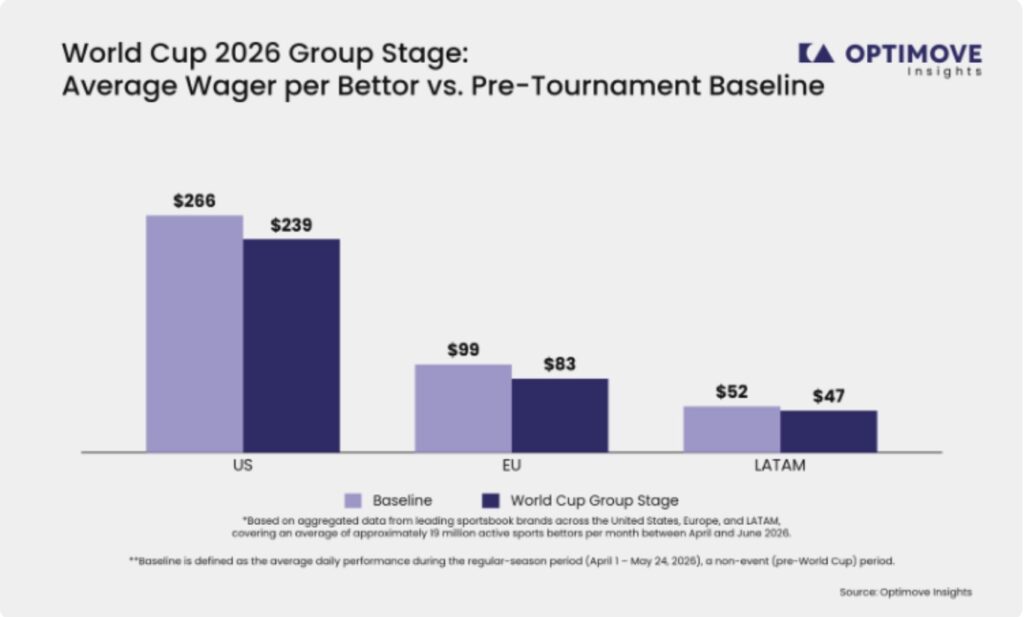
The firm found that LatAm grew 49 percentage points above the region’s regular-season weekly average (baseline) number of bettors, followed by the EU at 39 points, and the US at 18 points.

LatAm also saw the highest rise in first-time depositors, peaking at 300% compared to 200% in the EU and 171% in the US.
Optimove noted that this presents a retention challenge for the region, as an increase in betting activity suggests existing customers have been motivated by the tournament to bet more, while new depositors have no previous betting history.
In all three regions, the proportional growth in first-time depositors was larger than that of the number of bettors during the World Cup Group Stage. However, in LatAm the gap between the two was 156 percentage points, compared to 61 in Europe and 55 in the US.

Reflecting on the gap between seasoned bettors and new depositors, Optimove said, “Operators should focus on sharper segmentation, localized journeys, controlled offers, responsible gaming guardrails, and AI-assisted Positionless Marketing workflows that help identify which new and returning players are worth retaining, and which are unlikely to become long-term, high-value customers.”
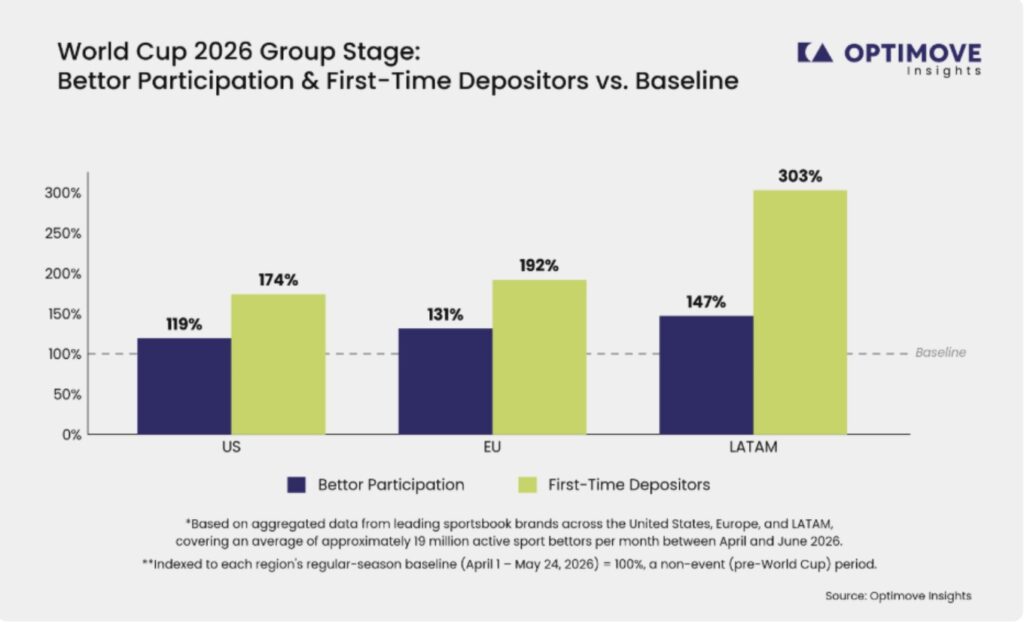
Meanwhile, despite the rising numbers of bettors, all three regions saw on average fewer bets placed, and bettors wagering less than they did during the pre-tournament baseline.
This, again, was most pronounced in LatAm where the average number of bets fell to 69%, and the average wager saw a 10% decline to US$47.

In the US, the average number of bets per player fell to 94% of the pre-tournament baseline, and the average wager fell from US$266 to US$239, also a 10% decline. Europe saw the average number of bets per player fall to 78% of the baseline, and the average wager fell by roughly 16% from US$99 to US$83.
Optimove said the results of its group stage research should be seen as both “an opportunity and a warning” for operators, pointing out that greater participation does not automatically mean higher value.
“A larger audience can also create pressure on margins, bonus budgets, CRM frequency, trading teams, risk controls, and customer support,” the report indicated.
“For the knockout phase, operators should move away from broad tournament campaigns and focus on sharper segmentation. Loyal football bettors, casual event-driven users, first-time depositors, reactivated players, bonus-sensitive customers, and high-value bettors should not receive the same journey. As matches become more decisive, campaigns should be triggered by team progression, match timing, betting history, region, customer value, and early signs of engagement.”
Optimove’s report was based on aggregated data from top-tier sportsbook brands across the US, Europe and LatAm, covering approximately 19 million active sports bettors per month between April and June 2026.

Verticals:
Sectors:
Dig Deeper
Related stories
 2025/07/03: Optimove expands into APAC with new operator partnerships
 2025/10/20: US bettors spend more than global average despite fewer active players
 2025/08/13: Optimove study indicates NFL bettors will bet consistently this year
2026/03/10: States with online sports betting receive failing grades for consumer protections, report says
2025/08/13: Optimove study indicates NFL bettors will bet consistently this year
2026/03/10: States with online sports betting receive failing grades for consumer protections, report says
2025/07/03: Optimove expands into APAC with new operator partnerships
2025/10/20: US bettors spend more than global average despite fewer active players
2025/08/13: Optimove study indicates NFL bettors will bet consistently this year
2026/03/10: States with online sports betting receive failing grades for consumer protections, report says
The Backstory
World Cup scale turns acquisition into a regional test
The 2026 World Cup has become a stress test for sportsbooks’ ability to convert mass attention into durable customers, with Latin America emerging as the clearest example of both the upside and the risk. Optimove’s group-stage data showed a sharper rise in bettors and first-time depositors in LatAm than in the U.S. or Europe, underscoring how tournament football can pull casual audiences into regulated betting funnels at speed.
That acceleration did not happen in isolation. Operators, suppliers, affiliates and governing bodies spent months positioning around a tournament designed to be larger, more commercial and more geographically favorable to the Americas than prior editions. The 2026 event, running June 11 to July 19 across North America, expanded to 104 matches, giving sportsbooks more inventory and more customer touchpoints than a traditional 64-match World Cup.
For LatAm, proximity matters. Matches in Mexico and across neighboring time zones reduce friction for viewing, wagering and marketing. That has made the region a priority for operators seeking growth beyond mature European markets and the fragmented U.S. sports betting landscape. It also has raised the bar for retention, because a surge in deposits during a global event does not necessarily translate into sustained betting activity once national teams are eliminated or the tournament ends.
Marketing infrastructure moved before the opening match
The current spike in LatAm acquisition was foreshadowed by a buildup in customer-acquisition investment. In June, digital marketing firm Media Troopers said it was expanding into Latin America ahead of the World Cup, citing soccer-focused channels, regional affiliates and localized tools for Spanish- and Portuguese-speaking users. Its platform updates targeted markets including Brazil, Mexico, Colombia, Argentina and Chile.
That expansion reflected a broader industry view that LatAm would be one of the tournament’s most efficient acquisition environments. Soccer already dominates the sports economy across much of the region. The World Cup adds national-team urgency, live viewing windows that align with local routines and a cultural relevance that broader sportsbook campaigns often struggle to replicate in the U.S.
Media Troopers’ rationale also pointed to why the region has outperformed in first-time deposits. With games staged in North America, the tournament is closer not only geographically but commercially. Operators can build campaigns around local languages, familiar teams and market-specific affiliates rather than relying on generic global creative. That localization can drive sign-ups quickly, particularly among users who engage primarily around major football events rather than weekly club competition.
The challenge is that acquisition-led growth often comes with lower predictability. First-time depositors have no betting history, making it harder to assess value, bonus sensitivity or responsible gambling risk. The larger the event-driven intake, the more pressure operators face to separate future loyal customers from one-off tournament bettors before promotional costs erode the value of the cohort.
FIFA’s commercial strategy gave betting more visibility
The World Cup’s betting backdrop also has changed at the sponsorship level. Betano, operated by Kaizen Gaming, extended its FIFA sponsorship to cover Europe and Latin America, building on a Europe-only arrangement from the 2022 tournament in Qatar. FIFA has said the expanded tournament is projected to generate $11 billion in revenue, highlighting how commercial categories around the event have broadened alongside the match schedule.
Betano’s inclusion in LatAm gives the betting sector an official presence in one of the tournament’s most engaged regions. It also normalizes the role of regulated operators in the fan experience, at least in jurisdictions where sports betting is legal and licensed. For operators competing across the region, official sponsorships can lift consumer awareness of betting brands while intensifying the cost of acquiring traffic during peak match windows.
FIFA’s commercial ecosystem has extended beyond traditional sponsorship. The organization also reached a deal with sports data company Stats Perform that allows some betting operators to livestream World Cup matches online, while prediction market ADI Predictstreet was announced as a World Cup partner. Those moves show how betting, data, streaming and event engagement are converging around the tournament.
That convergence helps explain why the World Cup is not merely a seasonal promotional opportunity. It is a product-development cycle. Operators are trying to use official rights, data feeds, in-play products and localized marketing to move fans from passive viewing into interactive betting environments. The current LatAm numbers suggest that the top of the funnel is working. The open question is whether operators can retain enough of those customers without overusing bonuses or creating compliance issues.
Product depth is changing how fans wager
Acquisition gains are only one side of the World Cup story. Betting behavior during the group stage also shows a shift toward more complex, live and player-specific products. Kambi reported that its Bet Builder accounted for about 20% of all live bets during the group stage, up from 3% across the full 2022 tournament.
That increase matters for retention because in-play bet builders and player props can keep users engaged beyond simple match-winner markets. Kambi said player-related betting was a core part of its soccer offering, with props tied to stars including Erling Haaland, Lionel Messi, Harry Kane, Kylian Mbappé and Cristiano Ronaldo driving significant match turnover. The supplier also highlighted substitute-related products as bench players contributed more than 40 goals during the tournament’s early stage.
For sportsbooks in LatAm, these products can help convert event-driven users into more frequent customers. A bettor who opens an account to back a national team may encounter live bet builders, player shots markets or substitution insurance-style features that resemble the app-based customization seen in other digital entertainment categories. That can raise engagement and differentiate regulated sportsbooks from informal or offshore channels.
But product complexity also increases operational demands. More live markets require stronger risk controls, faster trading decisions and clearer responsible gambling monitoring. When average bet counts and average wager sizes fall even as bettor numbers rise, operators need to decide whether the audience is broadening profitably or simply stretching support, trading and promotional budgets across lower-value customers.
Fan engagement is becoming broader than betting
The World Cup’s commercial pull has expanded into adjacent fan experiences, creating more ways for brands to capture attention around the final stages. Fanatics partnered with FIFA for Fanatics Fest in New York, scheduled for July 16 to July 19 at the Javits Center, coinciding with the tournament’s closing matches. The event is set to include immersive fan experiences, soccer legends, streaming access to the finals and a FIFA-linked penalty shoot-out element.
While Fanatics Fest is not primarily a betting story, it illustrates the same commercial logic driving sportsbook activity: the World Cup is being treated as a global cultural event rather than a series of matches. FIFA’s effort to connect sport, entertainment, creators and fan participation creates a larger attention economy around the tournament. Betting operators compete within that same economy, particularly when fans shift between live broadcasts, social platforms, affiliate content and sportsbook apps during match windows.
This broader engagement model can support LatAm growth because fans are not interacting with the tournament only through television. They encounter content through influencers, publishers, team-specific communities, streaming features and promotional campaigns. For customer-acquisition firms and sportsbooks, that creates more entry points. For regulators, it also complicates oversight, because the line between fan engagement, advertising and betting activation can become less visible to consumers.
Regulatory pressure shadows the growth case
The surge in World Cup betting interest also comes with enforcement and policy risks. Hong Kong police recently warned fans against using overseas betting sites, saying residents could violate local gambling law even if a platform is registered elsewhere. The warning, based on comments reported by the South China Morning Post, highlighted how major football events can drive users toward offshore operators, VPN workarounds and illegal syndicates.
Although Hong Kong is a different regulatory market from LatAm, the warning is relevant to the broader World Cup betting cycle. Major tournaments concentrate demand. If legal operators fail to provide trusted, localized and competitive products, offshore platforms can capture traffic. If legal operators market too aggressively, they may draw scrutiny over consumer protection, bonus practices and underage exposure.
LatAm’s growth therefore carries strategic stakes beyond the current group-stage numbers. The region offers operators a large football audience, improving regulatory frameworks and favorable time zones for the 2026 tournament. It also demands discipline: segmented retention journeys, compliance controls and localized responsible gambling tools. The World Cup can open the door to millions of new or reactivated customers, but the operators that benefit most will be those that treat the surge as the start of a longer relationship, not a one-month land grab.
