


Kambi returns to growth after World Cup-fueled 2Q26

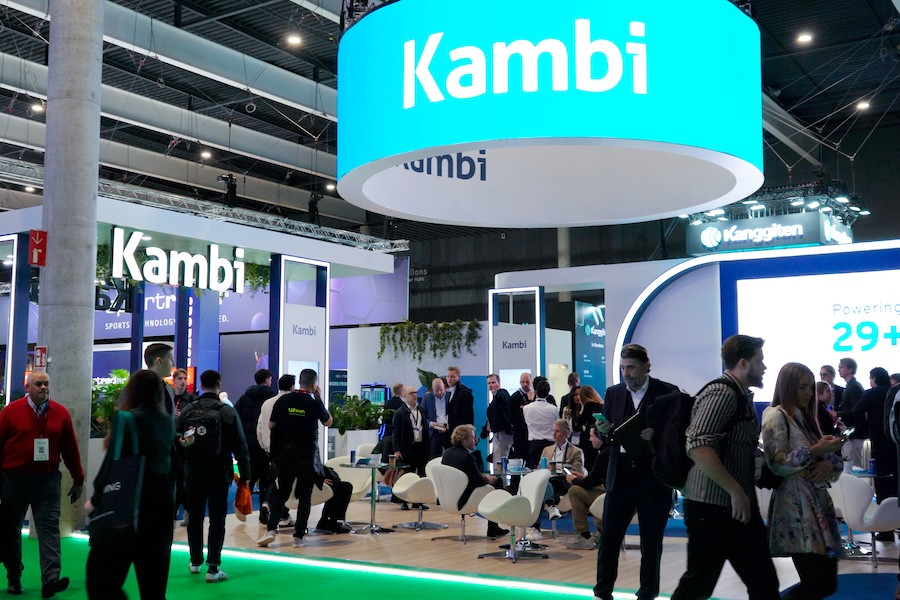
Kambi has reported a 13.5% rise in revenue in the second quarter of 2026 to €45.9 million (US$52.4 million)1 EUR = 1.1408 USD
2026-07-22Powered by CMG CurrenShift, from €40.5 million (US$46.2 million)1 EUR = 1.1408 USD
2026-07-22Powered by CMG CurrenShift.
The improving picture, supported by processing more than €1 billion (US$1.1 billion)1 EUR = 1.1408 USD
2026-07-22Powered by CMG CurrenShift in sportsbook turnover during the World Cup, brought revenue for the first half of the year to €89.4 million (US$102 million)1 EUR = 1.1408 USD
2026-07-22Powered by CMG CurrenShift, up 9.1% from €81.9 million (US$93.4 million)1 EUR = 1.1408 USD
2026-07-22Powered by CMG CurrenShift.

Adjusted EBITA (acq) was up 102% in the second quarter to €7.6 million (US$8.7 million)1 EUR = 1.1408 USD
2026-07-22Powered by CMG CurrenShift, from €3.7 million (US$4.2 million)1 EUR = 1.1408 USD
2026-07-22Powered by CMG CurrenShift at a margin of 16.5% (9.3%). Adjusted EBITA (acq) for the first half of the year increased by 83% to €13.3 million (US$15.2 million)1 EUR = 1.1408 USD
2026-07-22Powered by CMG CurrenShift (€7.2 million (US$8.2 million)1 EUR = 1.1408 USD
2026-07-22Powered by CMG CurrenShift), at a margin of 14.8% (8.8%).
Operating expenses were down 0.06% to €31.5 million (US$35.9 million)1 EUR = 1.1408 USD
2026-07-22Powered by CMG CurrenShift from €31.7 million (US$36.2 million)1 EUR = 1.1408 USD
2026-07-22Powered by CMG CurrenShift. Across the first half of the year operating expenses were €63.4 million (US$72.3 million)1 EUR = 1.1408 USD
2026-07-22Powered by CMG CurrenShift, down 1.4% from €64.3 million (US$73.4 million)1 EUR = 1.1408 USD
2026-07-22Powered by CMG CurrenShift.
Operating profit in the second quarter was €5.8 million (US$6.6 million)1 EUR = 1.1408 USD
2026-07-22Powered by CMG CurrenShift, at a margin of 12.7% For the first half of the year operating profit was €10.1 (US$12)1 EUR = 1.1408 USD
2026-07-22Powered by CMG CurrenShiftm, at a margin of 11.2%.

Cash flow, with the exception of working capital, M&A and financing activities, amounted to €1.5 million (US$1.7 million)1 EUR = 1.1408 USD
2026-07-22Powered by CMG CurrenShift (€1.3 million (US$1.5 million)1 EUR = 1.1408 USD
2026-07-22Powered by CMG CurrenShift) in the quarter and €8.8 million (US$10.0 million)1 EUR = 1.1408 USD
2026-07-22Powered by CMG CurrenShift (€9 million (US$10 million)1 EUR = 1.1408 USD
2026-07-22Powered by CMG CurrenShift) for the first half of 2026.
Earnings per share for the quarter were €0.128 (US$0.15)1 EUR = 1.1408 USD
2026-07-22Powered by CMG CurrenShift (€0.009 (US$0.01)1 EUR = 1.1408 USD
2026-07-22Powered by CMG CurrenShift) and €0.213 (US$0.24)1 EUR = 1.1408 USD
2026-07-22Powered by CMG CurrenShift (€0.036 (US$0.04)1 EUR = 1.1408 USD
2026-07-22Powered by CMG CurrenShift) for the first half of 2026
Full year estimated adjusted EBITA (acq) increased to €23 (US$26)1 EUR = 1.1408 USD
2026-07-22Powered by CMG CurrenShift – €27 million (US$31 million)1 EUR = 1.1408 USD
2026-07-22Powered by CMG CurrenShift from €20 (US$23)1 EUR = 1.1408 USD
2026-07-22Powered by CMG CurrenShift – €25 million (US$29 million)1 EUR = 1.1408 USD
2026-07-22Powered by CMG CurrenShift.

Commenting on the role of the Americas-based 2026 World Cup tournament, Chief Executive Werner Becher said, “While some of the kick-off times were less favorable for many European sportsbooks, Kambi’s broad Americas partner base helped to support turnover, highlighting again the value of our global network. Our partners in the Americas generated 57% of global network turnover, compared to 38% of the turnover of the 2022 FIFA World Cup.”
He also highlighted that this was the first FIFA World Cup to be fully traded by AI, describing it as “an important milestone” in the evolution of the supplier’s technology.
He also mentioned the firm’s expanded reach in the Americas, including partnerships with the Canadian Bank Note Company and Pure Casino Entertainment in Alberta. Elsewhere, Kambi inked deals with BetWarrior and Desert Diamond Casinos.
“While there remains work to do, the first half of 2026 has demonstrated we have now turned a corner and returned to growth,” Becher added. “This improved performance is driven by the development of our market-leading product, commercial progress and the ongoing transition to an AI-first organization. As we increase our estimated 2026 adjusted EBITA (acq), our focus now is on sustaining this momentum and translating it into long-term value for our partners and shareholders.”

Verticals:
Sectors:
Dig Deeper
Related stories
 2025/08/05: Sportradar posts ‘solid’ second quarter, Jefferies analyst says
 2026/02/18: Kambi reports Q4 and full-year revenue declines
 2026/02/26: Tabcorp revenue rises to AU$1.344 billion in H1 despite digital turnover decline
 2025/03/21: Bragg Gaming generates record US$28.8 million in fourth-quarter revenue
2025/08/05: Sportradar posts ‘solid’ second quarter, Jefferies analyst says
2026/02/18: Kambi reports Q4 and full-year revenue declines
2026/02/26: Tabcorp revenue rises to AU$1.344 billion in H1 despite digital turnover decline
2025/03/21: Bragg Gaming generates record US$28.8 million in fourth-quarter revenue
The Backstory
A World Cup bump after a long reset
Kambi’s return to growth in the second quarter of 2026 was not an isolated rebound. It was the product of a multiyear shift in sports betting demand, a larger World Cup, deeper exposure to the Americas and a supplier strategy built around automation rather than headcount-led expansion.
The company entered the tournament with several conditions moving in its favor. The 2026 World Cup was the first to feature 104 matches, up from 64 in 2022, and was staged across North America, giving U.S., Canadian and Latin American operators more favorable match windows than the Qatar tournament four years earlier. That mattered for Kambi because its partner base had become more weighted toward the Americas, where betting activity around the tournament was expected to be materially higher.
Before the tournament, Deutsche Bank analyst Steven Pizzella had described the World Cup as a potential short-term catalyst for online sports betting stocks, projecting that U.S. World Cup betting could generate $3.3 billion in handle. His analysis pointed to a larger match schedule, a broader population with access to legal online sports betting and greater media engagement tied to a North American event. That forecast, covered in an analysis of World Cup-driven online sports betting growth, framed the tournament as more than a seasonal boost. It was a test of whether operators and suppliers could convert a global soccer event into durable customer activity.
Americas exposure became the difference
Kambi’s second-quarter update showed how that thesis played out for a supplier with a broad partner network. The company said its partners in the Americas generated 57% of global network turnover during the 2026 World Cup, compared with 38% during the 2022 tournament. That shift helped offset less favorable kickoff times for many European sportsbooks and reinforced the commercial value of Kambi’s geographic diversification.
The groundwork had been laid earlier in the year. In April, Kambi announced that it had won a joint procurement process to serve as the sportsbook provider for Atlantic Lottery Corporation and British Columbia Lottery Corporation across multiple Canadian provinces. The arrangement covers online gambling and sports betting in Saskatchewan and Manitoba through BCLC, as well as Nova Scotia, New Brunswick, Prince Edward Island and Newfoundland and Labrador through Atlantic Lottery. The deal, detailed in Kambi’s multi-province Canada contract announcement, aligned with the company’s emphasis on lottery and state-backed operators.
That contract added to an Americas footprint that already included activity in Latin America and tribal gaming relationships in the U.S. It also gave Kambi a regulated-market narrative at a time when governments were pushing for stronger channelization, higher tax receipts and tighter control over online betting. In Canada, the lottery structure gave Kambi exposure to public-sector operators prioritizing governance and player protection. In Latin America, the company was navigating faster growth but also heavier regulatory and tax pressure.
Latin America delivered volume and complications
Latin America has been one of the clearest growth engines for online betting suppliers, but the World Cup illustrated both the upside and the operational strain. During the group stage, customer retention platform Optimove found that Latin American acquisition and reactivation levels outpaced the U.S. and Europe. The region’s number of bettors rose 49 percentage points above its regular-season weekly average, compared with 39 points in Europe and 18 points in the U.S. First-time depositors in Latin America peaked at 300% above baseline.
Those figures, reported in Optimove’s World Cup group-stage betting analysis, underscored why suppliers such as Kambi are focused on the region. High-profile soccer events can draw large numbers of casual and new bettors into regulated platforms. For operators, that creates a chance to build long-term customer relationships. For suppliers, it increases demand for trading, risk management, personalization and platform stability during compressed periods of activity.
But Optimove’s findings also showed the limitation of headline growth. In all three regions, the proportional increase in first-time depositors was larger than the rise in total bettors, suggesting that many new customers had little or no prior betting history. Average bets per player and average wager size fell during the tournament compared with pre-tournament baselines. In Latin America, the number of bets per player fell to 69% of baseline and average wager size declined 10% to $47. The lesson for operators was that a bigger audience does not automatically produce higher customer value.
Kambi faced the same regional trade-offs in its own outlook. In the first quarter, Chief Executive Werner Becher highlighted momentum in Brazil, a strong position in Argentina and a leading role in Colombia, where he said Kambi supplied about 70% of market share through partners including BetPlay and Rush Street. At the same time, the company was preparing for a roughly €4 million tax hit after Colombia imposed an additional 16% gross gaming revenue tax on top of an existing 15% rate. Growth in Latin America can lift turnover, but it also exposes suppliers and operators to abrupt fiscal and political changes.
AI moved from talking point to trading infrastructure
Kambi’s World Cup results also reflected a technology shift that had been building before the tournament. In its first-quarter update, the company said its AI trading system was pricing and trading more than 60% of bets across its network on a fully automated basis. Becher said the system had expanded beyond soccer into tennis, ice hockey and basketball, with more sports expected to be added.
By the second quarter, Kambi described the 2026 World Cup as the first FIFA World Cup it had fully traded by AI. That was significant for a supplier whose economics depend on managing large volumes of bets across many operators, jurisdictions and event types. Automated trading can improve margin control, reduce risk and allow a wider betting offer without a parallel increase in operating expenses. Kambi’s second-quarter numbers reflected that operating leverage: revenue rose 13.5%, while operating expenses were essentially flat from a year earlier.
The broader industry has been moving in the same direction. World Cup betting demand encouraged suppliers to expand content around the main event, especially where live match windows left gaps in the schedule. Beter, for example, expanded its eFootball content to 4,200 monthly events ahead of the tournament, adding World Cup-themed competitions and more matches during peak betting hours. The move, covered in Beter’s eFootball expansion ahead of the World Cup, showed how suppliers sought to keep bettors engaged before, during and after fixtures.
For Kambi, the strategic focus was less on supplemental content and more on the trading layer beneath sportsbook operations. The company’s AI-first positioning is designed to make its network more scalable as betting markets become more fragmented by jurisdiction, product type and customer behavior. The World Cup gave it a high-volume environment to demonstrate whether that infrastructure could translate into better margins.
FIFA’s betting ties raised the commercial stakes
The 2026 World Cup also arrived in a more openly commercial betting environment than past tournaments. FIFA expanded its relationship with betting operators and betting-adjacent companies, including Betano, which became a sponsor across Europe and Latin America after serving as the tournament’s first betting sponsor in 2022. The sponsorship, described in Betano’s expanded World Cup agreement with FIFA, reflected how soccer’s governing body has incorporated regulated betting into its global commercial program.
That shift benefits operators by increasing visibility around legal betting options, but it also heightens scrutiny. Regulators, leagues and public-sector lotteries are trying to balance tax revenue and consumer channelization against concerns over problem gambling, advertising saturation and market integrity. Suppliers such as Kambi sit in the middle of that system. They do not always own the customer relationship, but their technology shapes pricing, risk controls, bet availability and the reliability of regulated sportsbooks.
Kambi’s improved 2026 guidance therefore carries broader significance. The company’s stronger first half suggests that a supplier can combine major-event volume, regulated-market expansion and automation to rebuild profitability after a more difficult period. The next test is whether the World Cup lift can become recurring growth. That will depend on partner performance after the tournament, the pace of new market launches, the impact of taxes in Latin America and whether AI-led trading continues to improve efficiency without eroding product quality.
The second quarter showed that Kambi had turned favorable conditions into measurable gains. The backstory is that those conditions were years in the making: a larger global tournament, a more mature online betting market in the Americas, deeper government-backed partnerships and a technology model built to handle scale. The stakes now are whether that model can sustain momentum when the World Cup effect fades.
