


Iowa governor signs bill targeting sweepstakes casinos

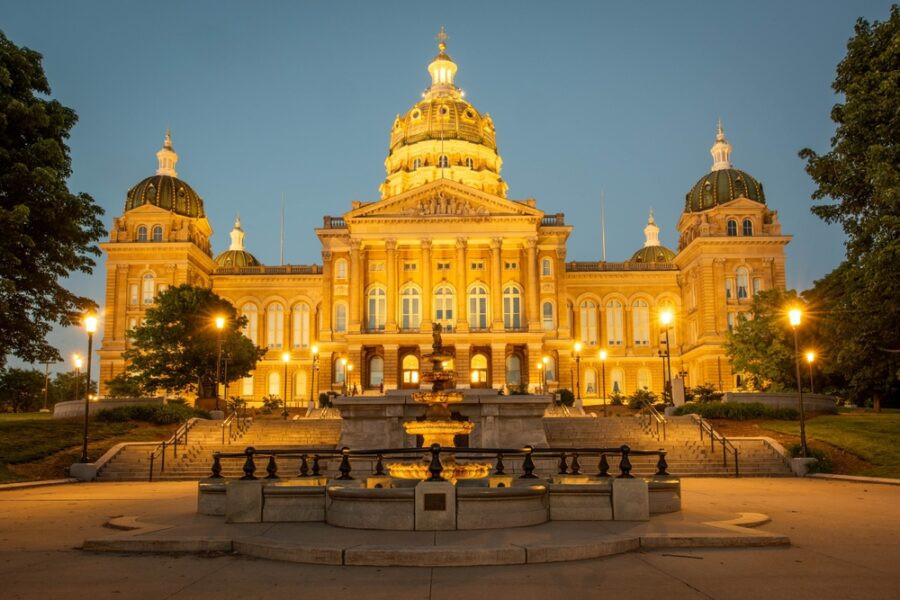
Iowa Gov. Kim Reynolds has signed Senate File 2289, giving the Iowa Racing and Gaming Commission more power against unregulated gaming.
SF 2289, which was signed by Gov. Reynolds on May 15, introduces stronger enforcement action, granting the regulator proper authority to carry out cease-and-desists and injunctive relief against illegal gambling operators.

That includes sweepstakes casinos, unlicensed daily fantasy sports operators, and other unlicensed operators carrying out other forms of gambling, including sports wagering.
The bill is set to go into effect on July 1.
The measure, introduced to the Senate by the Iowa Department of Inspections, Appeals, and Licensing in February, initially passed the Senate the same month with a unanimous vote of 44-0 before making its way through the House, passing the Ways and Means Committee on March 8 after another unanimous vote, and passing the entire chamber on March 21 with a vote of 93-0.

The bill was then sent back to the Senate, which later passed it on March 28 with a vote of 47-0. On May 5, the bill was enrolled and signed by the House President and Speaker, then sent to Gov. Reynolds that day.
Iowa isn’t the only state to effectively outlaw sweepstakes casinos. This month, Oklahoma also sent its own bill that would impose penalties on those operating sweepstakes casinos, which was later vetoed by the governor.
Charlotte Capewell brings her passion for storytelling and expertise in writing, researching, and the gambling industry to every article she writes. Her specialties include the US gambling industry, regulator legislation, igaming, and more.

Dig Deeper
Related stories
 2026/01/12: Iowa regulators to get new cease-and-desist powers in illegal gambling crackdown
2026/01/20: Proposed Iowa bill would expand regulators’ authority to control illegal betting platforms
2026/01/12: Iowa regulators to get new cease-and-desist powers in illegal gambling crackdown
2026/01/20: Proposed Iowa bill would expand regulators’ authority to control illegal betting platforms
 2026/05/13: Oklahoma governor vetoes anti-sweepstakes bill
 2026/05/06: Oklahoma anti-sweepstakes bill heads to Governor
2026/01/12: Iowa regulators to get new cease-and-desist powers in illegal gambling crackdown
2026/01/20: Proposed Iowa bill would expand regulators’ authority to control illegal betting platforms
2026/05/13: Oklahoma governor vetoes anti-sweepstakes bill
2026/05/06: Oklahoma anti-sweepstakes bill heads to Governor
The Backstory
Why Iowa moved now
Iowa’s new law targeting sweepstakes casinos did not emerge in a vacuum. Senate File 2289 gives the Iowa Racing and Gaming Commission sharper enforcement tools against unregulated gambling, including cease-and-desist orders and injunctive relief. The changes reflect a national shift toward clarifying the legal gray zone around social casinos that use dual currencies to convert virtual play into cash equivalents. Iowa lawmakers advanced SF 2289 with unanimous votes in both chambers before Gov. Kim Reynolds signed it on May 15. The measure, which takes effect July 1, follows months of debate in other states over whether to ban, regulate or redefine sweepstakes gaming. For reference, the bill’s text is posted on LegiScan at SF 2289 (2025).
The basic issue is scope and speed of enforcement. State regulators say unlicensed sweepstakes casinos and similar operators fall outside traditional gaming laws yet mimic online casino play with slots, table games and sports-style propositions. Granting explicit cease-and-desist and injunctive powers closes gaps that have slowed administrative action. By aligning statute with how these businesses function, Iowa positions its regulator to act without waiting for lengthy criminal proceedings.
A patchwork crackdown gains momentum
The Midwest is not alone. Oklahoma lawmakers advanced a bill this spring to outlaw online sweepstakes casinos and tighten definitions of what counts as casino gaming. The measure, Senate Bill 1589, won a series of lopsided committee and floor votes and reserved any current or future online gaming to tribal lands. It also broadened “representative of value” to cover virtual currency used in dual systems convertible to real-world prizes, with penalties for gambling off tribal land. The bill’s full text and status are posted at SB 1589 (2026). Oklahoma’s push underscores how definitions are becoming the battleground.
Indiana is exploring a similar line of attack. A proposal would impose civil and criminal penalties on social casinos that use dual-currency systems and offer cash prizes. The package targets common sweepstakes features such as slots and table games yet exempts classic promotions that do not award cash or equivalents. While not yet scheduled for debate, the measure illustrates rising pressure in states without legal iGaming. See Indiana’s House Bill 1052 overview and the bill page at HB 1052 (2026).
Not every effort has advanced. The Social and Promotional Games Association highlighted the failure of bans in multiple states this spring, including Maryland, Arkansas and Mississippi. The group framed the proposals as overbroad and a threat to mainstream loyalty programs, and it welcomed the withdrawals and missed deadlines that stalled the bills. That recap is here: SPGA on withdrawn legislation. The mixed outcomes point to a regulatory map that remains unsettled even as definitions harden and penalties rise.
California’s fault lines over social casinos
California’s debate shows how economic and tribal interests complicate blanket bans. Lawmakers are considering Assembly Bill 831, which would prohibit online social games with sweepstakes features statewide. The bill faces pushback from parts of the gaming industry and some tribes warning of unintended consequences for communities far from major casino corridors. Social casino operator VGW, for instance, sought a conditional partnership with the Kletsel Dehe Wintun Nation’s economic arm to run joint social platforms with sweepstakes promotions. That move, described in coverage of VGW’s deal with the Kletsel Dehe Wintun Nation, highlights how tribes and companies are testing models that could fit within or influence emerging rules.
Critics of AB 831 argue that a hard ban could widen disparities between large casino tribes with entrenched revenue and smaller tribes pursuing digital ventures to diversify. Proponents counter that sweepstakes mechanics are a backdoor to online casino play in a state where real-money iGaming remains illegal. The standoff mirrors a national split: whether to install targeted regulation for social casinos or eliminate the market and rely on traditional gaming channels.
Vetoes, definitions and the limits of bans
Louisiana’s recent veto shows how legal drafting and enforcement capacity can derail bans that look bulletproof. The Legislature passed SB 181 with unanimous bipartisan support to outlaw online sweepstakes sites and add steep penalties. Gov. Jeff Landry rejected it, arguing that the state’s current enforcement regime was sufficient and warning the bill’s language could be too vague. The governor’s veto message is posted by the Legislature here. A broader rundown is available in reporting on the Louisiana veto.
The Louisiana episode underscores two trends shaping policy design. First, prosecutors and regulators want tools they can use quickly against specific conduct, which favors measures like Iowa’s that empower civil enforcement tied to definitional tests. Second, legislatures that move to criminalize broad categories of online behavior risk pushback if language can be read to ensnare ordinary promotions or impede ongoing cases. That helps explain why some statehouses are gravitating toward precise definitions of “representative of value,” virtual currency and dual-currency systems rather than sweeping bans alone.
What to watch as the rules tighten
For operators, the stakes center on speed, certainty and market access. Iowa’s approach signals faster civil action against unlicensed gambling, including sweepstakes and unlicensed fantasy sports. Oklahoma’s bill would further restrict where online gaming of any sort can occur by reserving it to tribal lands, if legalized. Indiana’s proposal aims to fence off cash-out social models while sparing conventional sweepstakes. California’s path, if AB 831 advances, could force social casinos to exit a massive market or retool products to remove cash-like rewards.
For tribes, the evolving landscape cuts both ways. Some see social platforms and sweepstakes tie-ins as low-capital digital extensions of their brands. Others view them as a threat to compact-based exclusivity that underpins brick-and-mortar revenue. How states define online casino gaming versus promotional entertainment will shape that balance.
For consumers, practical effects will vary by state. In places that follow Iowa’s lead, users could see faster shutdowns of unlicensed sites and clearer signals about what is allowed. In jurisdictions adopting criminal penalties or strict venue rules, access to familiar social casino apps may tighten. With real-money iGaming legal in only a handful of states, the regulatory choices made this year will determine whether social casinos remain a mainstream diversion or retreat under a patchwork of prohibitions.
The through line across these fights is definitional clarity. Legislatures are drawing sharper lines around dual-currency systems and cash-equivalent rewards, and regulators are asking for direct authority to act. Whether states choose Iowa-style enforcement, Oklahoma-style venue restrictions, California-style bans or Louisiana-style restraint, the next phase will hinge on how precisely lawmakers draft the rules and how quickly agencies move to enforce them.
