


Football tops suspicious betting alerts worldwide in 2Q26 IBIA report

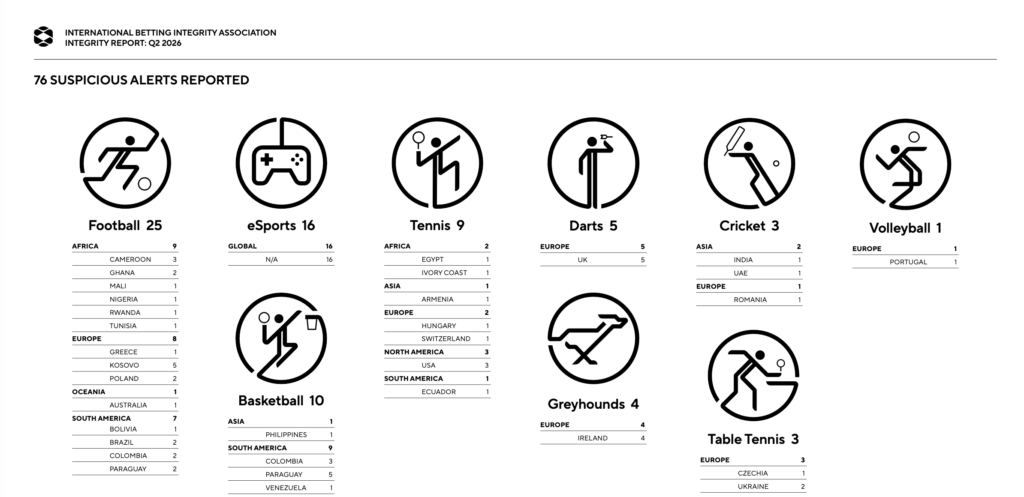
The International Betting Integrity Association (IBIA) has recorded 76 suspicious betting alerts across nine different sports for the second quarter of 2026, an 8.6% increase compared to the first quarter.
According to the IBIA’s latest integrity report, football generated the most alerts, with 25 cases, 33% of the total. Esports came second with 16 alerts – 21% of the total, while basketball had 10 – a 13% share. Tennis accounted for nine alerts, while the remainder were in darts (5), greyhound racing (4), cricket (3), table tennis (3) and volleyball (1).

Europe accounted for the largest share of alerts, with 25 cases. South America reported 17 alerts, followed by Africa with 11. North America reported only three alerts, down significantly from the 14 reported in 1Q26. Asia also recorded three alerts, while Oceania came last with only one.
The IBIA indicated that the data is gathered from its network of over 90 companies and more than 200 betting brands worldwide.
The group noted that it monitors over 1.5 million sporting events across 80 sports every year, with betting activity worth around a US$300 billion in global turnover.

The report also had a Canadian focus, examining Ontario’s online sports betting sector. IBIA’s latest report estimates that more than 90% of betting activity in the jurisdiction occurs on legal sites. It added that Alberta, which the organization began to monitor in May ahead of the launch of its legal market, is forecast to follow a similar trajectory.
The IBIA also announced efforts to expand integrity education initiatives in Canada, including a CA$300,000 (US$213,040)1 CAD = 0.7101 USD
2026-07-24Powered by CMG CurrenShift program supported by sportsbook operators Bet365, Betway and FanDuel, to give integrity training to nearly 200 Canadian Premier League players and staff.
“IBIA’s work in Canada shows that integrity is built through collaboration. When athletes, leagues, integrity experts and regulated betting operators work together, sport is better equipped to remain fair, transparent and trusted,” the IBIA said in its report.
Charlotte Capewell brings her passion for storytelling and expertise in writing, researching, and the gambling industry to every article she writes. Her specialties include the US gambling industry, regulator legislation, igaming, and more.

Dig Deeper
Related stories
 2025/03/05: Hard Rock Digital joins the International Betting Integrity Association
 2025/02/20: International Betting Integrity Association launches Payment Provider Forum in Brazil
 2026/01/30: Ontario reports record-breaking December for revenue
 2025/07/29: Sports betting margins hit record heights, Jefferies analyst says
2025/03/05: Hard Rock Digital joins the International Betting Integrity Association
2025/02/20: International Betting Integrity Association launches Payment Provider Forum in Brazil
2026/01/30: Ontario reports record-breaking December for revenue
2025/07/29: Sports betting margins hit record heights, Jefferies analyst says
The Backstory
Football’s betting footprint raises the integrity stakes
The latest International Betting Integrity Association report lands at a time when regulated sports betting is expanding into new markets, operators are leaning more heavily on live products and integrity monitoring is becoming a core part of market design. The association’s 76 suspicious betting alerts in the second quarter of 2026, up 8.6% from the first quarter, do not point to a crisis by themselves. They do, however, show how the betting ecosystem is being tested as volume rises, betting options multiply and operators process wagers across more jurisdictions in real time.
Football’s position at the top of the alert table is unsurprising but significant. As the world’s most wagered-on sport, it combines deep betting liquidity, global scheduling and uneven oversight across competitions. That makes it both commercially essential and exposed. The 25 football alerts in the quarter represented about one-third of all IBIA cases, ahead of esports, basketball and tennis. The ranking underscores a basic integrity challenge: the sports that generate the most betting engagement also create the broadest surface area for manipulation attempts, unusual market movements and account-level anomalies.
Canada has become a test case for regulated oversight
IBIA’s Canadian focus reflects how the country has moved from a gray-market battleground toward a regulated model that integrity groups and operators increasingly cite as a benchmark. Ontario’s regulated online sports betting market has given policymakers and compliance teams data they previously lacked, including evidence that more than 90% of betting activity in the province now occurs on legal sites. That figure matters because suspicious betting is easier to identify when wagers move through licensed operators that share data, cooperate with regulators and apply account-level controls.
Alberta is the next major proving ground. IBIA was approved as an integrity monitor for Alberta’s upcoming regulated online gambling market, giving it a formal role from the first day of launch. The arrangement puts IBIA’s Global Monitoring and Alert Platform alongside the Alberta Gaming, Liquor, and Cannabis Commission, with suspicious activity to be escalated to the regulator. The province’s expected July 13 launch would make it the second Canadian province after Ontario to adopt a regulated online sports betting framework.
The Alberta rollout also shows how integrity is being built into market entry rather than added later. The provincial regulator has said 28 online gaming operators registered, including BetMGM, Caesars Sportsbook, DraftKings, FanDuel and theScore Bet. That operator mix creates immediate scale, but also requires a common framework for reporting and intelligence sharing. For IBIA, which began monitoring Alberta in May ahead of launch, the province offers a chance to apply lessons from Ontario before the market reaches maturity.
Operators see opportunity, but regulation shapes the economics
The commercial stakes are clear from operator commentary. BetMGM has pointed to Canada as part of its growth path, with CEO Adam Greenblatt saying the company’s Ontario market share supported its expectations for Alberta. In April, the operator reported that first-quarter profit topped expectations and guidance, helped by strong online sports betting and igaming growth. Greenblatt said sports betting net revenue rose 68%, with handle up 29%, while igaming delivered $133 million in profit.
That kind of growth explains why Alberta is attracting major brands. But the same results also show the trade-offs regulators and operators face. Promotions can boost handle, but BetMGM executives warned that customer acquisition costs and promotional intensity must be managed carefully. Higher betting volume produces more revenue potential, more taxable activity and more data, but it also increases the need for monitoring systems that can spot suspicious patterns without overwhelming compliance teams.
Tax and illegal-market concerns are part of the same equation. Greenblatt said broader macroeconomic pressure could encourage more states and provinces to legalize, tax and regulate online sports betting and igaming. He also noted that better data on illegal betting strengthens the case for regulated channels. IBIA’s Ontario estimate supports that argument: high channelization can reduce the size of the unmonitored market, but only if licensed products remain competitive and integrity safeguards are credible.
Technology is changing both betting and fraud
The integrity picture is also being reshaped by technology on both sides of the market. Sportsbooks and suppliers are using automation and artificial intelligence to price markets, manage live wagering and process higher volumes more efficiently. Kambi’s second-quarter results showed how large events can magnify that shift. The supplier reported a return to growth after World Cup-fueled 2Q26, with revenue up 13.5% to 45.9 million euros and more than 1 billion euros in sportsbook turnover processed during the tournament.
Kambi CEO Werner Becher said the 2026 World Cup was the first to be fully traded by AI for the company, calling it an important milestone. The supplier’s Americas partner base also mattered, generating 57% of global network turnover during the tournament, compared with 38% during the 2022 World Cup. That shift highlights why the Americas, including Canada, have become more important to global betting suppliers. It also shows why monitoring must keep pace with faster trading systems and event-driven spikes in wagering.
Fraud trends point in the same direction. A Sumsub report found that Asia Pacific suspicious transaction volumes in igaming fell 45% since 1Q24, helped by stricter rules in the Philippines, Australia and New Zealand. Yet global igaming fraud rose 18% year over year, and the report warned that AI-generated identities, deepfakes and synthetic onboarding attempts are becoming more sophisticated. In APAC, 76% of fraud attempts occurred after initial onboarding, suggesting that one-time checks are no longer enough.
The relevance to sports betting integrity is direct. Suspicious wagering alerts are not only about match manipulation or unusual odds movement; they also depend on knowing who is behind the account, whether accounts are linked and whether activity reflects coordinated behavior. As fraudsters invest more time in verification and use AI-assisted content at scale, operators need continuous monitoring that combines identity, device, payment and betting data.
Sports bodies are moving before problems become public
Integrity monitoring is no longer limited to the largest leagues. Smaller and emerging betting sports are seeking surveillance tools as wagering markets expand beyond mainstream events. Compliance firm IC360 recently partnered with the World Surf League to monitor suspicious online wagering activity, adding its dashboard across global events and multiple time zones. The deal followed IC360’s work with the Southland Conference, a college athletic conference in Texas and Louisiana.
Those partnerships show how sports organizations are trying to address betting-related risk before it damages competitive credibility. For leagues and tours, betting can deepen fan engagement and create new commercial opportunities, but it also introduces reputational exposure. Monitoring systems give sports bodies a way to receive alerts, work with operators and regulators and demonstrate that betting growth is being matched by oversight.
IBIA’s second-quarter report should be read against that broader backdrop. Football led suspicious alerts because it is the biggest global betting product, not necessarily because it is uniquely vulnerable. The more important signal is that integrity systems are becoming embedded in regulated markets, supplier networks and sports governance. As Alberta prepares to join Ontario and as operators chase growth from major events and live betting, the industry’s central question is whether monitoring, identity controls and information sharing can scale as quickly as the market itself.
