


Xpoint granted a vendor license to launch in Massachusetts

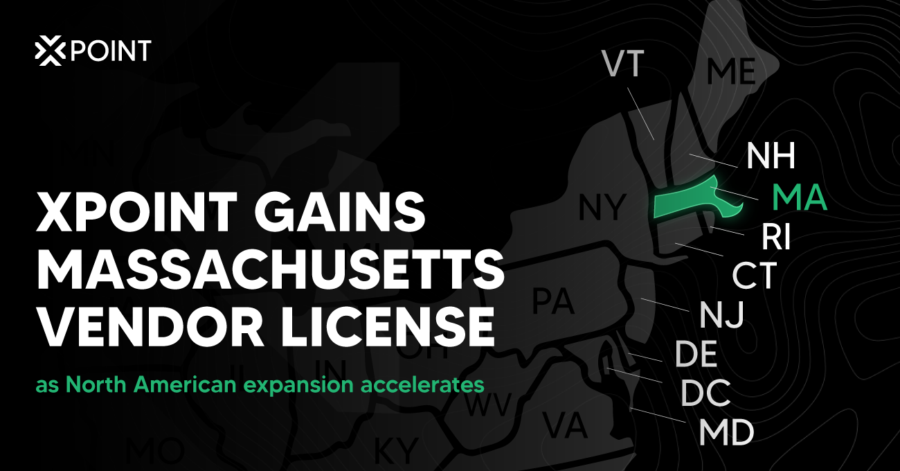
Geolocation and compliance company Xpoint has been granted a vendor license and will enter Massachusetts’ sports betting market.
Through the launch, operators in the state will have access to Xpoint’s geolocation product, which provides tools to ensure player activity remains compliant with the Massachusetts Gaming Commission’s regulatory requirements.

According to Xpoint, its platform is built for the gaming industry, offering geofencing technology to operators to prevent players from placing wagers outside legal jurisdictions and to highlight suspicious activity.
Xpoint is now active in 28 states and Ontario, Canada.
The company said the launch marks a strategic milestone, as it continues to expand its US and global presence, with recent launches in Missouri, Brazil, and the UAE.

“Securing our license in Massachusetts is a vital step as we continue to make strides in the geolocation space,” Manu Gambhir, Xpoint CEO, said in a news release. “Massachusetts has a passionate sports culture and a sophisticated regulatory framework, and we are excited to provide the precision technology necessary to maintain the integrity of the state’s sports betting ecosystem.
“Our growth into the Bay State demonstrates our team’s ability to navigate complex regulatory landscapes quickly and efficiently. This expansion underscores the global demand for more innovative and adaptable compliance solutions, and we remain committed to being the most reliable partner for regulated operators worldwide.”
Abi Bray brings strong researching skills to the forefront of all of her writing, whether it’s the newest slots, industry trends or the ever changing legislation across the U.S, Asia and Australia, she maintains a keen eye for detail and a passion for reporting.

Dig Deeper
Related stories




The Backstory
Why a Bay State license matters
Massachusetts has been one of the most closely watched sports betting regulators in the country, pairing a dense sports market with a reputation for meticulous oversight. For a geolocation and compliance vendor, winning entry signals technical credibility and regulatory trust. Xpoint’s vendor license clears the way for operators in the state to use its geofencing and spoofing-detection tools to ensure wagers originate inside legal boundaries and that suspicious activity is flagged before it becomes a risk. It also positions the company alongside a wave of U.S. market openings where regulators are insisting on stronger location assurance, real-time monitoring and auditable controls.
The approval lands as Xpoint has been expanding across the United States and Canada with a stated focus on precision and speed at scale. Massachusetts is a particularly visible testbed: regulators are active, enforcement is assertive and operators expect low-latency checks that do not degrade conversion. Securing this license suggests Xpoint’s software and compliance approach can meet those thresholds under scrutiny.
The company frames the Bay State as both a commercial opportunity and a proving ground. Its recent track record — new customers, fresh capital and executive hires — offers a through line for how it sought to reach this point and why it is trying to accelerate from here.
Funding fuels the product roadmap
Xpoint’s push into new jurisdictions has been underwritten by a recent capital raise led by Bettor Capital, earmarked for research and development and team expansion. The financing was positioned to speed delivery of spoofing defenses, streamline onboarding and keep location checks precise without sacrificing performance. The company tied the use of proceeds to live deployments with North American operators and several international pilots, including partnerships in Brazil and the United Arab Emirates.
The expansion of regulated markets outside the United States can be as much about signaling as sales. In the Middle East, Xpoint says it supports state-sanctioned gaming initiatives, including work with the UAE Lottery and regulated platform Play971. That narrative — regulated partners, custom controls, exportable technology — reinforces the company’s case to U.S. commissions that it can adapt to complex regimes. For details on the raise and its international footprint, see the company’s note on how it secured funding to support product development and market expansion.
Massachusetts’ license, arriving after that investment, suggests the roadmap translated into milestones regulators wanted to see: rapid-jurisdiction onboarding, real-time anomaly detection and demonstrable defenses against location spoofing. The commercial logic is straightforward. Stronger geolocation lowers operator compliance risk and charge-offs tied to blocked transactions, while faster checks lift conversion on first bet and in-play wagers — a dynamic that matters in a state with heavy live betting interest.
Building a bench for scale
The product push has been matched by hires meant to stabilize delivery as Xpoint adds markets. In November, the company named veteran technologist Shaan Devaraj as chief technology officer, citing his deep background in geolocation, cloud infrastructure and service-oriented architectures. Devaraj’s mandate: strengthen core location services and accelerate feature velocity without compromising on latency or accuracy. The company positioned his experience — from patent work in geolocation to long stints in gaming software — as a catalyst for the next stage of platform maturity. Read more on his appointment in Xpoint’s announcement that Shaan Devaraj joined as chief technology officer.
Operational alignment has also been a priority. This year, Xpoint added Chris Boni as chief of staff to drive cross-functional execution and support the executive team’s expansion agenda. The role spans program oversight, process discipline and coordination across product, engineering and go-to-market — plumbing that becomes critical when onboarding multiple operators across jurisdictions. For background on that move, see how Xpoint named Chris Boni as chief of staff.
Taken together with its recent finance leadership hire, the buildout signals an organization shifting from market-by-market wins to a repeatable playbook for multi-state deployments. Massachusetts’ approval provides a high-visibility test of whether that operating model can deliver at speed in a demanding environment.
A tightening but expanding U.S. map
Geolocation providers sit at the intersection of two opposing forces: regulators widening access to legal betting while tightening the rules to protect it. That tension has been on display in recent state actions. In Arkansas, the Racing Commission cleared the way for a major operator to enter the state via a local casino partnership, a move that will introduce more in-state users to mobile wagering and, in turn, raise the stakes for accurate geofencing at borders and tribal lands. The expansion underscores how each new operator rollout multiplies compliance points where location tech must perform. For more on that approval, see how the regulator granted a license to DraftKings pending final partnership sign-off.
At the same time, enforcement remains stringent. In New York, daily fantasy operator PrizePicks paid a penalty and halted contests before receiving a new interactive fantasy sports license. The episode shows how quickly regulators can move when companies operate outside set parameters and how a path back often runs through tighter compliance controls. For context on that reversal, see how PrizePicks secured a New York license following a settlement.
Massachusetts sits squarely in this pattern. Its sports betting framework invites competition but expects vendors to prove they can stop location spoofing, identify anomalous play and maintain auditable trails. For Xpoint, a license here is both permission to operate and a scorecard entry that may influence other states where approvals hinge on demonstrated precision and incident response.
Global compliance push extends beyond North America
The gating factor for geolocation today is not just drawing a line around a state. It is adapting to different legal standards, telecom networks and device behaviors across borders. Xpoint has presented its recent international work as evidence it can localize quickly and support sovereign requirements, including in regions where online gaming is newly regulated or tightly circumscribed. That experience can inform U.S. deployments where state rules diverge on in-play markets, collegiate restrictions and responsible gaming triggers that may rely on location as a control signal.
The company’s march into new geographies also carries strategic weight. As more governments open regulated channels, operators want a single vendor capable of handling multiple jurisdictions without sacrificing speed or detection fidelity. Massachusetts reinforces that theme: a demanding U.S. commission validating a vendor’s toolkit in one state can accelerate conversations in others, especially when paired with evidence from international rollouts described in the company’s update on its funding and market expansion plans.
The stakes are clear. For operators, a strong geolocation layer reduces friction at account creation and bet placement, unlocks more playable moments and limits fraud. For regulators, it is the foundation that keeps legal markets insulated from out-of-state traffic and bad actors. Xpoint’s Massachusetts entry will test whether its recent investment, leadership hires and global proofs of concept translate into reliable performance under one of the country’s tougher spotlights. If they do, the company’s bet that compliance can be a competitive advantage — not just a cost of entry — will look prescient as the map continues to fill in.
