


US Senate blocks CLARITY Act from moving forward

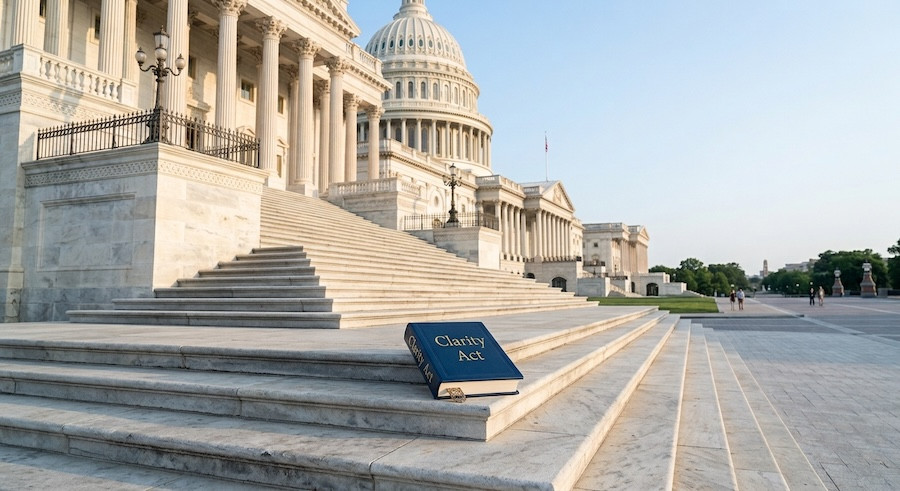
The US Senate has rejected a procedural vote on the CLARITY Act, preventing the cryptocurrency market structure bill from moving forward. A total of 49 senators voted against, while 50 voted for the motion to proceed, falling short of the 60 votes required to advance the legislation.
The Digital Asset Market Clarity Act aimed to establish a clear federal regulatory framework for cryptocurrencies and digital assets, including defining the roles of the Securities and Exchange Commission (SEC) and the Commodity Futures Trading Commission (CFTC).

It also included registration requirements and measures covering consumer protection and money laundering, according to CNBC.
The vote was a procedural step required for the legislation to advance to Senate debate and consideration. It would still have required further Senate negotiations and approval from the House before becoming law.
The failed vote follows months of discussions between lawmakers. A revised version introduced shortly before the vote included changes addressing concerns around ethics rules for public officials with cryptocurrency interests.

However, the amendments did not secure enough support for the bill to clear the Senate’s procedural vote.
The vote could make it more challenging for the bill to return for consideration, with Congress approaching its recess ahead of the midterm elections. Senators are due to leave Washington in October, and the House is scheduled to recess earlier.
The vote also comes one day after a coalition of 17 state attorneys general and the Indian Gaming Association urged senators to reject the bill, raising concerns that the bill could limit states’ authority to “oversee the securities and commodities markets to protect everyday Americans.”
Charlotte Capewell brings her passion for storytelling and expertise in writing, researching, and the gambling industry to every article she writes. Her specialties include the US gambling industry, regulator legislation, igaming, and more.

Dig Deeper
Related stories
 2026/08/07: US Senate postpones Clarity Act vote until September
 2026/09/15: Coalition of 17 US attorneys general and the Indian Gaming Association urge Senators to reject revised CLARITY Act
 2026/09/14: Donald Trump agrees to state enforcement role in CLARITY Act
 2026/08/20: SEC eases crypto regulations as White House doubles down on support for digital assets
2026/08/07: US Senate postpones Clarity Act vote until September
2026/09/15: Coalition of 17 US attorneys general and the Indian Gaming Association urge Senators to reject revised CLARITY Act
2026/09/14: Donald Trump agrees to state enforcement role in CLARITY Act
2026/08/20: SEC eases crypto regulations as White House doubles down on support for digital assets
The Backstory
A crypto framework ran into state and tribal resistance
The Senate’s rejection of a procedural vote on the CLARITY Act capped months of negotiations over how far Congress should go in creating a federal rulebook for digital assets and how much authority states, tribes and existing regulators should retain. The measure was designed to settle a central dispute in U.S. crypto policy: whether many digital assets should be overseen primarily by the Securities and Exchange Commission or the Commodity Futures Trading Commission, and under what conditions platforms, issuers and intermediaries should register with federal agencies.
The bill’s supporters argued that the absence of a single federal framework had left crypto companies navigating enforcement-driven regulation, overlapping agency claims and uncertainty over which products were securities, commodities or something else. Opponents increasingly framed the bill as a preemption fight, warning that a broad federal structure could weaken state consumer protection powers and open gaps in oversight at a time when online fraud, token promotions and event-contract platforms have grown more politically sensitive.
Those tensions intensified immediately before the vote, when a coalition of 17 attorneys general and the Indian Gaming Association urged senators to reject the revised CLARITY Act. Their intervention gave senators a clear signal that objections were not limited to partisan concerns about crypto regulation. State law enforcement officials said the bill risked displacing their ability to bring actions under securities and commodities laws, while tribal gaming leaders said the measure did not adequately protect tribal sovereignty or the Indian Gaming Regulatory Act.
The September vote was already a delay
The failed vote followed an earlier decision by Senate leaders to push consideration beyond the August recess. In that earlier stage, the Senate had postponed a procedural vote on the Digital Asset Market Clarity Act until September, giving negotiators more time to pursue the 60 votes needed to begin debate. That delay reflected the bill’s central challenge: It had industry support and Republican momentum but needed Democratic votes in a chamber where concerns over enforcement, ethics and election-year politics were mounting.
The postponement also exposed the narrowing legislative calendar. Senators were expected to leave Washington in early August and return in mid-September, leaving only a short window before attention shifted toward the November midterm elections. The House was on its own compressed schedule. Even if the Senate had advanced the bill, it still would have needed additional negotiations, a final Senate vote and likely further House consideration before reaching President Donald Trump’s desk.
During the delay, crypto industry groups pressed lawmakers to reach a deal, arguing that legislative clarity was needed for investment, product development and U.S. competitiveness. But the same pause gave opponents time to sharpen concerns beyond traditional securities regulation. Gaming groups, in particular, focused on the possibility that prediction market platforms could use a federal commodities framework to offer sports-related contracts without state or tribal gambling approvals.
Prediction markets widened the fight
The CLARITY Act debate became more than a dispute over token classification because of the rapid emergence of prediction markets as a regulatory test case. Platforms offering contracts tied to real-world events have argued they fall under commodities law, not gambling statutes. State gaming regulators, tribal governments and casino industry groups have countered that sports-event contracts can function like sports betting and should not bypass the state-by-state licensing model built around consumer protection, taxation and tribal compacts.
That concern put the bill in the crosshairs of the Indian Gaming Association and other gaming stakeholders. Tribal leaders warned that without explicit protections, federal crypto legislation could weaken tribal exclusivity agreements and the sovereignty framework that underpins regulated gaming in many states. The American Gaming Association also had raised alarms about prediction markets, arguing that sports contracts offered outside gaming laws could undermine regulated operators that have spent years securing licenses and complying with state controls.
Sen. Cynthia Lummis of Wyoming and other backers sought changes to address some of those concerns, but the revisions did not satisfy tribal representatives. The Indian Gaming Association said the language acknowledged the issue without resolving the underlying threat to tribal and state authority. That position mattered because the CLARITY Act needed a coalition broad enough to overcome a filibuster. By the time senators voted, prediction markets had become a bridge issue connecting crypto skeptics, state officials and tribal gaming advocates.
Ethics concerns complicated White House support
The bill also moved through Congress against a politically charged backdrop: Trump’s public support for digital assets and his family’s crypto-related interests. The administration had pushed Congress to pass a “fair version” of the legislation, presenting it as part of a broader effort to make the U.S. a leader in crypto, artificial intelligence and prediction markets. But Democrats and some Republicans sought stronger restrictions on public officials who hold or promote digital assets.
Those negotiations produced a late attempt at compromise. Trump reportedly agreed to give state attorneys general a role in enforcing the bill, according to Republican authors of the legislation. The development was seen as an effort to address concerns from Sens. Thom Tillis and Ruben Gallego, who wanted state law enforcement to have meaningful authority alongside the Justice Department. The agreement was described in a prior report on how Trump accepted a state enforcement role in the CLARITY Act.
The proposed changes also were expected to require officials with significant financial interests in crypto issuers to divest or place holdings in a blind trust, and to allow state attorneys general to sue exchanges that list banned digital assets. But those revisions arrived late and did not resolve broader doubts. For some senators, the ethics provisions did not go far enough. For some state officials, the enforcement language still left too much authority concentrated at the federal level. The compromise therefore pleased neither side enough to secure passage.
Regulators moved as Congress stalled
While lawmakers debated the CLARITY Act, federal regulators continued reshaping crypto policy through agency action. The SEC recently proposed “Regulation Crypto Assets,” a package intended to create clearer pathways for crypto companies to raise capital under federal securities laws. The proposal included exemptions for offerings up to $5 million over four years and up to $75 million during a 12-month period, with disclosure and reporting conditions.
That move, covered in a report on how the SEC eased crypto regulations as the White House doubled down on support for digital assets, underscored why Congress was under pressure to act. In the absence of legislation, the SEC and CFTC remain central to defining the market’s boundaries through rulemaking, interpretations and enforcement priorities. Industry groups prefer a statute that limits uncertainty across administrations, while critics fear Congress could lock in weaker standards than agencies and states can currently impose.
The SEC proposal also highlighted the administration’s pro-crypto posture. Trump has argued that crypto companies should remain in the U.S. and operate under rules that support innovation. But that stance has made ethics questions harder to separate from policy design, especially as lawmakers scrutinize whether senior officials and their families can benefit financially from a sector that federal agencies are simultaneously regulating.
The stakes now shift to timing and leverage
The Senate vote does not necessarily end the CLARITY Act, but it makes revival harder. A failed procedural vote shows that negotiators lacked enough bipartisan support even after late revisions on ethics and state enforcement. With lawmakers approaching recess periods and midterm campaigning, the cost of taking another difficult crypto vote rises, particularly for Democrats wary of appearing to aid an industry tied closely to Trump’s economic agenda.
For the crypto sector, the immediate consequence is continued fragmentation. Companies will keep operating under a mix of federal agency guidance, court decisions, state rules and enforcement risk. For gaming stakeholders, the defeat preserves, at least for now, their ability to argue that sports prediction contracts should be addressed through gambling law rather than folded into a digital-asset market structure bill.
The episode also signals a broader legislative reality. Digital asset regulation cannot be separated from state policing powers, tribal sovereignty, gambling policy and public corruption concerns. Any future version of the CLARITY Act will likely need to provide more explicit protections in each of those areas. Without that, the same coalition that helped block this vote could remain large enough to stop the bill again.
