


Sporttrade leaving US sports betting market

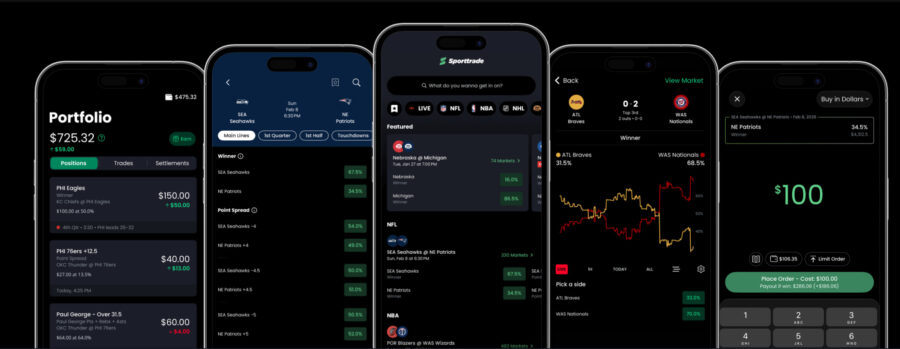
Sports betting operator Sporttrade will leave the US market, according to a notice on 15 May.
In that notice, Sporttrade revealed that wagering on its platforms will cease on 25 May. Users in New Jersey need to withdraw all money on that same day, while users in Arizona, Colorado, Iowa, and Virginia can withdraw their money by 25 June.

Sporttrade will remove access to its platform for everyone on 26 June and remaining balances will be mailed to users as checks.
The operator teased a possible rebrand, ending its notice with, “Stay tuned for what’s next!”
Sporttrade, which launched its sports betting platform in New Jersey in 2022, did not give a reason for its closure. However, over the past couple of months, the operator has said it has been struggling with growing competition, particularly from prediction markets.

With more sportsbooks transitioning to prediction markets, unencumbered by state gambling regulations, operators like Kalshi could offer their event contracts in all 50 states, whereas Sporttrade remained limited to five.
Sporttrade CEO Alex Kane told Sportico, “It’s really hurt the business.”
Sporttrade applied to the Commodity Futures Trading Commission for a license to become a Designated Contract Market and Derivatives Clearing Organization, with the application pending approval.
Charlotte Capewell brings her passion for storytelling and expertise in writing, researching, and the gambling industry to every article she writes. Her specialties include the US gambling industry, regulator legislation, igaming, and more.

Dig Deeper
Related stories
 2025/11/13: FanDuel and DraftKings exit Nevada amid prediction market crackdown
2025/10/17: Nevada Gaming Control Board warns licensees that sports event contracts are wagers
2025/11/13: FanDuel and DraftKings exit Nevada amid prediction market crackdown
2025/10/17: Nevada Gaming Control Board warns licensees that sports event contracts are wagers
 2025/05/15: Prediction markets seem to be inevitable, panel says
 2025/11/25: What does the future hold for prediction markets after big players break from AGA?
2025/11/13: FanDuel and DraftKings exit Nevada amid prediction market crackdown
2025/10/17: Nevada Gaming Control Board warns licensees that sports event contracts are wagers
2025/05/15: Prediction markets seem to be inevitable, panel says
2025/11/25: What does the future hold for prediction markets after big players break from AGA?
The Backstory
Why Sporttrade’s retreat matters now
Sporttrade’s decision to shut down U.S. wagering underscores a structural rift opening inside American betting. It is not a simple case of a challenger squeezed by larger sportsbooks. The company has been caught between a slow, state-by-state regulatory model for traditional betting and a faster federal pathway emerging for event contracts and prediction markets. That divergence matters for operators, investors and regulators because the rules that govern who can trade on outcomes — and where — are shifting in real time.
Sporttrade launched its exchange-style sportsbook in New Jersey in 2022 with the promise of tighter pricing and a market-driven user experience. But in recent months the company pointed to intensifying competition from prediction markets that do not face the same patchwork of state gambling rules. In parallel, Sporttrade sought a federal route of its own, applying to the Commodity Futures Trading Commission to operate as both a federally regulated exchange and clearinghouse. The company disclosed those moves in Sporttrade’s filing with the CFTC for exchange and clearing registration, signaling a strategic pivot even as it wound down state operations.
The stakes are larger than one operator’s exit. They reflect a contest over whether bets on events belong under gambling commissions in 30-plus jurisdictions or under commodities regulators with nationwide reach. That resolution will influence how capital, technology and consumer activity flow across the next phase of U.S. wagering.
Prediction markets changed the competitive calculus
Prediction markets have pushed into territory once associated with sportsbooks by offering contracts tied to outcomes, priced by supply and demand and often available to a national audience. Their operators argue they are offering financial products, not gambling, and therefore fall under federal oversight. Sporttrade’s chief executive has been candid about the commercial impact of that shift, telling Sportico in a recent interview that the rise of lightly encumbered prediction venues has hurt business constrained by state licenses and market-by-market compliance burdens.
The CFTC is now a central arena for that debate. Its handling of exchange and clearing applications — visible on the CFTC’s docket for derivatives clearing organizations — could define whether exchange-style sports markets emerge at scale under federal charters. For firms like Sporttrade, approval could reopen the U.S. in one sweep. Denial or delay would lock them back into expensive, state-led expansion where incumbents already dominate. Either way, the regulatory outcome will reorder competitive dynamics across trading, gaming and media.
A fragmented map: Missouri as a case study
State-by-state legalization has created opportunity but also friction. Timelines, tax rates and technology requirements vary widely, shaping who can compete and how fast customer bases form. Missouri shows the path and the pitfalls. Regulators there finalized a schedule that pushed the start to Dec. 1, as detailed when the state set out a licensing window and emphasized the depth of vetting for market applicants in a report on the Missouri launch date and process.
Compliance vendors scaled alongside that rollout. Geolocation provider Xpoint, which fences state lines and flags suspicious activity, went live in Missouri on launch day, highlighting how critical infrastructure partners have become to satisfy regulators’ demands. Early revenue snapshots show the fledgling market’s contours. The Missouri Gaming Commission’s January financials give a glimpse of bet volume and hold even as operators and tax collections settle into a baseline after a heavy promotional start.
This mosaic of rules can be a moat for established brands but a drain on smaller entrants, which must replicate licensing, payments, KYC and risk frameworks in each jurisdiction. It also explains why some upstarts are weighing federal routes that promise one set of approvals and uniform access.
Incumbent gravity: early winners entrench
Where new markets open, the same names tend to capture share. In Missouri’s first two months, DraftKings and FanDuel controlled about 73% of handle and tallied roughly $120 million in profit, according to state data cited by local media. The marketing machine that helped legalize the market also underscored the financial clout of those firms. The Missouri Independent reported profits nearly tripled campaign costs the two operators bore to push legalization, a payoff that fuels more ad spend, promotions and customer lock-in.
For would-be disruptors, that dynamic raises the bar. Compete on price and product without seamless national access and they face a grind. Compete under federal rules with exchange-style markets and they risk uncertain regulatory outcomes. Sporttrade’s pivot sits squarely at that crossroads.
Global expansion and consolidation shape expectations
U.S. dynamics mirror global forces. As operators chase scale, consolidation is accelerating in other mature markets. In Australia, BlueBet’s parent, which runs Betr, completed the acquisition of TopSport, migrated customer data and signaled it is still pursuing a larger PointsBet deal. The message to investors is that speed, M&A playbooks and cost synergies matter as margins compress and customer acquisition costs rise.
Meanwhile, growth tailwinds remain strong. A recent analysis projects the global sports betting market could reach $182.12 billion by 2030, driven by mobile adoption, regulatory liberalization across the Americas and technology like AI-enhanced personalization. That backdrop gives operators more incentive to secure national channels to market, whether via federal permissions in the U.S., cross-border licenses or partnerships that bundle media, data and wagering.
For exchange-style models, that growth potential is a double-edged sword. It promises deeper liquidity, which improves pricing and user experience. But it also invites scrutiny from market and consumer regulators worried about retail exposure to complex products and event-linked contracts. Any federal green light will likely come with tight guardrails on contract design, leverage and retail access.
What to watch next
Three threads will determine whether Sporttrade’s exit is a pause or a precedent. First, how the CFTC handles pending applications and any new guidance on event contracts. Second, whether state markets keep concentrating around a few national brands, making organic entry even tougher. Third, how quickly operators align product, compliance and capital around models that can scale across borders.
If federal approval arrives, exchange betting could reenter with a national footprint and a different regulatory playbook. If it does not, the U.S. map will remain a jurisdictional maze where incumbents hold most of the cards and challengers must either consolidate or find profitable niches. Either way, the industry is converging on a familiar conclusion: distribution, regulation and liquidity are destiny.
