


Sportradar CEO says grand strategy is on schedule

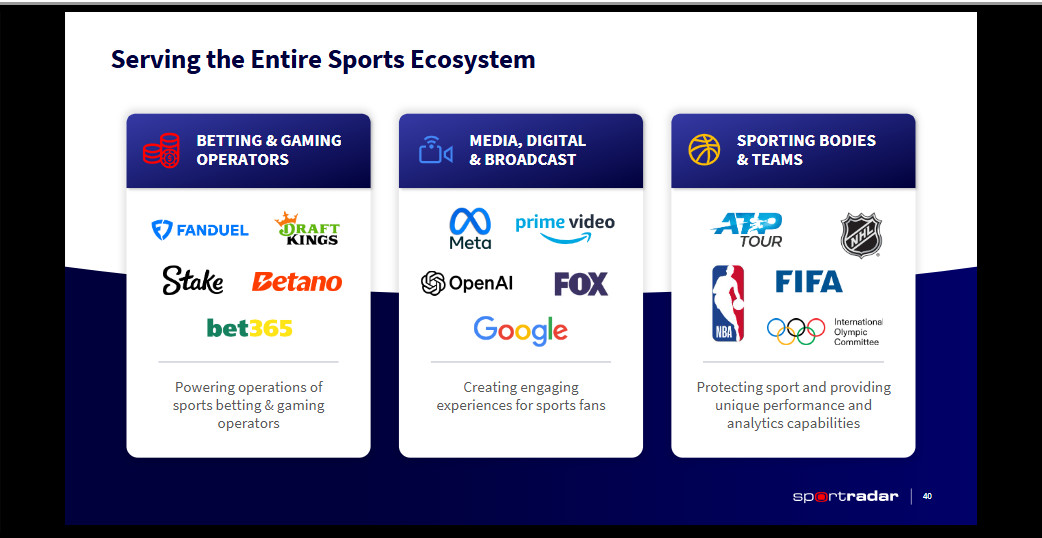
In 2025, Sportradar laid out a three-year plan for its business through 2027. “Over the course of 2025 we delivered on this strategy,” said Chief Executive Carsten Koerl during the company’s fourth-quarter earnings call 3 March.
“We performed ahead of the expectations we laid out,” Koerl continued. “We see a long runway ahead for further expansion.”

Even so, Koerl lamented a “disconnect” between the fundamental strength of his business and its stock price. To that end, a US$300 million share-repurchase authorization was being increased to US$1 billion.
Among fourth-quarter achievements was the provision of IMG Arena content to Sportradar customers, reflecting a purchase that was consummated late in 2025. “The customer response has been strong,” Koerl reported. “This puts us firmly on track to unlock encrypted synergies.
“All the operators are now converted to this contract,” the Chief Executive said, and Sportradar was extrapolating new products from IMG content. As for anticipated synergies, “We are a little bit ahead of the target.”

For sports coverage, Koerl said Sportradar was “unmatched in content and depth.” He pointed to the extension of a German soccer contract through 2032.
The Chief Executive also lauded a performance-data model for professional basketball, using data points “from thousands of NBA games.” He said the technology would be applied also to tennis and, in time for the World Cup, soccer.
In 2025, Sportradar streamed 525,000 games, Koerl declared. For 2026, that number is projected to exceed 700,000. The company’s advertising business “delivered strong, record volume,” he continued, reflecting increased demand.

Sportradar was, the Chief Executive reported, using artificial intelligence to transform player data into onscreen graphics. This was being incorporated into ongoing relationships with NBC-TV and Peacock.
On the topic of prediction markets, “this is a rapidly developing opportunity in the US,” Koerl said, “and one where we are uniquely positioned.” He reported that the company was working with MLS, the NHL and the UFC “to establish clear safeguards. We are already seeing strong demand for our marketing services” with more to come from event-contract providers.
“We are very proud of what we accomplished” with FIFA, Koerl said. He conceded that Sportradar couldn’t protect bettors on prediction markets. “Sport is caring about this now,” he continued, and the leagues were working with the market providers.
Koerl predicted that the NBA would eventually embrace event contracts. But first “we need to put the guardrails in place to protect the players and the integrity” of the games.
Stressing that 70% of Sportradar’s revenue came from outside the US, Koerl said two-thirds of the remainder was represented by online sports activity and his clients “see little or no cannibalization” from prediction markets. He said he expected “an uplift opportunity in the tens of millions” from the latter.
Thanks to the IMG deal, Chief Financial Officer Craig Felenstein reported that Sportradar was seeing a customer-retention rate of 109%. Meanwhile, expenses for acquiring matches had increased 18%, prompting Felenstein to say that Sportradar “will remain strategic and disciplined” in such moves.
Despite the international-currency headwinds created by a weak US dollar, Felenstein said, “we anticipate an acceleration of growth in 2026.” Most of that, he added, would occur in the second and third quarters.
Sportradar ended 2025 with €365 million (US$424 million)1 EUR = 1.1612 USD
2026-03-03Powered by CMG CurrenShift cash on hand and no debt. “We are confident in our ability to generate further revenue growth,” Felenstein added.
The Chief Financial Officer said that revenue guidance was unchanged since it was laid out in November, save for the weakness of the American dollar: “The business continues to operate exactly as we had planned.”
Sportradar’s operating expenses had been up 25%, which Felenstein attributed to the costs of entering Brazil. Koerl said Sportradar was using Brazil as a test market for its igaming products. He added that live-betting products in Brazil were demonstrated at the recent ICE Barcelona show “and the pickup was enormous.”
Queried about mergers and acquisitions, Koerl said the company was constantly looking at branching out into businesses such as advertising or igaming but that nothing compelling had matched Sportradar’s criteria. Instead, a better use of capital was to repurchase stock.
With a potential MLB lockout by team owners looming, Koerl reassured investors that Sportradar had PGA and WNBA content lined up to fill any resultant gaps. Still, he said, he hoped for “a nice, gentle start for the baseball season.”
David McKee is an award-winning journalist who has three decades of experience covering the gaming industry.

Dig Deeper
Related stories


The Backstory
Setting the stage
Sportradar’s latest earnings call leans on themes the company has been telegraphing for months: build scale through data rights, monetize live content more deeply and buy back stock to signal confidence. That narrative has been shaped by a string of milestones in late 2025 and early 2026, including a high-profile investor day, upgraded guidance and an acceleration of share repurchases. Together they show how Sportradar is trying to turn product breadth and league partnerships into pricing power and cash flow while defending valuation in a volatile market for sports tech names.
In November, Sportradar lifted full-year guidance to €1.3 billion and expanded its buyback after closing the acquisition of IMG Arena’s sports rights portfolio, a move executives said would deliver “must-have” betting content and near-term synergies. Analysts acknowledged currency and cost headwinds but pointed to operating leverage, particularly in the United States where growth outpaced the rest of the world. Those themes set up a fourth quarter in which the company posted record revenue and cash flow and used the beat to scale its repurchase authorization materially.
A deal reshaping the playbook
The IMG Arena transaction is central to Sportradar’s go-forward story. Management pitched it as a portfolio fit that broadens rights inventory, deepens live-betting content and can be ingested quickly across existing distribution. At the firm’s April 1 investor day, Wall Street analysts pressed less on star guests and more on the mechanics: how scale, data capture and AI can support higher take rates, stickier customers and margin accretion. Jefferies’ David Katz and J.P. Morgan’s Samuel Nielsen both flagged the deal’s potential to accelerate revenue and free cash flow, with Katz modeling €137 million in revenue and €33 million in cash flow once integrated and Nielsen calling the terms margin accretive.
The integration case rests on cross-selling, improved retention and new products. Management has argued that clients buying multiple Sportradar modules generate substantially more revenue than single-product customers, a dynamic analysts say can compound as IMG content is woven into live wagering streams and personalized feeds. Sportradar has also told investors that automation is lowering unit costs. The company has automated data collection for more than half the games it covers, a material efficiency gain that supports scale without proportional expense growth.
From cautious beats to a clean turn
The financial arc through late 2025 shows the company tightening execution even as rights costs rise. In the third quarter, Sportradar posted €292.1 million in revenue, €85 million in cash flow and a €22.5 million profit, with U.S. growth of 30% offsetting a modest top-line miss versus some estimates. Management added another US$100 million to buybacks and emphasized predictable rights costs despite renewals with ATP and MLB that lifted expenses.
The turn became more visible a quarter later. Sportradar swung to a €4.4 million fourth-quarter profit and delivered full-year records, including €1.3 billion in revenue and €297 million in cash flow. The company leaned into capital returns, disclosing US$91 million of 2025 repurchases and signaling a larger authorization for 2026. Management framed the numbers as validation of a product-led strategy and of the IMG deal’s early monetization. Segment mix underscored that point: Betting and Gaming Content powered the gains, while Marketing and Media Services added incremental growth and integrity-related lines softened.
Prediction markets, integrity and regulation
Another through line is Sportradar’s bid to position itself at the center of fast-evolving U.S. prediction markets. Executives have said these contracts remain a small slice of wagering volume but could be complementary to sports betting if properly regulated and safeguarded. On a fall earnings call, CEO Carsten Koerl argued the category needs clarity on player protections and anti-money-laundering controls and noted that leagues are aligned on financial participation, while states focus on tax and consumer safety. The company presented this stance alongside momentum in integrity services, which CFO Craig Felenstein said more than doubled year over year, even as headline scandals raised the stakes for providers and leagues.
Sportradar is trying to make integrity a differentiator. It touts anomaly detection, rights-holder relationships and enforcement support as table stakes in an era of in-play microbetting and high-frequency props. The message to investors: as event-level markets proliferate, trusted data pipes and monitoring become more valuable, not less, and can justify higher pricing and share of wallet.
Live betting, AI and the growth lanes
The company’s product roadmap ties directly to where analysts see the market going. In the U.S., in-play and proposition wagers are expected to surge from one-third of bets in 2024 toward a near-majority by 2027, according to projections discussed at investor day. Sportradar says each percentage point of prop share can translate into several million euros of incremental revenue, a reason it continues to invest in courtside streaming, low-latency data and AI-driven personalization and real-time tools. Management also flagged deeper NBA integrations and new applications that model thousands of player data points to feed both media and betting products.
Beyond sports wagering, Sportradar has been candid about exploring online casino marketing and tooling, using markets like Brazil as beachheads. The company told investors it services 84 icasino brands and sees a multibillion-dollar serviceable market where its media, data and adtech stack can travel. That adjacency pitch mirrors its league strategy: land with core data rights, expand into content, streaming and marketing services, then leverage cross-sell to lift retention and pricing.
The 2027 scorecard investors track
Management has put hard numbers on its medium-term ambition. Ahead of investor day, Sportradar set a 2027 target of €1.7 billion in revenue, a 15% compound rate, with EBITDA of €455 million and free cash flow of €275 million. On April 1, executives outlined how scale, automation and IMG integration could underpin that path. Analysts were broadly constructive. Jefferies, Deutsche Bank and J.P. Morgan cited defensible positioning, operating leverage and what they viewed as conservative forecasting, though they noted investor education on the model is still in early innings. Some raised price targets and nudged up cash flow estimates for 2026 and 2027 after the event.
The near-term checklist is clear. Investors will watch for continued expansion in live content streams, evidence that IMG rights are lifting retention and take rates, and steady discipline on rights renewals. Currency remains a swing factor. So do regional investment cycles as the company prioritizes markets with outsized growth, including North America and Latin America. The buyback stance matters too. Sportradar has already authorized additional repurchases in response to what it calls a disconnect between fundamentals and valuation, a lever it can pull while cash generation improves.
The broader bet is that sports betting continues to compound at a double-digit clip and that in-play products intensify the need for accurate, fast data. Sportradar’s backstory over the past several quarters points to a company trying to be the operating system for that shift—bundling rights, streams, models and marketing into a package that turns scale into pricing power and cash flow. The next few quarters will test how durable that formula is as integration, regulation and competition converge.
