


Ripple signs multi-year agreement with Florida Athletics to advertise in college football

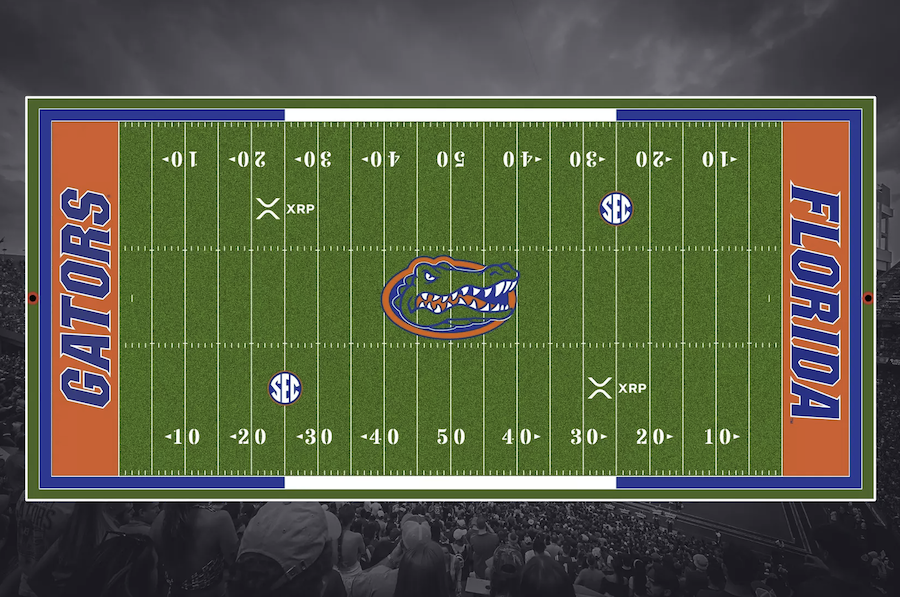
Blockchain solution group Ripple, which operates cryptocurrency token XRP, is moving further into the college football space, signing a multi-year agreement with Florida Athletics ahead of the 2026 Florida football season.
The agreement includes the XRP logo “prominently featured on the field at Ben Hill Griffin Stadium.”

The move comes after an early July announcement that XRP would be the official cryptocurrency and game jersey patch partner of Kansas Athletics, also under a multi-year partnership.
Speaking of the new alliance, University of Florida Director of Athletics Scott Stricklin noted, “Florida has a long history of embracing innovation and technology to enhance the experience of our fans and advance our programs.
“Ripple has established itself as an innovative leader in financial technology, and we’re excited to welcome XRP to Gator Nation. This partnership brings together two organizations that think boldly about the future, and we look forward to introducing XRP to our fans,” noted Stricklin.

The partnership encompasses branding at the stadium, digital properties and event signage, with Ripple also to support “financial and technology education for Florida student-athletes and the campus community, covering both traditional finance and digital assets.”
In January of this year, the National Collegiate Athletic Association, which regulates student athletics among 1,100 schools in the US and 1 in Canada, approved a proposal allowing Division 1 sports programs “to place additional commercial logos or patches on uniforms, equipment and apparel for any non-NCAA championship competition.”
This has expanded the sponsorship possibilities for the widely watched college games, however major sports betting operators such as DraftKings, BetMGM and FanDuel have voluntarily signed on to the American Gaming Association’s Responsible Marketing Code for Sports Wagering, which bans partnerships with college sports that “promote, market or advertise sports wagering activity.”

Given that crypto and prediction market operators aren’t technically classified as sports wagering under the AGA code, such operators are still able to advertise in college sports and more such deals could be appearing throughout the season.

Dig Deeper
Related stories
 2026/08/21: Florida AG sues sweepstakes operators over alleged illegal gambling
 2025/03/06: Bally Live to rebrand as Bally Sports Live
 2025/02/05: Florida Gaming Control Commission sends out cease-and-desists to illegal online gaming operators
 2025/11/06: Florida judge dismisses lawsuit challenging Seminole Tribe’s sports betting deal
2026/08/21: Florida AG sues sweepstakes operators over alleged illegal gambling
2025/03/06: Bally Live to rebrand as Bally Sports Live
2025/02/05: Florida Gaming Control Commission sends out cease-and-desists to illegal online gaming operators
2025/11/06: Florida judge dismisses lawsuit challenging Seminole Tribe’s sports betting deal
The Backstory
College sports opens a new sponsorship lane
Ripple’s move into Florida athletics lands at a moment when college sports departments are looking for new commercial inventory and financial technology companies are seeking mainstream sports audiences without the regulatory limits that apply to sportsbook advertising. The company’s XRP branding at Ben Hill Griffin Stadium follows a broader shift in how universities can package logos, digital placements and educational programs around high-profile football assets.
The backdrop is the NCAA’s January decision to allow Division I programs to place additional commercial logos or patches on uniforms, equipment and apparel outside NCAA championship competition. That change expanded a sponsorship market already reshaped by name, image and likeness payments, conference realignment and rising media-rights pressure. For athletic departments, every visible surface now carries more potential value. For crypto companies, college football offers reach, loyalty and a chance to present digital assets as part of a technology discussion rather than a speculative trading pitch.
The opening is especially important because sports betting companies have accepted tighter boundaries around college sports marketing. DraftKings, BetMGM and FanDuel have signed on to the American Gaming Association’s Responsible Marketing Code for Sports Wagering, which bars partnerships with colleges that promote or advertise sports wagering. Crypto and prediction-market companies are not classified the same way under that code, leaving them room to strike deals that gambling brands have largely avoided.
Florida’s gambling market remains tightly controlled
The Florida deal also plays out in one of the most restrictive online gambling environments in the U.S. The state has moved repeatedly to protect its regulated market, where the Seminole Tribe’s Hard Rock Bet is the only legal online gambling platform available to Floridians. That distinction matters because any sports-adjacent commercial push in Florida is likely to be viewed against a backdrop of enforcement, compact litigation and the state’s long-running effort to define what is permitted online.
Earlier this year, the Florida Gaming Control Commission sent cease-and-desist letters to offshore bookmakers and casinos including BetUS, Bovada and MyBookie, saying they were illegally offering wagers to state residents. The agency emphasized that gambling in Florida is strictly regulated and pointed to the limited number of legal slot businesses and tribal gaming locations. That message reinforced a central policy line: sports wagering and casino gambling are not open categories in Florida, even if offshore sites or adjacent digital platforms try to reach residents.
That environment gives Ripple’s sponsorship a different complexion from a sportsbook or online casino campaign. XRP is not being positioned as a betting product, and the Florida agreement includes references to financial and technology education for athletes and the campus community. Still, the deal arrives in a state where regulators have shown little tolerance for companies that use novel formats to reach consumers with gambling-like products. The distinction between financial technology, gaming, sweepstakes and wagering has become a central regulatory question.
Sweepstakes cases sharpen the line between play and gambling
Florida’s lawsuit campaign against sweepstakes casino operators underscores why that line is so closely watched. Attorney General James Uthmeier has sued online sweepstakes casino operators over alleged illegal gambling, targeting platforms such as Stake and VGW’s Chumba Casino, LuckyLand and Global Poker. The suits challenge dual-currency models in which users buy one type of token and receive another that can be redeemed for cash, gift cards or cryptocurrency.
Those cases are not about college sponsorships, but they shape the risk environment for any digital platform mixing entertainment, money and prizes. Florida argues that if a platform looks like a casino, takes real money and pays out value, it should be treated as gambling. The suits also challenge marketing practices, including the use of celebrities and influencers to promote winnings and draw customers. That focus on consumer presentation is relevant to sports marketing because college football delivers mass audiences, strong emotional affiliation and a younger fan base.
Regulators in Kentucky, Iowa, Oklahoma, Maryland and Michigan also have moved against sweepstakes or offshore operators, showing that state-by-state enforcement is becoming more coordinated. The result is a narrowing lane for companies that depend on ambiguity. Crypto firms, by contrast, may find more opportunity if they can frame deals around payments technology, education and brand awareness rather than contests, casino games or betting outcomes.
The Seminole compact still defines Florida’s sports betting stakes
The legal foundation for Florida’s current sports betting market remains the 2021 compact between Gov. Ron DeSantis and the Seminole Tribe. The agreement permitted the tribe to accept mobile sports wagers placed statewide and added craps and roulette at Seminole casinos. It also required the state to receive at least $2.5 billion in the first five years, creating a large fiscal stake in the compact’s survival.
A challenge to that structure was recently narrowed when a Leon County judge dismissed a lawsuit challenging the Seminole Tribe’s sports betting deal, finding that the plaintiff lacked standing. The suit argued that the compact violated a 2018 constitutional amendment giving Florida voters the exclusive right to authorize casino gambling, subject to an exception for tribal lands. Although the plaintiff was given time to amend, the decision was another sign that the state’s preferred regulatory structure remains intact for now.
That structure affects sponsorship strategy. National sportsbooks can build deep relationships with professional teams in states where they are licensed, but their Florida options are constrained by both the compact and responsible marketing policies around college sports. The opening left for other categories helps explain why a crypto brand can appear in a major Southeastern Conference football venue while traditional betting brands tread more carefully around campuses.
Pro teams show where gambling partnerships still thrive
Outside college sports, gambling operators continue to expand team partnerships where regulation permits. BetMGM recently extended its partnership with the Pittsburgh Steelers through the 2029 season, remaining the team’s official sports betting, iCasino and gaming partner. The agreement includes in-stadium promotions, co-branded digital content, VIP experiences, Steelers-branded casino games and responsible gambling messaging before home games.
That contrast is instructive. A professional football franchise can connect a licensed operator to legal sports betting and online casino markets in Pennsylvania and West Virginia, with eligibility rules and wager thresholds spelled out in promotions. A university, by comparison, faces reputational, regulatory and student-protection concerns that make sportsbook branding more sensitive. Even where sports betting is legal, college administrators must account for athlete integrity, underage audiences and political scrutiny.
At the same time, the commercial pressure on schools is intensifying. Athletic departments need money for facilities, travel, staff, revenue-sharing models and NIL-related competitiveness. Corporate partners want engagement beyond static signage, and emerging technology companies want credibility with consumers who may be skeptical of crypto after years of market swings and enforcement actions. That combination makes college football attractive, even if it requires careful messaging.
Sports media and finance brands compete for fan attention
The broader sports business is also moving toward platforms that blend live content, loyalty programs and interactive features. Bally’s, for example, has been repositioning its digital sports strategy through the rebrand of Bally Live as Bally Sports Live, emphasizing live streaming, gamification, multiview options and rewards tied to fan engagement. The move came as the company faced investor pressure, including a canceled earnings call after a share-price decline, according to the report and an external account from CDC Gaming.
That shift shows how sports properties, gaming companies and technology platforms are converging around attention rather than only wagers. Fans can watch, chat, earn loyalty currency, play branded games or interact with sponsors during live events. Ripple’s college football deals fit into that same attention economy, but from the financial-technology side: the company is buying visibility in a trusted, communal setting and attaching its brand to education and innovation.
The stakes are therefore larger than a field logo. If Ripple’s Florida and Kansas partnerships are accepted by universities, fans and regulators, more crypto and prediction-market companies may pursue college inventory that sportsbooks cannot easily access. If the deals draw criticism, schools may face pressure to distinguish innovation sponsorships from products seen as speculative or gambling-adjacent. In Florida, where the state has aggressively defended its gambling boundaries, that distinction will remain central.
