PayNearMe reached $200 million revenue in 2025

PayNearMe this week announced record results for 2025, with revenue exceeding $200 million, representing 60% year-over-year growth. A news release said revenue was driven by “growing demand for effective, streamlined, and consumer-friendly payment experiences.
“2025 was a defining year for PayNearMe,” PayNearMe Founder and CEO Danny Shader said in a statement. “Organizations are increasingly embracing Payment Experience Management to improve outcomes and deliver better experiences at every payment touchpoint. Our momentum reflects our commitment to innovation on the PayXM platform and the trust our clients place in us. As we look to 2026, we’re dedicated to helping businesses transform their payment experience.”

PayNearMe’s 2025 financial performance reflects increasing market adoption of Payment Experience Management as organizations look for solutions to deliver better payment experiences and operational outcomes.
PayNearMe moves more than $50 billion annually on behalf of its clients and customers.
To support its growing market presence, PayNearMe also broadened its U.S. footprint in 2025 with the opening of a Dallas office, increasing proximity to key clients while expanding access to top talent.

In 2025, PayNearMe secured a $50 million investment from Atlantic Vantage Point through its growth fund to accelerate innovation and advance its leadership in Payment Experience Management. The funding supports continued product development, expansion across key verticals, and deeper partnerships as demand for payment experience strategies continues to grow.
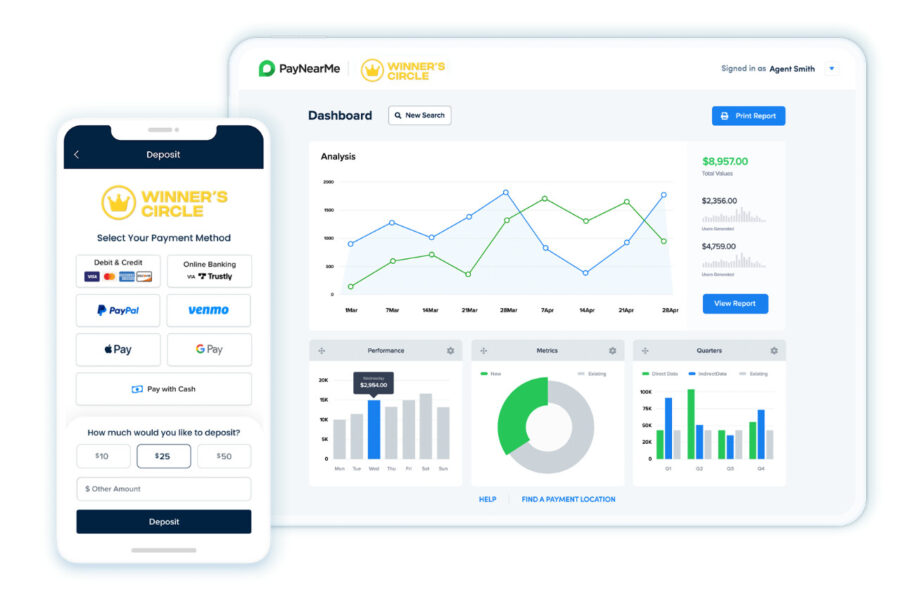
As part of its continued investment in Payment Experience Management, PayNearMe renamed its platform to PayXM, a purpose-built platform designed to improve the end-to-end payment experience. PayXM enables businesses to manage the entire payment journey across major payment types and channels through a single platform and integration.
According to the news release, client acquisition and platform adoption accelerated in 2025 as organizations across lending, tolling, credit unions, and igaming selected PayNearMe to advance payment experience strategies.
Highlights include:
- Expanded market presence across key verticals, including the addition of new clients such as Lentegrity and Alorica.
- Increased platform adoption, with the number of businesses using PayXM growing from about 16,000 in 2024 to 20,000 in 2025.
In 2025, PayNearMe also continued to strengthen the intelligence, resilience, security, and flexibility of PayXM through new capabilities, enhancements to existing features, and upcoming releases, including:
- Smart Switch Advancements: Expanded functionality to include ACH redundancy and additional bank partnerships, strengthening processing reliability, and supporting more consistent payment performance across channels.
- Agent Experience Enhancements: Launched new capabilities that improve agent efficiency and reduce clients’ cost of payment acceptance, including support for multiple future-dated payments, improved searchability, and configurable agent widgets that streamline workflows.
- Compliance & Security Investments: Continued investment in platform security and compliance, including support for PCI DSS 4.0 and SOC 2, helping clients meet evolving regulatory and risk management requirements.
- Intelligent Virtual Agent: Announced new capabilities designed to enable automated inbound payments and account interactions, while streamlining operations and delivering a more modern, convenient, and responsive consumer payment experience.
PayNearMe expanded its partner ecosystem in 2025, extending the reach of PayXM and enabling broader adoption of Payment Experience Management across the payment workflow:
- Emotive Software strengthens PayNearMe’s presence in the auto finance and personal lending market, offering lenders a more seamless way to incorporate PayXM into their enterprise resource planning platform to improve the borrower payment experience.
- Solera DealerSocket iDMS extends PayNearMe’s reach in the buy-here-pay-here market, enabling dealers to embed PayXM directly into their agent servicing workflows to streamline payments, improve borrower engagement, and accelerate cash flow.
- Constant AI enables borrowers to self-service loan changes — including due date adjustments and hardship relief — directly within PayNearMe’s PayXM platform, reducing call volume and eliminating manual intervention for lenders.
- Shaw Systems and PayNearMe deepened their partnership with a full integration into the Spectrum loan management software, extending the company’s reach in the captive auto lending market.

Dig Deeper
Related stories
 2025/05/22: PayNearMe targets payment friction to boost igaming margins
 2025/08/29: PayNearMe attacks failed payments with Payment Experience Management
 2026/01/20: ICE: Paysafe’s Zak Cutler prepares the ground for greater crypto adoption over next two years
 2025/11/20: Continent 8 promotes David Brace to executive team
2025/05/22: PayNearMe targets payment friction to boost igaming margins
2025/08/29: PayNearMe attacks failed payments with Payment Experience Management
2026/01/20: ICE: Paysafe’s Zak Cutler prepares the ground for greater crypto adoption over next two years
2025/11/20: Continent 8 promotes David Brace to executive team
The Backstory
Why this milestone lands now
PayNearMe’s breakout year arrives as the U.S. betting and trading landscape trades on speed, reliability and trust. Operators have poured money into customer acquisition only to see margins squeezed by failed deposits, fraud frictions and back-office drag. Payments have moved from plumbing to profit lever. In that context, PayNearMe’s push to package orchestration, risk controls and workflow automation into a single layer reflects where the market’s bottlenecks — and opportunities — really sit.
The shift is broader than casino or sportsbook rails. Event-driven wagering is drawing new volumes and user cohorts, and that depends on fast, low-friction movement of funds in and out. At the same time, regulators and leagues are tightening controls on riskier bet types, raising the bar for compliance and data transparency. A payments provider that can raise authorization rates while navigating rule changes and fraud spikes has leverage with both operators and regulators.
The stakes are evident across the industry’s 2025 storylines. Trading apps are testing event contracts, crypto-native prediction venues are scaling, and sports leagues are setting new boundaries on microbets. Each trend relies on payments that clear the first time, resolve chargebacks efficiently and surface auditable data when integrity questions hit. That is the backdrop to a platform bet on “payment experience management.”
In short, PayNearMe’s revenue jump reflects a demand curve that is shifting from acquisition at any cost to retention and compliance at scale. The winners are likely to be firms that turn payments from a cost center into a strategic engine.
Inside the payment bottleneck
Operators have learned that routing transactions across multiple processors is necessary but insufficient. The bigger drag is the cumulative weight of fraud screens, manual reviews, reconciliation chores and support tickets that follow a failed or delayed payout. That diagnosis tracks with the priorities outlined in an analysis of how operators are targeting payment friction to lift margins, where executives argued that every failed deposit is a lost bet and a likely churn event as detailed in our look at why payments are eroding igaming ROI. The piece also highlighted how stricter filters can alienate good customers while looser ones invite abuse.
Vendors are layering tools on top of orchestration: fraud mitigation tuned by data, automation that removes manual touches, and interfaces that speed agent resolution. Artificial intelligence is seeping in to spot patterns in failed payments, route transactions more intelligently and flag risky behavior earlier in the flow. The logic is simple: higher first-pass approval rates and cleaner back-office handoffs lower unit costs and improve lifetime value.
That thesis is playing out beyond casinos. As platforms add event contracts and real-money markets to draw engagement, the variability of transaction types, counterparties and jurisdictions expands. A unified payment layer that can adapt to new rail partners, risk models and reporting rules becomes a competitive hedge.
Prediction markets set the pace
The past year showed how quickly event-driven trading can scale. A crypto-native operator is close to sealing a large round that would value it above unicorn status, underscoring investor conviction in the format even as access in the U.S. remains limited. Reuters reported the financing would be led by Founders Fund, signaling deep-pocketed backers believe prediction venues can convert audience spikes around elections, sports and geopolitics into recurring volume as we reported on Polymarket’s planned US$200 million raise. The company bars U.S. residents and faces persistent controversy, but price-discovery markets proved sticky during 2024’s election cycle.
On the brokerage side, a mainstream trading app has already tallied about US$200 million tied to sports and event contracts, according to a sell-side note that boosted its price target. The app splits fees with a federally regulated exchange that has seen record action tied to NFL and NCAA demand, especially in September as outlined in our coverage of Robinhood’s prediction-market windfall. Two-thirds of covering analysts rate the stock a buy or strong buy, betting that regulators will allow expansion of these products.
Surging interest in granular, event-level wagers raises the throughput demands on payments: more frequent, smaller transactions, faster settlement expectations and tight integration between identity, compliance and risk. As these markets mature, platforms that can minimize friction while preserving audit trails will capture share from operators struggling with declines, reversals and customer complaints.
Integrity rules redraw the playing field
Growth is colliding with sharper integrity and enforcement lines. Major League Baseball and top U.S. sportsbooks agreed to cap individual pitch bets at US$200 and ban them from parlays after a pitch-rigging case that produced about US$450,000 in illicit winnings. The move aims to reduce manipulation risk in the most vulnerable markets and has already led leading books to update their menus as we reported on the nationwide micro-prop limits. It is a clear signal that leagues and operators will preemptively narrow offerings when data suggests exposure.
Event contracts face their own tests. Several states have sought to block sports-linked markets offered by the exchange that partners with the trading app, arguing they fall under gaming statutes. The company is fighting the rulings, setting up case law that could define the reach of federally regulated prediction products versus state oversight of sports betting as detailed in our reporting on regulatory pushback to Kalshi’s sports contracts.
Enforcement has intensified abroad, too. Indonesia’s national task force created in November has pursued more than one thousand cases tied to online gambling operations, freezing and confiscating hundreds of billions of rupiah while targeting sophisticated networks with foreign links as our coverage of Indonesia’s crackdown shows. The pattern is familiar: where markets liberalize, regulators move to police gray zones and criminal sprawl.
For payments providers, the common denominator is compliance credibility. Platforms that can embed evolving rules, deliver PCI and SOC attestations, and surface granular transaction data to integrity units will be stickier partners as operators rebalance product risk and promotional spend.
What this means for PayNearMe’s runway
As operators shift from top-line growth to unit economics, payment success rates and operational efficiency become margin drivers. The vendor’s pitch — fewer failed deposits, smarter routing redundancy, automated back-office work and embedded security — aligns with operator pain points spelled out by industry leaders in our earlier analysis of payment friction on optimizing the end-to-end payment journey. Its platform strategy also maps to the sector’s needs: consolidate fragmented tools, reduce vendor sprawl and future-proof against rule and product changes.
The upside case is that event-driven markets continue to expand, sportsbooks standardize integrity safeguards rather than retreat from micro-markets altogether, and operators prioritize retention and trust over one-off promos. In that scenario, a unified payments layer with strong compliance and analytics should see durable demand across verticals, not just gaming.
The risk case is regulatory whiplash: narrower bet menus, state-federal clashes over event contracts, and rising fraud sophistication that raises costs. International enforcement waves can also spill into cross-border payments and partner risk. Vendors will need to keep shipping resilience features — from ACH redundancy to tighter identity controls — while arming clients with data that speeds regulator and league inquiries.
Either way, the market has made clear that payments are now strategy, not back office. The companies that prove they can turn authorization, compliance and reconciliation into competitive advantages will set the pace in 2026.