


Kalshi sues Minnesota to block prediction market ban


Kalshi has sued Minnesota, challenging legislation that bans prediction markets from operating or being advertised in the state.
The bill, SF 3432, was signed by Minnesota Gov. Tim Walz this month and is scheduled to take effect on August 1. It makes it a criminal offense to operate or promote prediction market services in the state.

The legal complaint, filed by Kalshi in federal court, names Walz, Attorney General Keith Ellison, and the Director of the state’s Alcohol and Gambling Enforcement division, Jon Anglin, as defendants. Kalshi is seeking to block the enforcement of the law before it comes into effect.
The company argues that prediction markets fall under the “exclusive jurisdiction” of the Commodity Futures Trading Commission. It claims that the state law conflicts with federal jurisdiction over event contracts and, therefore, violates the Supremacy Clause of the US Constitution.
This suit follows similar efforts in other states, with Kalshi suing Arizona in March to prevent it from shutting down its operations.

Minnesota’s legislation is part of wider state-level efforts across the US to regulate or restrict prediction markets. It follows concerns raised by state officials about the potential for prediction market platforms to operate as unregulated gambling products.

Dig Deeper
Related stories
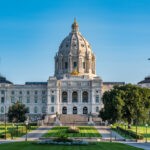 2026/04/27: Minnesota Senate to vote on prediction market ban
 2026/07/28: Prediction markets win in Minnesota, judge blocks ban days before implementation
 2026/05/27: Trump backs Commodity Futures Trading Commission and prediction markets
2026/04/21: Minnesota Lottery partners with Scientific Games for system upgrade
2026/05/27: Trump backs Commodity Futures Trading Commission and prediction markets
2026/04/21: Minnesota Lottery partners with Scientific Games for system upgrade
2026/04/27: Minnesota Senate to vote on prediction market ban
2026/07/28: Prediction markets win in Minnesota, judge blocks ban days before implementation
2026/05/27: Trump backs Commodity Futures Trading Commission and prediction markets
2026/04/21: Minnesota Lottery partners with Scientific Games for system upgrade
The Backstory
Minnesota turns a market-access fight into a federal test
Kalshi’s lawsuit against Minnesota is the latest move in a widening fight over whether prediction markets are federally regulated financial products or gambling offers that states can prohibit. The dispute has moved quickly from legislative hearings to federal court, with Minnesota now joining a group of states that have tried to restrict event-contract platforms as their products expanded into politics, sports-adjacent outcomes, weather and pop culture.
The Minnesota law, SF 3432, is scheduled to take effect Aug. 1 and would make it a criminal offense to operate or advertise prediction market services in the state. Kalshi argues the measure conflicts with the Commodity Futures Trading Commission’s authority over event contracts and is preempted by federal law. That legal theory is central to the company’s strategy: If courts accept that federally regulated prediction markets sit within the CFTC’s exclusive jurisdiction, state gambling regulators would have limited ability to block them even when the contracts resemble wagers to state officials.
The case also reflects a broader political discomfort with a fast-growing sector whose users can trade on the outcomes of public events. State lawmakers have framed the issue as consumer protection and gambling enforcement. Kalshi and similar platforms frame it as access to federally supervised derivatives markets. The legal result could determine whether prediction markets scale nationally under one federal regime or face a patchwork of state bans and enforcement actions.
How the Minnesota ban gained momentum
Minnesota’s legislative push began with concerns that existing state gambling laws did not clearly cover prediction platforms. In committee, backers argued that products offered by Kalshi and Polymarket had moved faster than state law and could allow people with nonpublic information to profit from elections or other future events. That concern helped move the bill through the Senate State and Local Government Committee, as lawmakers sought to close what they viewed as a regulatory gap. The early committee action is detailed in Complete iGaming’s report on how the Minnesota Senate advanced a prediction market ban.
The issue became more politically charged after Kalshi said its investigation team had identified three U.S. political candidates who placed bets on their own races, conduct the platform says violates its rules. One was Minnesota Sen. Matt Klein, who acknowledged placing a $50 wager on his congressional primary race and later agreed to a settlement that included a five-year platform ban. The episode gave supporters of the ban a concrete example for their argument that prediction markets create conflicts of interest and insider-risk problems that conventional gambling law was designed to prevent.
By the time the bill approached the Senate floor, lawmakers were no longer debating an abstract financial product. They were debating whether political candidates, campaign staff and other insiders could exploit information advantages in markets tied to elections, court cases or policy outcomes. Complete iGaming’s earlier coverage of the Minnesota Senate vote on the prediction market ban showed how those concerns converged with broader skepticism about Kalshi’s claim that it could operate nationwide outside state gambling systems.
A clash with Minnesota’s broader betting debate
The prediction-market fight is unfolding as Minnesota continues to debate whether and how to legalize online sports betting. That context matters because lawmakers are simultaneously considering a tightly controlled sports wagering model while trying to stop prediction platforms from offering products they believe function like unlicensed betting. The contrast strengthens the state’s argument that market access should be conditioned on local licensing, consumer safeguards and tax rules.
One Minnesota proposal, Senate Bill 3414, would legalize mobile sports betting and daily fantasy contests while placing operations largely in the hands of federally recognized tribes. It would impose a 22% net sports betting revenue tax and include responsible gambling rules, including a distinctive ban on push notifications that could lure inactive users back to betting apps. Complete iGaming’s report on the Minnesota betting bill’s push notification ban underscored how carefully lawmakers have been trying to design a regulated wagering framework.
That regulated framework is part of the stakes in the Kalshi case. If prediction markets can offer event contracts involving sports, politics or entertainment without state licenses, state lawmakers may see them as bypassing the policy compromises embedded in sports betting bills. Those compromises include tribal compacts, tax allocations, advertising rules, age restrictions and responsible gambling requirements. For Minnesota, the prediction-market ban is not only about one company. It is about preserving state control over the boundary between financial markets and gambling.
Kalshi’s state-by-state litigation playbook
Kalshi’s Minnesota suit follows a similar challenge in Arizona, where the company sued regulators after the Arizona Department of Gaming warned that its products violated state law. Arizona officials said only licensed operators may accept sports wagers and pointed to state prohibitions on bets involving uncertain future events. Kalshi responded that its contracts are derivatives, not gambling, and that federal regulation displaces state enforcement. Complete iGaming’s coverage of the Kalshi lawsuit against Arizona regulators outlined the core preemption argument now resurfacing in Minnesota.
The company’s approach has produced mixed results nationally. Kalshi has obtained temporary injunctions in some states, including Tennessee and New Jersey, while courts elsewhere have allowed regulators to keep pursuing related actions. That uneven record means each new case is important beyond its own state borders. A favorable ruling in Minnesota could help Kalshi build momentum and reassure market participants that state bans are vulnerable. An adverse ruling could encourage other legislatures and attorneys general to move more aggressively.
Kalshi’s position depends heavily on the idea that federal designation as a contract market changes the legal analysis. State regulators, by contrast, argue that an event contract can be both financially structured and gambling-like in practical effect, especially when users are staking money on elections, sports outcomes or other public events. Courts must decide whether form, regulatory status or consumer use controls the classification.
The CFTC steps into the state enforcement fight
The broader landscape shifted further when the CFTC began suing states directly over prediction-market restrictions. In Wisconsin, the agency filed a federal action after the state brought civil suits against Kalshi, Polymarket, Crypto.com, Robinhood and Coinbase, alleging felony violations of gambling laws. The CFTC argued that Congress assigned it exclusive authority over derivatives traded on designated contract markets, including event contracts, and asked a court to block Wisconsin enforcement. Complete iGaming’s report on the CFTC lawsuit against Wisconsin over prediction markets showed that the federal regulator is no longer a bystander in the jurisdictional fight.
That intervention raises the stakes for Minnesota. Kalshi can point to the CFTC’s position as support for its claim that state bans interfere with federal law. States can counter that federal oversight of exchanges does not automatically authorize products that local gambling law would otherwise prohibit, particularly when contracts touch elections or other sensitive public events. The dispute is therefore not only between Kalshi and Minnesota. It is part of a broader contest between federal market regulation and state police powers.
The CFTC’s involvement also complicates the politics. State officials who see prediction markets as unlicensed gambling are now confronting not just private platforms but the federal agency charged with supervising derivatives markets. If courts broadly endorse the CFTC’s view, states may need to seek changes from Congress rather than rely on gambling enforcement. If courts side with states, federally regulated platforms could face a fragmented compliance map that limits national product launches.
Why the Minnesota case matters
Minnesota’s law is blunt: It seeks to prohibit operation and promotion of prediction markets before they become entrenched. Kalshi’s response is equally direct: It is asking a federal court to stop the state before criminal penalties can take effect. That timing matters because the case may produce early guidance on whether states can preemptively bar federally regulated event-contract platforms or must defer to the CFTC.
The outcome will influence more than Minnesota users. A ruling could affect how platforms design contracts, market products and assess state-by-state risk. It could also shape how lawmakers draft future gambling and sports betting legislation, especially in states that have not yet legalized online sports wagering or that give tribes and licensed operators exclusive access to digital betting markets.
For prediction markets, the central question remains unresolved: Are these contracts a tool for price discovery and risk transfer, or are they wagers dressed in financial-market language? Minnesota’s lawsuit will not settle the national debate alone. But it is now one of the clearest tests of whether state legislatures can draw that line for themselves.
