


FC Bayern enters multi-year partnership with Asian igaming group Mega Casino World

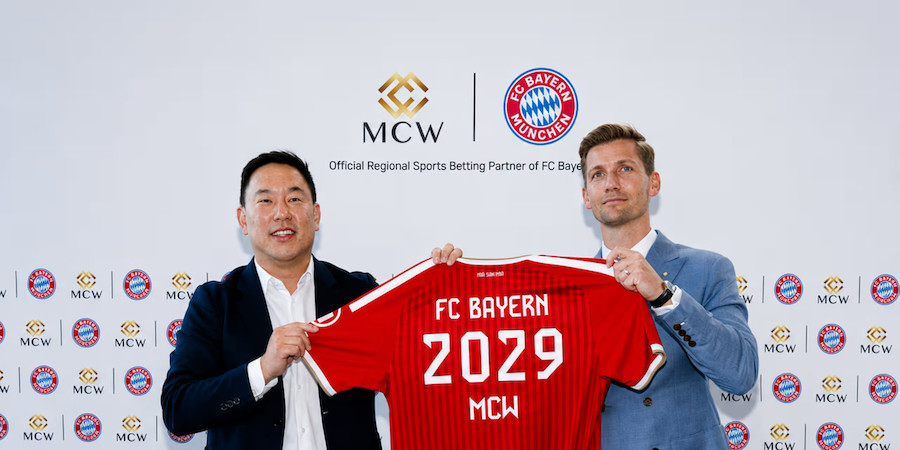
German football team FC Bayern Munich has entered into a three-year deal with Asian igaming group Mega Casino World (MCW), becoming its Official Regional Partner across multiple regulated markets in Asia.
Under the partnership, MCW will propel Bayern to its Asian fans across South, Southeast, Central and East Asia. According to Bayern, the partnership allows the club to grow closer to its Asian fanbase while also expanding its presence in the region.

The deal is expected to start at the beginning of the new Bundesliga season, which begins on 28 August with FC Bayern taking on VfB Stuttgart, and will span three years. MCW and Bayern will establish an extended commercial framework as part of the agreement, which Bayern says will include promotions and football-related communications.
“Asia is an important market for the club. For this reason, we are very happy to start and develop this regional partnership,” commented Rouven Kasper, Chief Marketing and Sales Officer, and Member of the Executive Board at FC Bayern.
“Mega Casino World has a strong portfolio and a significant following throughout Asia. We are optimistic that this cooperation will broaden our reach in the Asian market. The three-year commitment with Mega Casino World will lift our commercial presence throughout Asia,” he furthered.

This isn’t the first time MCW has entered a football-related partnership. In 2023, it entered into an agreement with the Bundesliga. In 2025, that partnership was renewed, with MCW remaining the league’s exclusive partner in Asian markets until the ‘26-27 season.
As Bayern announces a new gambling sponsor, there is wider global scrutiny over gambling brands partnering with sports teams. In the UK, the Premier League agreed to withdraw all gambling sponsors from matchday shirts in the aim of reducing gambling-related harm.
Likewise, during the World Cup, controversy arose over alleged betting irregularities in certain matches and over Folarin Balogun’s one-game suspension. At the same time, a report from Gaming Compliance International found that 95% of illegal streams during the tournament carried advertising for unregulated gambling.
Charlotte Capewell brings her passion for storytelling and expertise in writing, researching, and the gambling industry to every article she writes. Her specialties include the US gambling industry, regulator legislation, igaming, and more.

Dig Deeper
Related stories


The Backstory
Asia has become football’s most contested commercial frontier
FC Bayern Munich’s three-year regional partnership with Mega Casino World fits a broader shift in how European clubs, gaming operators and sports technology companies are pursuing growth in Asia. The region has long been valuable for audience development, merchandising and preseason tours. It is now also central to the commercial strategies of online gaming brands seeking legitimacy, visibility and lower-cost access to football audiences across multiple jurisdictions.
The Bayern deal gives MCW a club-level platform across South, Southeast, Central and East Asia, building on its existing Bundesliga relationship. That structure matters. Rather than relying only on league inventory, MCW now gains access to one of Europe’s most recognizable football brands, while Bayern deepens its ability to engage fans in markets where match times, digital consumption and mobile betting habits have made football a high-value entertainment product.
The timing also reflects a crowded field. European clubs are increasingly treating Asia not only as a fanbase but as a market where sports, media, casino-style content and wagering converge. AC Milan recently took a similar route through its regional online casino partnership with SureWin, aimed at supporters in Asia after the club’s preseason appearances in Singapore and Hong Kong. The pattern is clear: clubs are pairing live fan engagement with digital campaigns, using gaming partners to extend commercial reach between tours, fixtures and major tournaments.
Club partnerships are following gaming capital
The commercial logic behind these deals is reinforced by the expansion of regulated and semi-regulated gaming hubs in the region. The Philippines, in particular, has emerged as a key licensing and operating base for online gaming companies targeting Asian players. SureWin, AC Milan’s partner, obtained a license from Philippine regulator PAGCOR in 2017 and entered the Asian market in 2023. Its club deal underlines how operators with regional ambitions are using elite football relationships to build trust and brand recognition.
That backdrop helps explain why Bayern’s agreement with MCW is positioned across “regulated markets” in Asia rather than as a single-country sponsorship. Asian gaming is fragmented by law, language, payments, enforcement and consumer behavior. A regional club partnership can provide flexible marketing rights that operators adapt market by market, from localized digital content to promotional campaigns aligned with fixtures or fan events.
Other suppliers are making parallel moves into the region’s betting and gaming ecosystem. Australian racing data and technology company Racing and Sports appointed Ronnie Tay as Head of Asia as it expands operations and partnerships across the continent. The company’s move, described in its Asia leadership appointment, followed its establishment of Hong Kong operations and the onboarding of racing publications and a data service. That expansion is not football-specific, but it reflects the same underlying trend: companies see Asia as a growth market for wagering infrastructure, media products and digital engagement.
For clubs, gaming operators and data providers, the opportunity is linked. More sophisticated regional betting markets create demand for stronger brands, better content and more reliable customer acquisition channels. Football clubs bring emotional affinity and global credibility. Operators bring sponsorship money and digital activation. Technology suppliers support the systems that keep users engaged and transacting.
Engagement tools are reshaping sponsorship value
The Bayern-MCW agreement is likely to be judged not only by visibility but by how effectively it turns fan attention into measurable digital engagement. That is where the wider igaming industry has been moving. Operators are under pressure to reduce acquisition costs, retain existing users and build campaign mechanics that can be repeated across seasons, tournaments and jurisdictions.
International Game Technology’s PlayDigital unit has been developing that model through its Mega Vault product, which combines prize drops, leaderboards and marketing jackpots into a single promotional hub. The company said in May that Mega Vault was designed to centralize player engagement campaigns for operators such as Fanatics Casino, FanDuel Casino and Rush Street Interactive. The product is not tied to football sponsorship, but it shows how gaming companies are investing in repeatable promotional formats that keep players active over time.
That matters for sports partnerships. A club logo or regional designation is no longer enough to justify a multi-year agreement. Operators want campaigns tied to matchdays, tournament windows, loyalty mechanics and localized digital content. The strongest sponsorships are likely to be those that combine rights to a football brand with technology capable of turning attention into retention.
IGT’s later update on the product points to the direction of travel. In an interview around G2E, IGT PlayDigital executive Andrew Bonnici said the company planned a larger version of Mega Vault with a pooled prize pot across operators and jurisdictions. The planned Mega Vault upgrades suggest operators are asking for bigger campaigns, broader liquidity and more interactive mechanics. Those same demands are likely to influence football-linked gaming promotions in Asia, where operators must compete for users across sports betting, casino games, streaming content and social media.
Major tournaments are intensifying the race for attention
Football’s global calendar is another reason gaming companies are moving now. The 2026 World Cup, scheduled to begin June 11, is expected to bring a surge of casual and experienced bettors into football-related products. Gaming suppliers are preparing accordingly. Playradar, Sportradar’s online gaming brand, released four football-themed titles for the tournament, including a bracket-style game, a virtual football product, a plinko format and a football-themed bingo spin-off.
The launch, detailed in Playradar’s World Cup gaming rollout, shows how operators are broadening football beyond match betting. Tournament-themed casino and instant-win products can keep users engaged during downtime between games, especially in markets where mobile-first play dominates. For rights holders such as Bayern, that environment raises the value of partnerships with operators that can activate football interest year-round, not only during live matches.
Bayern’s deal begins with the new Bundesliga season, but its three-year term will cover major international football cycles and club competitions. That gives MCW time to integrate Bayern-themed messaging into broader football campaigns while benefiting from the club’s continuing success, player visibility and Asian fan networks. It also gives Bayern a longer runway to test how a gambling partner can support regional commercial objectives without displacing other sponsors.
The strategic risk is that tournament-driven gambling activity can attract heightened scrutiny. Football’s biggest moments draw regulators, integrity monitors and public-health advocates alongside fans and sponsors. The more operators use football to acquire or retain customers, the more clubs may be expected to show that partnerships are confined to permitted markets and responsible marketing standards.
Scrutiny is now part of the commercial equation
Bayern’s agreement arrives as gambling sponsorship in football faces tougher political and reputational tests. The Premier League has agreed to withdraw gambling sponsors from the front of matchday shirts, a compromise aimed at reducing harm while preserving other forms of betting sponsorship. That decision has not stopped clubs from pursuing regional or sleeve-level deals, but it has changed the tone of the market. Sponsors and clubs increasingly have to explain geography, licensing and safeguards.
For Asian-facing partnerships, the challenge is even more complex. The region includes mature regulated environments, tightly restricted markets and jurisdictions where offshore operators compete for users despite enforcement uncertainty. Clubs seeking regional income must balance commercial growth with the risk that their brands appear in contexts regulators or fans view as problematic.
There is also the issue of illegal streaming and unregulated advertising. A report cited in the current article found that 95% of illegal streams during a tournament carried advertising for unregulated gambling. That matters because football clubs sell official partnerships partly to create controlled, legitimate channels for brand association. But fans may encounter gambling advertising through a mix of authorized sponsorships, social platforms, affiliate sites and piracy. The boundary between regulated activation and the wider gray market can be difficult for consumers to see.
The causality behind Bayern’s move is therefore two-sided. Asia’s expanding gaming economy creates demand for elite football partnerships, and football clubs need regional sponsors to monetize global audiences. At the same time, the growth of gambling-linked football marketing invites closer scrutiny from regulators and campaigners. Bayern and MCW are entering a market where scale is attractive but compliance, messaging and public perception will shape the long-term value of the deal.
The stakes go beyond one sponsorship
The Bayern-MCW partnership is part of a larger reordering of sports commerce in Asia. Clubs are no longer relying only on broadcast reach and shirt sales. Operators are no longer relying only on betting markets. Data companies, gaming suppliers and football brands are building connected ecosystems designed to keep fans engaged before, during and after matches.
That ecosystem can generate significant revenue. It can also test the limits of responsible marketing, especially when club loyalty is used to promote gambling products across diverse regulatory environments. For Bayern, the upside is a deeper commercial position in Asia and a partner already tied to the Bundesliga. For MCW, the prize is credibility and visibility through one of football’s strongest global brands.
The broader lesson from recent industry moves is that Asia has become a proving ground for sports-gaming partnerships. AC Milan’s SureWin deal, Racing and Sports’ regional expansion, IGT’s engagement tools and Playradar’s World Cup products all point in the same direction: football audiences are being integrated into wider digital gaming strategies. Bayern’s agreement is not an isolated sponsorship. It is another signal that the commercial center of gravity for football-linked igaming is moving decisively toward Asia.
