


Enteractive appoints former William Hill exec Stephen Parry as Group CEO

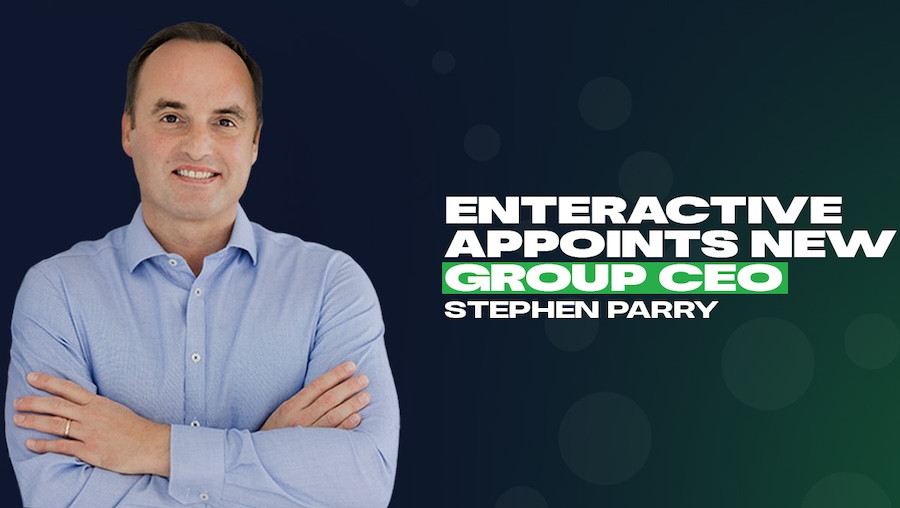
Player reactivation group Enteractive has appointed Stephen Parry as its new Group CEO, effective 1 October, according to a company release.
Parry replaces co-founder Mikael Hansson, who had led the Malta-based company since 2008. Hansson has moved to Executive Chairman of the board.

Parry previously held senior roles at Flutter Entertainment, William Hill, Superbet, FDJ/Kindred and Vodafone, having also led William Hill’s international business.
The group provides player activation and reactivation services for online gambling operators, contacting inactive and non-depositing players through one-to-one conversations. Enteractive indicates that it employs about 250 staff and works with more than 100 brands in 50 markets.
The group said its priorities include international expansion, deeper operator partnerships and further development of its technology, including AI tools, with co-founder Hansson indicating that Parry will lead the company’s push into “new markets, products and technologies.”

Speaking of the new role, Parry noted that he will use his industry relationships to help more operators improve player retention.
In the US, Enteractive operates an office in Fort Lauderdale, Florida, and holds licensing agreements in several states, including New Jersey. It signed a partnership with BetMGM in 2025.
The company also lists Latin America, Asia and Australia among its markets, which it serves from its offices in Malta and Bucharest.

Dig Deeper
Related stories




The Backstory
Retention moves up the agenda
Enteractive’s appointment of Stephen Parry as group CEO comes at a time when online gambling companies are paying closer attention to the economics of keeping players, not just acquiring them. In regulated markets, rising media costs, heavier compliance requirements and intense competition have made customer lifetime value a central measure of performance. That has elevated companies that can help operators convert registered users, reactivate dormant accounts and manage player contact in a more targeted way.
Enteractive has operated in that niche since 2008, building its business around direct, one-to-one conversations with players who have either stopped engaging or signed up without depositing. The Malta-based company says it works with more than 100 brands across 50 markets, supported by offices in Malta, Bucharest and Fort Lauderdale, Florida. Its pitch is that human-led outreach can reach player segments that automated customer relationship management systems often miss.
The leadership change also reflects a wider pattern across the gambling supply chain: founder-led companies are bringing in executives with broader international operating experience as they prepare for the next phase of expansion. Parry’s background at Flutter Entertainment, William Hill, Superbet, FDJ/Kindred and Vodafone gives Enteractive a CEO with experience across major operators, regulated markets and consumer-facing digital businesses. Co-founder Mikael Hansson’s move to executive chairman preserves continuity while shifting day-to-day leadership to an executive brought in to scale the business.
BetMGM gave Enteractive a higher-profile U.S. foothold
The clearest recent marker of Enteractive’s growth ambitions came through its U.S. work with BetMGM. The operator partnered with Enteractive to support player conversion and reactivation, using the supplier’s one-to-one engagement model to reach users who had registered but not deposited in U.S. markets.
That deal mattered because the U.S. remains one of the most expensive and competitive online gambling markets in the world. Operators have spent heavily to acquire customers as states opened to sports betting and online casino, but the industry has increasingly shifted from land-grab mode to profitability. Reactivating an existing registered user can be less costly than acquiring a new one, especially in states where promotional intensity and advertising costs have pressured margins.
BetMGM’s rationale was consistent with that shift. Traditional CRM systems can segment databases, automate offers and send mass communications, but they do not always convert hesitant, inactive or lapsed customers. Enteractive’s model sits in that gap, using direct contact to understand why a player did not deposit or why an account went dormant. For large operators, the commercial stakes are clear: even marginal improvements in reactivation can affect lifetime value, marketing efficiency and revenue stability.
The partnership also helped validate Enteractive’s U.S. strategy. The company already has a Fort Lauderdale office and licensing arrangements in several states, including New Jersey. Working with BetMGM gave it a marquee client in a market where supplier credibility is often built slowly through licensing, compliance performance and measurable operational results.
Expansion now depends on local execution
Enteractive’s plans for international expansion sit within a broader industry move into markets that are either newly regulated or moving from gray-market activity toward formal oversight. The challenge is that these markets rarely behave like mature European jurisdictions. Products, marketing assumptions and engagement models often need to be rebuilt around local player behavior, language, regulation and payment habits.
That dynamic was evident in Inside Asian Gaming’s interview with Light & Wonder executive Magdalena Podhorska-Okolow, who described the company’s approach to emerging markets as a “fail fast” strategy. Light & Wonder’s work in the Philippines showed how quickly assumptions can break down. The supplier initially expected land-based casino brands to resonate strongly online, but found that many digital players were in remote areas and had little relationship with casino-floor content. The company adjusted its approach after learning that the online and land-based player bases were more distinct than expected.
The same lesson applies to retention and reactivation. Contact strategies that work in one jurisdiction may not translate neatly into another. A dormant player in New Jersey, Brazil, the Philippines or Australia may have different reasons for disengaging, from product familiarity and trust to payment friction, affordability concerns or competing entertainment options. As Enteractive pursues growth in Latin America, Asia, Australia and other markets, its ability to localize conversations while staying within regulatory boundaries will be central to its value proposition.
Light & Wonder’s experience also underscored the importance of local expertise in Brazil, where global operators and local brands created a more complex market structure than many suppliers expected. For companies such as Enteractive, that means expansion is not just a matter of adding languages or signing operators. It requires understanding which brands control player relationships, how regulators view outbound engagement and where reactivation crosses into sensitive responsible gambling territory.
A leadership reshuffle trend across igaming
Parry’s appointment is part of a broader executive reset across the sector as companies prepare for a more disciplined growth cycle. Nasdaq-listed Gambling.com Group recently appointed co-founder Kevin McCrystle as chief executive, with fellow co-founder Charles Gillespie moving to executive chairman. That transition was framed around a new phase involving sports data services, diversification of the marketing business and the impact of AI on operations.
The parallels are notable. Both Gambling.com Group and Enteractive are founder-built businesses moving into a stage where operational execution, technology investment and international expansion carry greater weight. In each case, a founder shifted to the chairman role while a new or newly elevated CEO took responsibility for scaling the company. The structure allows institutional knowledge to remain in the boardroom while giving management clearer authority to pursue growth.
Other suppliers are also strengthening commercial leadership. Relax Gaming named Antonia Svensson chief commercial officer, putting a former Light & Wonder Malta general manager in charge of partnership development and revenue growth. That appointment, like Enteractive’s, reflects a market in which supplier differentiation increasingly depends on commercial relationships, regulatory awareness and the ability to support operators across multiple jurisdictions.
These moves point to a maturing igaming services sector. Companies that once grew through product specialization now need executives who can manage licensing complexity, operator procurement cycles, responsible gambling expectations and regional expansion without diluting their core proposition.
Technology and AI raise the stakes
Enteractive has identified technology development, including AI tools, as one of its priorities under Parry. That focus mirrors a wider industry push to use data and automation to improve decision-making, personalize engagement and reduce inefficient marketing spend. But for a business built around direct player contact, the balance between AI and human interaction will be especially important.
AI can help identify which players are most likely to return, when to contact them and what barriers may have caused inactivity. It can also support compliance controls by flagging risk indicators and ensuring outreach is appropriate. But the company’s core claim is that one-to-one conversations can succeed where automated CRM fails. The strategic question is therefore not whether Enteractive automates more of its workflow, but how it uses technology to make human engagement more precise, compliant and scalable.
The industry’s interest in data-led models is also visible outside traditional casino and sportsbook operations. Moon Intelligence recently strengthened its leadership team as it targets U.S. prediction markets, adding executives with trading, technology and exchange experience. While prediction markets are distinct from Enteractive’s reactivation business, both developments reflect demand for specialized service providers that can help operators or platforms improve liquidity, engagement or customer value in fast-changing markets.
For Enteractive, Parry inherits a company with established operator relationships, a growing U.S. profile and a service model aligned with operators’ margin priorities. The opportunity is to turn those assets into broader international scale. The risk is that expansion into new markets, products and technologies brings greater regulatory scrutiny and execution complexity. His appointment signals that Enteractive wants to compete not only as a reactivation vendor, but as a strategic retention partner for operators under pressure to make every acquired player count.
