Dubai-based airline Emirates launches crypto payment for UAE customers

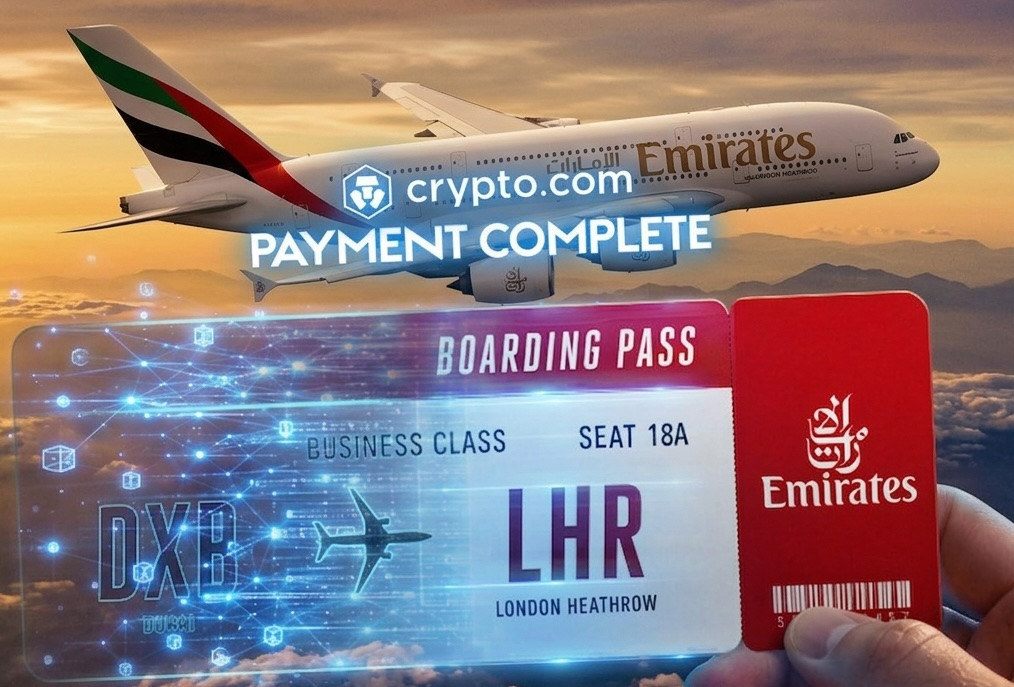
UAE-based airline Emirates has announced a partnership with Crypto.com that will allow for UAE residents with an account on the site to pay for their flights in crypto via the airline’s website and app platforms.
The option is available for bookings priced and settled in Emirati Dirham.

“Bringing this initiative to life delivers on our commitment to expanding customer choice in how they pay for travel,” said Adnan Kazim, Emirates’ Deputy President and Chief Commercial Officer.
“It also reflects the rapidly evolving preferences of a younger, digitally fluent generation who manage their money and plan their journeys primarily from their phones and they expect the airlines they fly with to keep pace. Moving from signature to launch with Crypto.com in under a year is a credit to both teams and to a regulatory environment that makes this kind of innovation possible, reflecting the UAE’s and Dubai’s ambition to lead in fintech and the digital economy,” noted the executive.
Emirates said the integration is backed by Crypto.com’s Dubai entity which was the first Virtual Asset Service Provider (VASP) to be granted a Stored Value Facilities (SVF) licence by the Central Bank of the UAE and operates within the scope of the SVF framework.

The group explained that customers will now see Crypto.com Pay appear as a payment option at checkout on emirates.com and the Emirates App.
According to Emirates, the launch supports the Dubai Cashless Strategy under the emirate’s D33 Economic Agenda, which aims to make 90% of all financial transactions across government and private sectors digital by the end of 2026.
The UAE has been cautiously expanding its gaming industry, granting multiple supplier licenses for igaming while limiting its online casino, sportsbook and lottery options to just one operator – all under the Momentum Group – ahead of the launch of the jurisdiction’s first land-based casino, Wynn Al Marjan Island, next year.

This tech-forward approach is unique within the region and demonstrates the strong regulatory capacity it is building, bringing onboard industry veterans to ensure it can not only ensure regulation but also adapt to an increasingly digital world.

Dig Deeper
Related stories



The Backstory
Dubai’s payments push meets a tightly managed gaming opening
Emirates’ move to accept cryptocurrency payments from UAE customers sits at the intersection of two policy tracks the country has been advancing in parallel: digitizing commerce and building a federally supervised commercial gaming market. The airline’s partnership with Crypto.com adds a high-profile consumer use case to the UAE’s digital-payments agenda, while also underscoring how regulators have been willing to permit new products in sensitive sectors when they are routed through licensed entities.
That approach has become increasingly visible in gaming. Since creating the General Commercial Gaming Regulatory Authority in 2023, the UAE has moved from a market with no formal commercial casino framework to one preparing for lottery, internet gaming, sports wagering and land-based casinos under federal oversight. The authority’s remit is broad, but the early pattern has been selective licensing rather than an open market. That makes the Emirates crypto-payment launch notable beyond aviation: It reflects the same policy preference for controlled innovation, regulated intermediaries and rapid digital adoption.
The UAE’s Dubai Cashless Strategy, tied to the D33 Economic Agenda, aims to make 90% of government and private-sector transactions digital by the end of 2026. For airlines, retailers and financial technology companies, that creates pressure to broaden payment options. For gaming, it raises a more complex question: how far digital transactions can extend into lotteries, casino-style games and sports betting in a region where gambling has historically been restricted.
A federal regulator changes the market’s direction
The General Commercial Gaming Regulatory Authority was established in September 2023 to oversee commercial gaming and apply standards covering integrity, transparency, innovation and responsible practices. Its creation signaled that any opening would be run at the federal level rather than through fragmented emirate-by-emirate experimentation.
One of the clearest early signs of that framework came when Scientific Games was licensed as a UAE lottery vendor. The company said the authorization allowed it to supply lottery products and services in the country, bringing experience from 150 lotteries across 50 countries. The licensing of a major global supplier showed that the UAE was not merely drafting rules but beginning to assemble the infrastructure needed for a regulated lottery market.
The regulator’s scope also made clear that lottery would not be the only category under review. Commercial gaming activities in the UAE include lottery, internet gaming, sports wagering and land-based gaming facilities. That breadth matters because it places very different products under one supervisory umbrella: retail and digital lottery games, online casino platforms, sports betting and physical casino resorts. For policymakers, the challenge is to encourage investment without allowing a lightly controlled market to emerge ahead of formal safeguards.
That tension is visible in the sequence of launches. Vendors have received licenses, a national lottery has gone live and online gambling platforms have appeared, but public detail on the full legal architecture has remained limited. The result is a market that appears to be moving quickly while still keeping access concentrated among a small group of approved participants.
Momentum emerges as the central online operator
Momentum has become the key name in the UAE’s early gaming rollout. The Abu Dhabi-based company operates the UAE Lottery through its subsidiary The Game, which received the country’s lottery license. Its position expanded further when Momentum launched the TrueWin and Dream Island online gambling platforms, offering casino and sportsbook services.
Those platforms marked a significant development because they suggested that the UAE’s digital gaming market was not limited to lottery draws or scratch-style products. TrueWin and Dream Island reportedly offered live dealer tables, poker, roulette, slots and betting on sports including football, tennis, cricket and basketball. Their emergence also raised questions because they were live despite the absence of a widely publicized law formally legalizing online gambling in the Emirates.
The timing added to the intrigue. TrueWin’s domain was registered in March 2023, before the gaming regulator was officially established, while Dream Island’s domain dated to 2020. Momentum had also been linked to recruitment for an online casino and sportsbook brand months before the platforms became public. Taken together, those details point to a market in which planning by selected operators preceded the full public unveiling of the regulatory regime.
The stakes are large. Analysts at Bloomberg Intelligence have estimated that gaming revenue in the UAE could eventually reach about $6.6 billion, equal to 1.3% of gross domestic product and potentially larger than Singapore’s established casino market. That kind of forecast helps explain why the government has been willing to build a new regulatory system from the ground up, even while maintaining tight control over licensing.
Lottery products test digital demand
The UAE Lottery has provided the most visible consumer-facing test of regulated gaming demand. Its launch in November 2025 gave the country a sanctioned national lottery under the authority’s oversight, with digital games central to the proposition. The subsequent release of the UAE Lottery’s Quick 5 online game showed how quickly the market could move from traditional draw formats to faster, mobile-friendly products.
Quick 5 offers draws every two minutes, with players choosing numbers and bet types for prizes of up to 550 times the stake. Tickets start at 2 dirhams, or about 54 cents, making the game accessible while also raising the importance of controls around frequency, affordability and player behavior. Fast-draw games can generate sustained engagement, but they also require careful monitoring because the time between staking and outcome is short.
This is where the UAE’s broader digital economy agenda intersects directly with responsible gambling policy. A cashless, app-based environment can make transactions faster and more convenient. It can also generate detailed data on spending, deposits and play patterns. International operators have increasingly used that data to build responsible gambling tools, and the UAE’s regulator is likely to face similar expectations as online gaming grows.
In the United States, for example, FanDuel said half of its customers used a responsible gambling dashboard during the 2024-25 NFL season. The dashboard gave users insight into spending, deposit and wagering activity, and its adoption suggested that digital tools can become part of mainstream betting behavior when they are placed directly in the customer experience. For the UAE, where gaming is new and politically sensitive, comparable safeguards may be central to maintaining public and regulatory confidence.
Wynn anchors the land-based opportunity
The online rollout is unfolding alongside the UAE’s most prominent land-based gaming project: Wynn Al Marjan Island in Ras Al Khaimah. Wynn Resorts is building the resort as the country’s first major casino development, making it a centerpiece of the UAE’s effort to attract international gaming investment. The project gives the regulatory framework a tangible anchor and signals that the country’s ambitions extend beyond lottery and digital betting.
Wynn’s progress has drawn global attention, including a Bloomberg report on the company receiving a gaming license as it builds the Ras Al Khaimah resort at Wynn’s UAE casino project. A destination resort model gives the UAE a way to position gaming within tourism, hospitality and luxury entertainment, rather than as a stand-alone gambling market.
That distinction is important for the Emirates brand. Dubai and Abu Dhabi have spent decades building reputations as global aviation, finance, tourism and technology hubs. Ras Al Khaimah’s casino project adds a new vertical, but one that must be reconciled with regional norms and the country’s broader image. A federally supervised framework allows authorities to present gaming as controlled, taxable and aligned with economic development rather than informal or unregulated.
For Emirates, accepting crypto payments is not a gaming product, but it belongs to the same modernization narrative. The airline’s integration with a licensed virtual asset provider shows how major UAE companies are being encouraged to adopt new financial infrastructure under regulatory supervision. In gaming, that infrastructure could eventually shape how players fund accounts, how operators monitor behavior and how regulators track compliance.
The strategic bet is controlled innovation
The through line across aviation payments, lotteries, online betting and casino resorts is not deregulation. It is managed expansion. The UAE has shown willingness to enter sectors that many regional peers avoid, but it has done so through licensed entities, federal oversight and a small number of approved operators and suppliers.
That model creates advantages. It can help prevent a fragmented gray market, attract experienced international companies and give regulators visibility into transactions and customer activity. It also creates risks. Concentrated licensing can limit competition, while rapid product launches may outpace public understanding of the rules. The lack of extensive public detail around online gambling legalization has already made transparency a recurring issue.
Emirates’ crypto-payment launch therefore lands in a market where digital finance is no longer an abstract policy goal. It is becoming embedded in consumer services, including sectors that require heightened oversight. The UAE’s next challenge will be proving that its regulatory capacity can keep pace with the technology it is enabling and the gaming economy it is beginning to build.