


Trump backs Commodity Futures Trading Commission and prediction markets

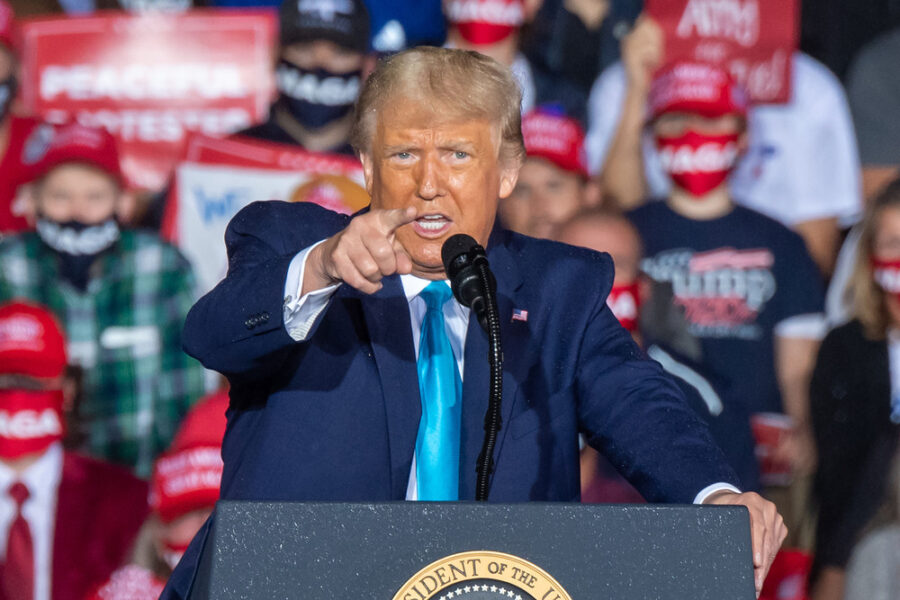
President Donald Trump has publicly backed prediction market platforms amid legal and regulatory challenges from several US states.
In a post made to his social media platform, Truth Social, Trump said it was important that prediction market companies remain under the oversight of the Commodity Futures Trading Commission and continue operating without interference from state regulators.

He also criticized officials in states that have taken action against prediction market companies, including Kalshi and Crypto.com.
“Under my leadership, we are setting ‘rules of the road’ that are the Gold Standard for the States,” Trump wrote. “We cannot have SCUM like Chris Christie, Letitia James, Tim Walz, and JB Pritzker setting the rules!”
Several states have argued that prediction market platforms violate gambling laws. James, the New York Attorney General, filed a legal action involving Coinbase and Gemini over prediction markets, while Illinois issued cease-and-desist notices to operators. Minnesota recently enacted legislation banning prediction markets.

Prediction market companies say they fall under federal regulation through the CFTC rather than state gambling laws. The regulator, led by Trump appointee Michael Selig, has supported legal challenges against states seeking to restrict the platforms.
Trump also has financial and personal connections to the industry.
His son, Donald Trump Jr., serves as an adviser to Kalshi and has investments linked to the prediction market platform Polymarket, while Trump Media & Technology Group has also announced plans to enter the prediction markets sector.
Charlotte Capewell brings her passion for storytelling and expertise in writing, researching, and the gambling industry to every article she writes. Her specialties include the US gambling industry, regulator legislation, igaming, and more.

Dig Deeper
Related stories
 2025/10/29: Trump Media partners with Crypto.com to offer prediction market
 2026/01/05: Bill aims to prevent government officials from using prediction market platforms
 2025/04/24: EvenBet Gaming: Tackling Recruitment Challenges
 2025/11/25: What does the future hold for prediction markets after big players break from AGA?
2025/10/29: Trump Media partners with Crypto.com to offer prediction market
2026/01/05: Bill aims to prevent government officials from using prediction market platforms
2025/04/24: EvenBet Gaming: Tackling Recruitment Challenges
2025/11/25: What does the future hold for prediction markets after big players break from AGA?
The Backstory
Federal oversight becomes the central fault line
President Donald Trump’s public defense of prediction markets marks the clearest political intervention yet in a dispute that has been building across financial regulation, sports betting and crypto. His position places the White House firmly behind the argument advanced by companies such as Kalshi, Crypto.com and Polymarket: that event contracts fall under federal commodities law rather than state gambling statutes.
That distinction is now the core issue. Prediction market operators say they are listing regulated financial contracts tied to real-world outcomes. State gambling regulators and attorneys general say many of those contracts, especially those tied to sports, function like wagers and should be subject to state licensing, tax and consumer protection rules. Trump’s comments elevate what had been a series of legal and administrative fights into a broader federalism battle over who controls a fast-growing retail trading market.
The timing is significant. The Commodity Futures Trading Commission is already in transition, with Trump moving to install new leadership as the agency takes on a larger role in both event contracts and digital assets. That makes the president’s intervention more than rhetorical. It signals the policy direction the administration expects from a regulator that has become central to the future of prediction markets.
Selig nomination ties prediction markets to crypto policy
Trump’s choice of Michael Selig to lead the CFTC helps explain why the agency has become a focal point. Selig, a lawyer and crypto policy adviser, was nominated after serving as chief counsel for the Securities and Exchange Commission’s Crypto Task Force and as an adviser to SEC Chair Paul Atkins. His selection came as Congress and regulators were moving to define a broader framework for digital assets, including through the GENIUS Act and the CLARITY Act.
As Trump’s nomination of Selig to chair the CFTC showed, the administration views commodities regulation as a vehicle for financial market modernization. Selig has publicly aligned himself with the president’s goal of making the US a leading venue for crypto markets, and his expected portfolio would include the most contentious questions surrounding federally regulated prediction markets.
The nomination also followed a failed earlier effort to install former CFTC Commissioner and Kalshi director Brian Quintez, who faced resistance from Gemini co-founders Cameron and Tyler Winklevoss. That episode underscored the political sensitivity of the role. The CFTC chair is no longer simply a referee for traditional commodities and derivatives. The position now sits at the junction of crypto, retail speculation, sports markets and state gambling enforcement.
Polymarket’s return sharpened the debate
The immediate regulatory backdrop includes the CFTC’s decision to allow Polymarket to resume US operations after more than three years outside the domestic market. The company’s return followed its acquisition of QCEX, a derivatives exchange and clearing house, in a transaction that gave it access to regulated infrastructure.
As reported in the CFTC’s go-ahead for Polymarket’s US launch, the agency issued no-action relief on Sept. 3 after the acquisition. That move placed Polymarket back into direct competition with Kalshi and expanded the universe of federally supervised event-contract platforms. It also intensified criticism that prediction markets are using financial regulation to enter areas historically controlled by gambling authorities.
The Polymarket decision was controversial because it relied on a licensing structure critics describe as “rent or buy,” in which an operator can acquire or partner with an already regulated exchange rather than build a compliance record from scratch. Supporters say the model brings platforms under federal supervision and avoids the patchwork of state rules. Critics say it lets consumer-facing betting-like products bypass state limits, responsible gaming requirements and local tax regimes.
Polymarket’s return also carried political significance. The platform had gained prominence during the 2024 election cycle and later attracted high-profile capital and advisers, including Donald Trump Jr. His role in the sector, alongside Trump Media & Technology Group’s plans to enter prediction markets, adds a conflict-of-interest concern to an already polarized policy fight. The president’s defense of CFTC authority therefore lands in an environment where regulatory doctrine, political influence and family-linked business interests overlap.
State regulators see sports contracts as gambling
State officials have been moving in the opposite direction. Arizona, Illinois, Minnesota, New York and other jurisdictions have challenged or restricted prediction market offerings, particularly where contracts involve sports outcomes. Their argument is straightforward: if a customer pays money to predict the result of a game and receives a payout if correct, the product resembles sports betting regardless of whether it is labeled a derivative.
That view was stated directly when Arizona Gaming Director Jackie Johnson criticized the CFTC over platforms such as Kalshi. Johnson said sports-event contracts would constitute illegal gambling in Arizona and accused the federal regulator of failing to enforce rules that should prevent registered entities from offering contracts that violate state law.
Arizona had already issued cease-and-desist notices to Kalshi, Crypto.com and Robinhood. Other states issued similar notices, while Kalshi and Robinhood challenged regulators in court in some jurisdictions. Those cases have yet to produce definitive rulings, leaving operators, investors and state agencies without clear boundaries.
The state backlash reflects more than legal formalism. Since the Supreme Court cleared the way for legal sports betting in 2018, states have built licensing systems that control market entry, impose taxes and require safeguards on advertising, deposits and self-exclusion. If event-contract platforms can offer sports-linked products under CFTC supervision, states could lose leverage over a lucrative and politically sensitive industry.
Internal warnings exposed gaps in consumer protection
Concern also has come from inside the CFTC. Former Commissioner Kristin Johnson used her departure to warn that prediction markets and some crypto platforms were drawing unprecedented retail participation without adequate safeguards. Her remarks framed the issue less as a turf battle and more as a consumer risk problem.
In Johnson’s warning on prediction market risks, she said the sector lacked visibility, responsible gaming tools and sufficient guardrails. She tied those concerns to the same day the CFTC allowed Polymarket’s return, criticizing the ease with which firms could acquire regulated status through existing exchanges or clearing entities.
Her warning matters because it challenges the assumption that federal regulation alone resolves the public-policy questions. The CFTC’s traditional remit is market integrity, derivatives oversight and protection against manipulation. State gambling regulators, by contrast, are designed to police consumer behavior, addiction risk, advertising practices and wagering integrity. Prediction markets sit uncomfortably between those systems.
Johnson’s concerns also echoed lessons from crypto failures, where rapid retail adoption outpaced oversight and left regulators reacting after losses had occurred. The stakes are similar if event-contract platforms expand from political and economic questions into sports, entertainment and other mass-market categories. The more retail money involved, the harder it becomes to treat prediction markets as a narrow derivatives niche.
Licensing disputes show the market’s commercial stakes
The fight is not limited to established prediction market brands. Fantasy and sports-adjacent companies are also testing the federal route. Sleeper Markets, tied to the fantasy sports sector, sued the CFTC and Acting Chair Caroline Pham, alleging the agency interfered with its application for a futures commission merchant license after the National Futures Association had deemed it ready for approval.
The lawsuit, described in Sleeper Markets’ complaint against the CFTC, accused the agency of creating competitive harm by delaying its application while a rival, PrizePicks, received approval for a similar application. Sleeper argued that the delay undermined fairness and transparency in the emerging sports markets sector.
That dispute illustrates why Trump’s endorsement of CFTC primacy matters to companies beyond Kalshi and Polymarket. A federal pathway could allow fantasy sports, crypto and fintech operators to build event-contract businesses without negotiating state-by-state gambling approvals. Conversely, if states prevail, those companies may face licensing costs, product restrictions and enforcement exposure similar to sportsbooks.
The outcome will shape the next phase of US wagering and retail trading. A CFTC-led model could accelerate national scale for prediction markets and strengthen Washington’s role in defining digital finance. A state-led model could slow expansion but preserve existing gambling controls. Trump has now put the administration on one side of that divide, increasing pressure on courts, Congress and the CFTC’s next leadership to determine whether prediction markets are financial innovation, unlicensed gambling or a hybrid requiring a new regulatory settlement.
