

Sportradar data reveal surge in World Cup betting activity


Data from sports technology company Sportradar show that its Managed Trading Services (MTS) platform handled over 350 million betting tickets for 250 global sportsbook operators during the 2026 FIFA World Cup.
The figures reveal a significant increase in betting activity compared to the previous tournament, which was held in 2022.

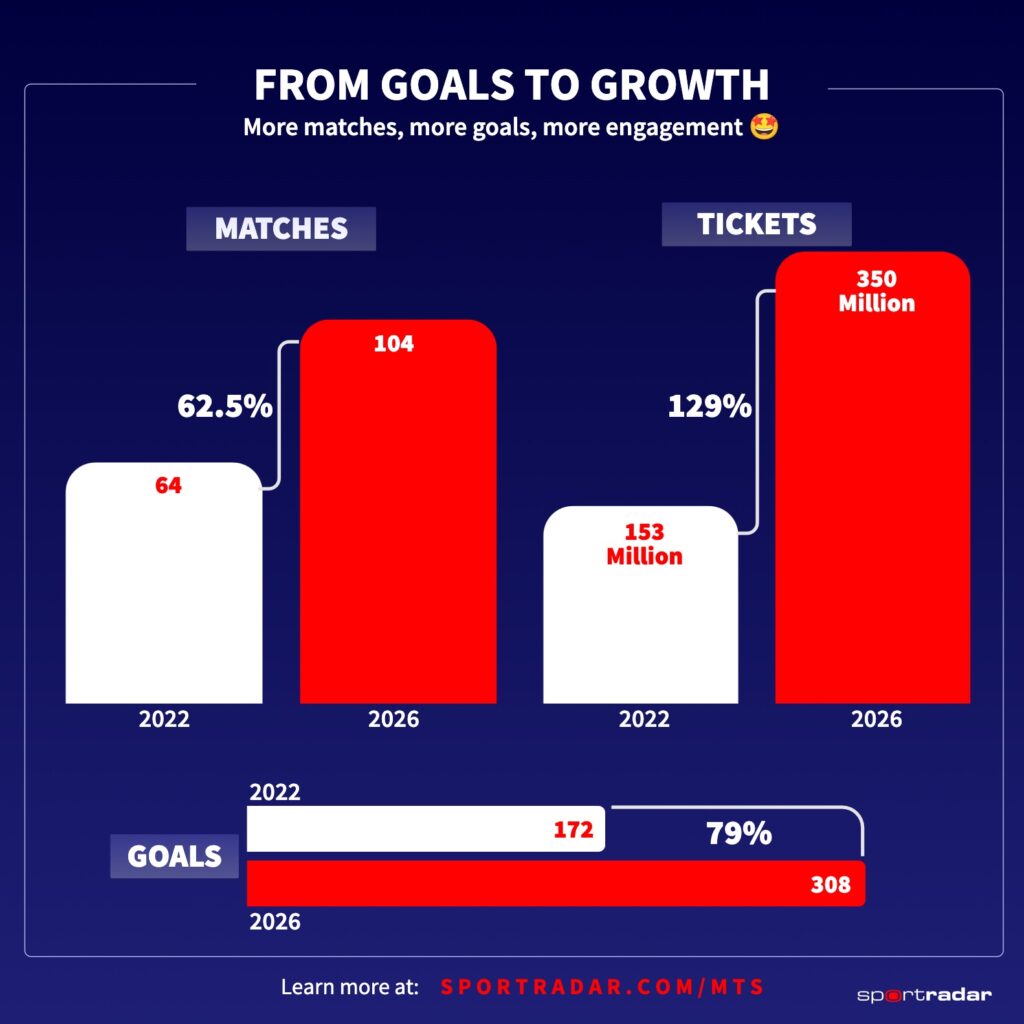
Despite the number of matches growing 62%, from 64 in 2022 to 104 in 2026, betting activity increased even more, with the number of tickets processed by MTS rising from 153 million in 2022 to over 350 million this year, a 129% increase.
Betting engagement also expanded during the later stages of the tournament. From the Round of 16 through to the final, activity was at least 50% higher than similar matches in 2022, and the final saw a 109% increase in betting tickets.
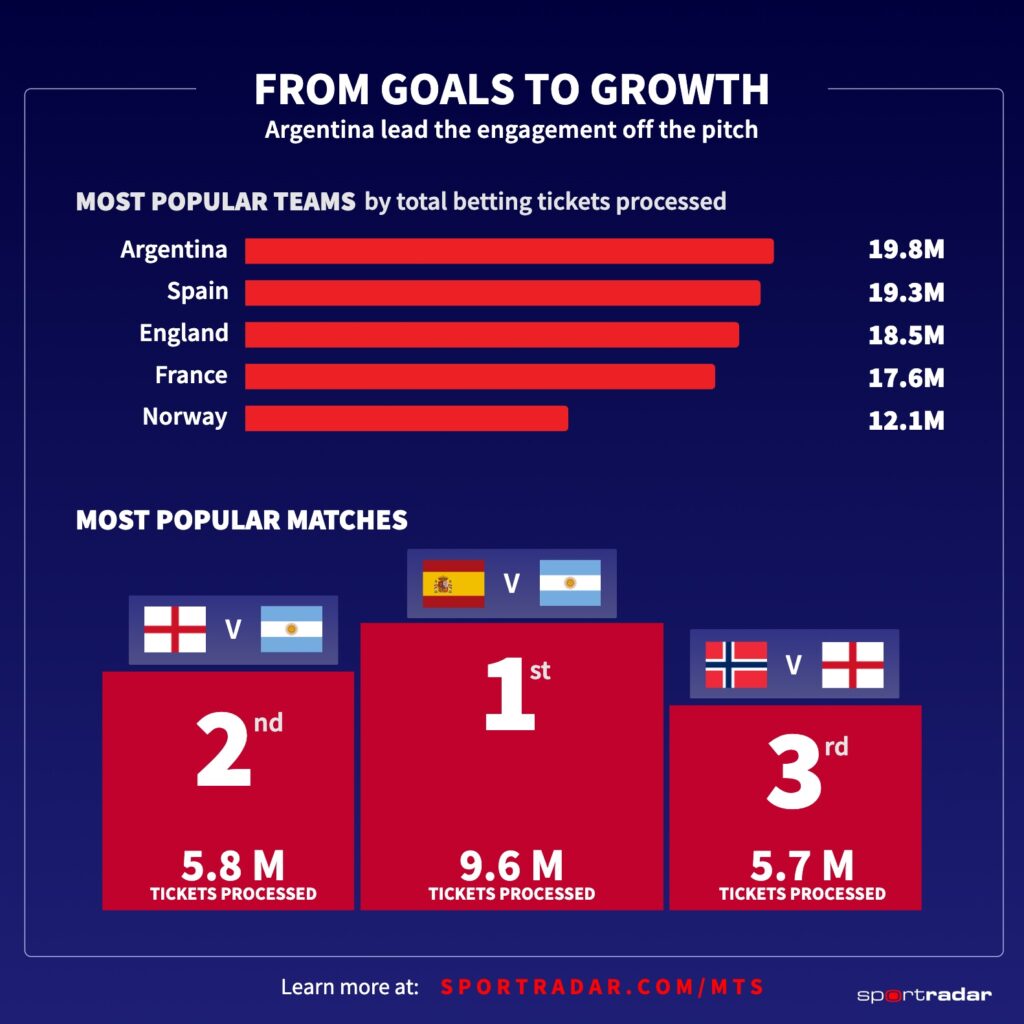
Argentina recorded the highest level of betting activity, with 19.8 million betting tickets, highlighting the growth of Latin America’s regulated betting markets.

Before the tournament, Sportradar had also projected that the 2026 World Cup could generate approximately US$50 billion in global bets, with Brazil expected to account for around 10% of this total. The company also estimated 6 billion engagements would be recorded across the 104-match tournament.
Traditional sportsbooks were not the only operators benefiting from increased betting interest. Prediction markets accounted for 27% of World Cup-related betting activity, showcasing the growing competition between established sportsbooks and sports event contracts.
This surge in World Cup betting reflects the expanding global sports wagering market, with operators using major sporting events to attract users through a wider range of betting products.
Charlotte Capewell brings her passion for storytelling and expertise in writing, researching, and the gambling industry to every article she writes. Her specialties include the US gambling industry, regulator legislation, igaming, and more.

Dig Deeper
Related stories
 2025/03/19: IC360 partners with the World Surf League to monitor suspicious online wagering activity
 2026/05/22: Sportradar AI simulation predicts Spain or France as World Cup winners
 2025/06/13: Sportradar signs FIFA Club World Cup rights deal with DAZN
 2026/05/13: International Betting Integrity Association becomes Alberta’s suspicious betting activity monitor ahead of igaming launch
2025/03/19: IC360 partners with the World Surf League to monitor suspicious online wagering activity
2026/05/22: Sportradar AI simulation predicts Spain or France as World Cup winners
2025/06/13: Sportradar signs FIFA Club World Cup rights deal with DAZN
2026/05/13: International Betting Integrity Association becomes Alberta’s suspicious betting activity monitor ahead of igaming launch
The Backstory
World Cup scale turned forecasts into a market test
Sportradar’s disclosure that its Managed Trading Services platform processed more than 350 million World Cup betting tickets gives the industry a hard measure of what had been widely expected before the tournament: the expanded 2026 event would be a stress test for global sports wagering infrastructure, liquidity and compliance systems.
The 2026 World Cup was built for higher betting volumes. FIFA expanded the tournament from 64 matches in 2022 to 104, increasing the number of betting events by 62%. But Sportradar’s ticket count rose 129% from 104 million in 2022, showing that demand outpaced the growth in games. The acceleration was most visible in the knockout rounds, where betting activity was at least 50% higher than comparable 2022 matches, while the final more than doubled the prior tournament’s ticket count.
That jump was not isolated to one operator or market. Sportradar’s MTS platform serves 250 global sportsbook operators, making the data a useful proxy for regulated sports betting growth across mature and emerging jurisdictions. The company had also projected before the tournament that the 2026 World Cup could generate about $50 billion in global wagers, a figure that put sportsbook capacity, risk management and real-time data delivery at the center of the event’s commercial story.
Analysts expected North America to lift the handle
The scale of the reported activity tracks with pre-tournament expectations that the first North American World Cup in the modern U.S. online betting era would drive a significant increase in wagering. In May, Deutsche Bank analyst Steven Pizzella said the tournament could generate $3.3 billion in U.S. handle, with a possible range from $2.5 billion to $4.1 billion, according to analysis that framed the World Cup as a catalyst for online sports betting growth.
Pizzella’s case rested on three factors that later showed up in Sportradar’s global activity figures: more matches, more eligible bettors and stronger engagement because the tournament was hosted across North America rather than in a distant time zone. The U.S. betting population had expanded since the 2022 World Cup in Qatar, with an estimated 135 million adults eligible to place legal sports wagers compared with 104 million four years earlier.
The tournament also arrived after operators had spent years building user bases through football, basketball and same-game parlay products. Soccer had historically been less central to U.S. wagering than in Europe or Latin America, but the World Cup offered a compressed calendar of high-profile matches during U.S.-friendly broadcast windows. Pizzella’s projections suggested FanDuel and DraftKings would capture the bulk of U.S. World Cup handle, reflecting their dominant positions in online sports betting and their ability to convert casual tournament viewers into active bettors.
Sportradar’s latest figures do not break out the U.S. contribution, but the overall increase supports the view that the tournament worked as both a betting event and a customer-acquisition vehicle. The 104-match format created more inventory for sportsbooks, while live betting, micro markets and parlays gave operators more ways to monetize each match.
Data rights became part of the betting product
The betting surge also highlighted how sports data companies have become central to the economics of major tournaments. Sportradar was not only measuring World Cup betting demand; it had positioned itself throughout the soccer calendar as a supplier of low-latency data, media content and integrity services to sportsbooks and rights holders.
That strategy was visible in the company’s earlier agreement tied to the FIFA Club World Cup. Under a rights deal with DAZN for the FIFA Club World Cup 2025, Sportradar agreed to supply ultra-low latency betting data and nonexclusive media content to 800 betting operators and 900 media companies. The arrangement gave Sportradar access to micro and player markets, including 190 pregame and 200 in-play markets, underscoring how granular betting products increasingly depend on official or near-official data pipelines.
Those data feeds matter because modern sportsbook revenue is less dependent on simple pregame win markets than on in-play activity. Bettors expect odds to update instantly after shots, fouls, substitutions and momentum shifts. Operators, in turn, need reliable feeds to price markets accurately and manage risk. The larger the tournament, the greater the operational risk when thousands of markets move simultaneously across jurisdictions.
Sportradar’s World Cup ticket numbers therefore reflect more than consumer demand. They also show how much wagering activity has migrated to technology-intensive products that require fast data, automated trading and fraud detection. For major events, the data provider’s role now sits close to the core of the betting supply chain.
Prediction models helped seed engagement
Before the tournament, Sportradar also used its data network to push engagement through forecasting content. The company released an AI-based simulation that ran 100,000 projections for each of the World Cup’s 104 matches, identifying Spain and France as the most likely winners and projecting Kylian Mbappe as the leading Golden Boot candidate.
The AI simulation of potential World Cup outcomes was not a betting product in itself, but it illustrated the broader convergence of data science, media coverage and wagering. Probability models provide storylines for broadcasters and publishers, inform casual bettors and help operators frame markets around likely matchups, player performance and tournament paths.
Sportradar said that model used information from a network of 800 sportsbook operators, historical match data and tournament-specific factors. That feedback loop is important: betting markets generate data, data models produce engagement and engagement can drive more betting activity. During a tournament with 104 matches, such content gives operators and media partners a way to sustain interest beyond marquee games.
The company’s current MTS numbers suggest that this ecosystem helped create sustained demand through the event. Betting activity did not merely rise in the group stage because there were more matches. It intensified in the later rounds, when narratives, projections and futures markets typically converge around a smaller field of contenders. That pattern is valuable for sportsbooks because high-engagement knockout matches often bring both higher volume and broader casual participation.
Integrity concerns rose with the volume
The same growth that benefits operators also raises the stakes for monitoring suspicious activity. Higher volumes, more markets and faster in-play betting create more opportunities for manipulation attempts, especially around lower-liquidity props or niche events. That is why integrity services have become a standard part of sports betting expansion, not an optional add-on.
Sportradar has repeatedly emphasized that point through its work with sports bodies and regulators. Its Club World Cup arrangement included protection through the company’s Universal Fraud Detection System, which uses artificial intelligence to identify suspicious betting patterns. The company also has provided integrity services and training to government and sports entities, including in Brazil, a market expected to be a major contributor to World Cup betting demand.
Other integrity providers have been expanding in parallel. IC360 recently partnered with the World Surf League to monitor suspicious wagering activity across global events, an example of how even sports outside the largest betting categories are preparing for broader wagering exposure. The World Surf League integrity monitoring agreement with IC360 followed similar work with a U.S. college athletic conference and showed how monitoring tools are moving deeper into the sports ecosystem.
Regulators also are building integrity requirements into new markets from launch. In Canada, the International Betting Integrity Association was approved as an integrity monitor for Alberta’s regulated online gambling market, using betting company intelligence and account-level data to flag suspicious activity. The IBIA approval ahead of Alberta’s igaming launch reflected lessons from Ontario and other regulated markets: growth must be matched by information-sharing among operators, regulators and sports bodies.
Regulated markets and new rivals reshaped the field
One of the most important details in Sportradar’s World Cup data was Argentina’s position as the market with the highest activity, at 19.8 million betting tickets. That result pointed to the growing weight of Latin America, where regulated sports betting has expanded and soccer remains the dominant wagering sport. Sportradar had previously estimated Brazil could account for about 10% of global World Cup bets, a sign that Latin American markets were expected to play a central role even before the event began.
The data also showed that traditional sportsbooks no longer have the field to themselves. Prediction markets accounted for 27% of World Cup-related betting activity, according to Sportradar. That share highlights a growing competitive pressure from sports event contracts, which can resemble sportsbook products for consumers even as they operate under different regulatory structures in some jurisdictions.
For established sportsbooks, the implication is clear: major tournaments remain powerful acquisition and engagement events, but the competitive set is widening. Operators must compete on pricing, market depth, product design, speed and trust. For regulators and sports bodies, the rise of alternative wagering formats complicates oversight and integrity monitoring because betting-like activity may occur outside traditional sportsbook channels.
Sportradar’s World Cup figures therefore capture a broader shift in global wagering. The expanded tournament provided more inventory, regulated markets provided more legal access and technology enabled more real-time betting choices. The result was a surge that exceeded the growth in match count and showed that soccer’s biggest event has become a global test of betting infrastructure, not just a peak-season revenue opportunity.