


Rio de Janeiro bans betting-related outdoor ads

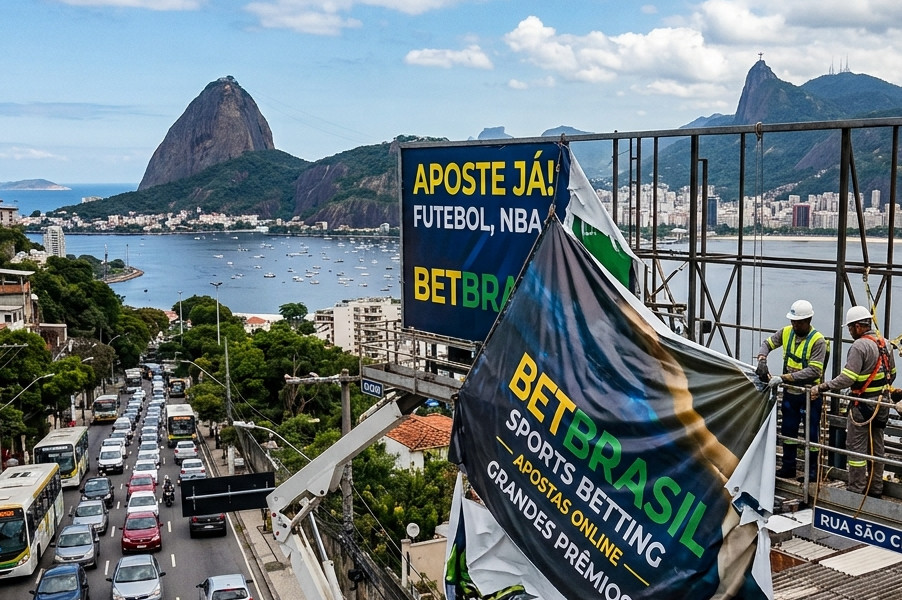
Brazil’s capital Rio de Janeiro has become the first of the nation’s state capitals to prohibit betting-related advertisements in spaces subject to municipal approval, after a decree published on 13 July took immediate effect.
Advertisers and media companies were given 10 days before fines are issued.

Decree No. 58,274, presented by City Hall as a measure aimed at reducing public exposure to betting advertising, prohibits such promotion across outdoor media, street furniture and other public spaces regulated by the municipality.
The ban covers advertising linked directly or indirectly to betting operators, including commercial brands, corporate names, digital platforms, websites, mobile applications, promotions, institutional campaigns, bonuses, logos, symbols, slogans and mascots.
According to City Hall, the measure is intended to protect Rio’s urban landscape, strengthen city planning and reduce exposure — particularly among children and teenagers — to advertising for sports betting and online gambling.

Rio de Janeiro Mayor Eduardo Cavaliere said the city would “not accept municipally regulated space being used to promote an activity that has caused indebtedness, gambling addiction and the destruction of families.”
Municipal enforcement
Enforcement will fall to the Licensing and Inspection Coordination Office (CLF), which may order the immediate removal of advertisements that breach the decree and apply the sanctions available under municipal law once the 10-day grace period expires.

All municipal agencies and public bodies must also apply the new rules when entering into, renewing or reviewing contracts, concessions, permits, authorizations and licenses involving advertising space.
The restriction also extends to campaigns and events organized, sponsored or contracted by City Hall.
The decree does not amend Brazil’s federal betting framework or challenge licenses issued by the Ministry of Finance’s Secretariat of Prizes and Betting (SPA).
Instead, it relies on the municipality’s authority to regulate the use of urban space, oversee outdoor advertising and protect the cityscape, alongside local legal provisions prohibiting advertising deemed contrary to public morals, accepted standards of conduct or the protection of third parties.

Dig Deeper
Related stories
 2025/11/24: Argentina’s Pico City Council approves bill to curb youth gambling
 2025/12/17: Cebu City in the Philippines bans gambling advertisements
 2026/07/10: ICE Barcelona adds hall for technology, data and fintech leaders
 2025/01/31: Betby partners with SABA Sports to provide gaming content in Asia
2025/11/24: Argentina’s Pico City Council approves bill to curb youth gambling
2025/12/17: Cebu City in the Philippines bans gambling advertisements
2026/07/10: ICE Barcelona adds hall for technology, data and fintech leaders
2025/01/31: Betby partners with SABA Sports to provide gaming content in Asia
The Backstory
Local governments move to curb gambling’s street-level reach
Rio de Janeiro’s ban on betting-related outdoor advertising fits a widening pattern: regulators and local governments are increasingly treating gambling promotion as a public-exposure issue, not only a licensing issue. The decree does not seek to rewrite Brazil’s federal betting framework or revoke operator approvals. Instead, it uses municipal authority over billboards, street furniture, public spaces and city contracts to limit where betting brands can be seen.
That approach mirrors measures emerging in other markets where national gambling rules remain intact but local officials are trying to reduce the visibility of betting messages in daily life. In the Philippines, Pasig City banned public gambling ads across billboards, public transport vehicles regulated by the city, terminals, building wraps, posters, LED screens, brochures and flyers. Gambling promotions there are allowed only inside licensed casinos or betting venues. The ordinance was framed as a way to protect vulnerable residents from constant reminders to gamble, even though gambling advertising remains lawful elsewhere in the country.
Rio’s decree follows the same logic. Rather than challenge the legality of sports betting or online gambling, City Hall is asserting control over the public environment. That distinction matters. Brazil’s regulated betting market is being built at the federal level, with licensing handled through the Ministry of Finance’s Secretariat of Prizes and Betting. Rio’s measure operates alongside that regime, using planning and advertising powers to decide what can appear in spaces subject to municipal approval.
Advertising becomes the first pressure point
Betting operators rely heavily on visibility to acquire customers, especially in newly regulated or fast-growing markets. Outdoor ads, public transit campaigns, digital screens and event sponsorships help normalize betting brands and keep promotional offers in front of casual consumers. For governments concerned about indebtedness, gambling addiction and exposure among minors, advertising is often the first intervention point because it can be regulated without closing licensed businesses.
Pasig’s ordinance and Rio’s decree both reflect that calculation. Each targets public-facing media rather than the underlying availability of gambling. Both also cite harm prevention, particularly the effect of repeated promotional exposure on people at risk of gambling problems. The measures suggest a shift from viewing advertising as a commercial afterthought to treating it as part of the broader risk architecture of regulated gambling.
The stakes are significant for operators and media companies. Outdoor inventory in major cities can be central to brand-building, especially where online customer acquisition is competitive. Removing those channels raises marketing costs, pushes spending toward digital media and sponsorships and may favor larger companies able to absorb compliance changes. It also creates a fragmented map for advertisers: a campaign that is lawful nationally can still be restricted or prohibited in a specific city.
Digital platforms tighten the gate
The same pressure is visible online, where large technology platforms have been revising rules for gambling and gambling-adjacent products. Google has repeatedly narrowed access to its advertising and distribution systems, demonstrating how private platforms can become de facto regulators for operators seeking scale.
In India, Google Ads said it would ban rummy and daily fantasy sports advertisements from Jan. 21, 2026, for campaigns directed at Indian audiences. The decision aligned the company’s policies with India’s evolving online gaming legislation and removed two major real-money gaming categories from approved advertising formats. That change is expected to affect operators, affiliates, publishers and agencies that depend on paid search and display advertising for user acquisition.
Google also has moved against products that sit near the boundary between gaming, gambling and financial speculation. It banned sweepstakes casino ads by excluding such platforms from its social casino category, a move that ended their ability to obtain Google Ads certification. Sweepstakes casinos had faced mounting scrutiny in several U.S. states, where authorities have described dual-currency models as disguised gambling. Google’s update effectively translated that regulatory unease into advertising policy.
More broadly, Google tightened gambling ad certification rules and banned prediction market extensions, expanding requirements across gambling and games categories and adding restrictions on tools that facilitate real-money predictive contracts. The company’s position underscores a larger trend: platforms are increasingly unwilling to give gambling-adjacent products broad promotional access unless local legal status, account history and compliance controls are clear.
Fragmentation becomes a compliance risk
For gambling companies, the emerging challenge is not simply stricter regulation. It is uneven regulation. Federal agencies may license operators, cities may restrict public advertising, technology platforms may impose separate certification rules and app or browser ecosystems may block related products. Each layer can change the commercial value of a license without altering the license itself.
Rio’s decree is a clear example. A federally authorized betting operator may still serve customers in Brazil, but it cannot use municipally regulated outdoor space in Rio to promote its brand. A media owner with existing advertising contracts may have to remove campaigns or decline renewals. City agencies must consider the ban when entering, renewing or reviewing concessions, permits and licenses tied to advertising space. The practical effect is to narrow the promotional field while leaving the betting market legally open.
This layered model is becoming common because it lets authorities respond quickly to social concerns. Municipal decrees and ordinances can be faster than national legislative reforms. Platform policy updates can take effect across entire ad networks on fixed dates. For consumers, the outcome may be reduced exposure in some channels while gambling products remain accessible through direct search, apps, sponsorships or licensed venues. For operators, the outcome is a need for market-by-market and channel-by-channel compliance planning.
New markets are opening more cautiously
At the same time some jurisdictions are restricting promotion, others are opening gambling markets under tight controls. The United Arab Emirates illustrates the cautious end of market liberalization. Playtech received a Gaming-Related Vendor License in the UAE, allowing it to supply products and services in the new igaming market through an approved structure. But the country has only one approved internet gaming licensee for now, Momentum subsidiary Coin Technology Projects LLC, which operates Play971.
The UAE’s model shows how new jurisdictions are trying to capture the benefits of regulated gaming while tightly managing market entry. Vendor licenses have been issued to major suppliers, but consumer-facing access remains limited. That contrasts with Brazil’s broader federal betting rollout, where operator licensing has created a larger commercial market and made public advertising a more visible political issue.
The comparison is useful for understanding Rio’s move. Jurisdictions that liberalize gambling must then manage the consequences of commercialization. The first signs often appear in advertising: brands on city streets, promotional offers on screens and sponsorships tied to events. Once betting becomes highly visible, local officials face pressure to show that regulation includes not only tax collection and licensing but also harm reduction and control over public space.
Rio sets a marker for Brazil’s betting debate
Rio de Janeiro’s decision may influence other Brazilian cities watching the social and political effects of the country’s regulated betting market. As the first state capital to impose this kind of municipal ban, Rio has created a template that relies on urban-management powers rather than gambling-law reform. That could make the model attractive to other local governments seeking visible action without entering a direct conflict with federal licensing authority.
The decree also signals to operators that compliance in Brazil will not end with federal approval. Betting companies will have to account for local advertising rules, public morality provisions, child-protection concerns and contract restrictions tied to municipal assets. In practice, the growth of Brazil’s betting market may be shaped as much by where companies cannot advertise as by where they can legally operate.
The broader backstory is a global recalibration of gambling promotion. Pasig, Google and the UAE are acting in different legal systems and through different mechanisms, but each reflects the same underlying concern: gambling expansion is being met with tighter controls on visibility, access and distribution. Rio’s outdoor ad ban is therefore not an isolated municipal action. It is part of a wider effort to draw sharper boundaries around how gambling businesses reach the public.
