


PhilWeb unveils new visual identity as “technology-driven infrastructure provider”

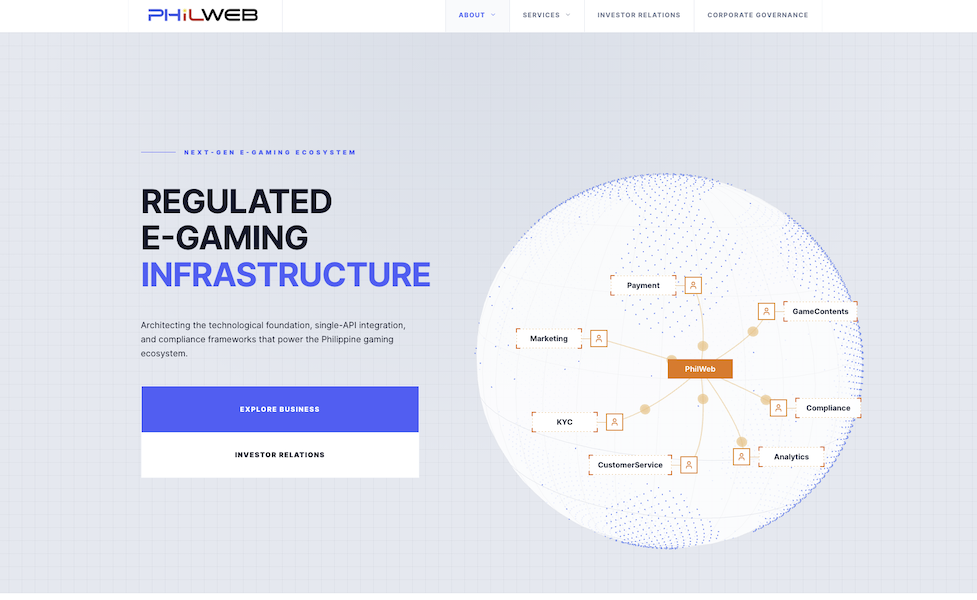
Philippines technology and digital infrastructure group PhilWeb has unveiled a new visual identity, aimed at “aligning PhilWeb’s public brand, digital presence, and investor communications with the company’s evolving role as a technology-driven infrastructure provider serving regulated digital industries.”
In a Monday release, the group noted that the new branding reflects its strong foundation of robust compliance, which “positions the company to capture scalable technology and infrastructure opportunities both domestically and across the wider region,” while transitioning the group “into a technology-driven, infrastructure-focused, and future-ready enterprise.”

PhilWeb, as part of a change of ownership and board replacement, has revamped itself with new partnerships focused on Philippine gaming operators. This includes launching Hann Online early this year, partnering with FBM Philippines to launch an online gaming platform across 30,000 of its electronic gaming machines, partnering with Okada Manila on Okada Play, and providing online gaming platform support for Newport World Resorts, among others.
In March, PhilWeb received accreditation from Philippine gaming regulator PAGCOR to operate as a service provider and affiliate. The company noted at the time that the accreditation was part of its move to an asset-light model focused on platform management and systems integration.
“Our refreshed identity represents a pivotal milestone in PhilWeb’s ongoing evolution,” stated Brian Ng, President of PhilWeb Corporation. “As technology continues to reshape regulated industries, we are aggressively strengthening our core platform capabilities, deepening strategic partnerships, and elevating our stakeholder engagement. This launch is a direct reflection of our commitment to building a more agile, transparent, and infrastructure-focused PhilWeb.”

In its release, the company notes that its newly redesigned corporate website provides “clearer, optimized access to information regarding PhilWeb’s core business, corporate governance, investor relations, and operational updates.” This is aimed at “higher transparency and more streamlined communication.”
The group highlights that, despite the evolution of its visual identity, its “core commitment remains unchanged: driving innovation, maintaining operational excellence, and creating sustainable long-term value for shareholders, partners, customers, and stakeholders.”
PhilWeb returned to profit in 1Q26, reporting net income after tax of Php13.9 million (US$228,933)1 PHP = 0.0165 USD
2026-06-22Powered by CMG CurrenShift, reversing a Php25.5 million (US$419,985)1 PHP = 0.0165 USD
2026-06-22Powered by CMG CurrenShift loss reported in the same period last year. Revenues for the period grew 30.4% to Php233.1 million (US$3.8 million)1 PHP = 0.0165 USD
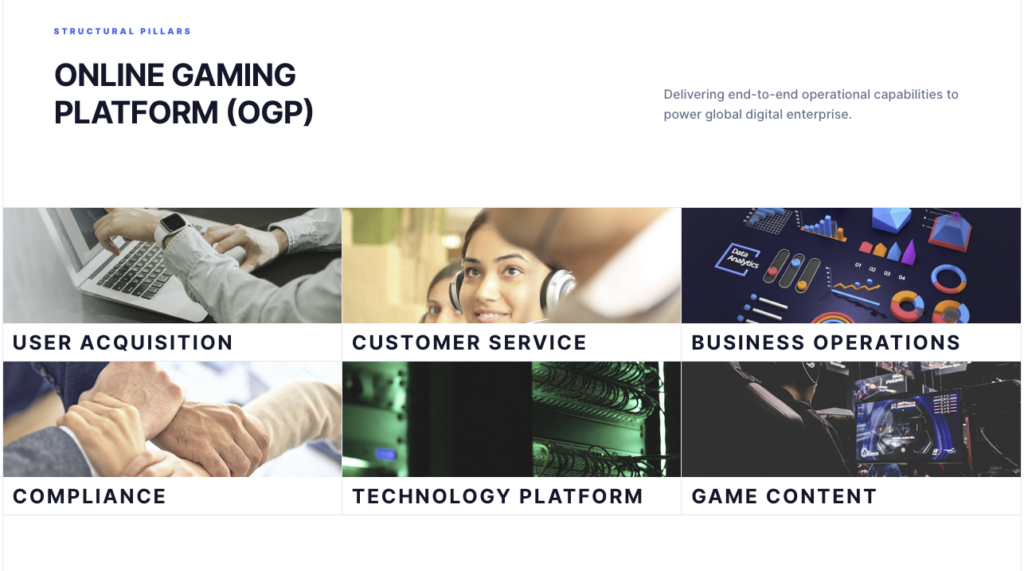
2026-06-22Powered by CMG CurrenShift, “primarily driven by revenue generated from eGaming Solutions, which provides online gaming platform technology, systems integration, content distribution and operational support to licensed operators within the regulated gaming sector.”

Dig Deeper
Related stories
 2026/07/09: PhilWeb inks exclusive partnership with Pragmatic Play to provide its games to licensed operators
 2026/06/23: Philippine billionaire Lance Gokongwei assuming personal 15% stake in gaming tech firm PhilWeb
 2026/04/17: Philippine online gaming surpasses land-based casinos as largest revenue source
 2026/02/05: Hann Online relaunches in the Philippines with PhilWeb
2026/07/09: PhilWeb inks exclusive partnership with Pragmatic Play to provide its games to licensed operators
2026/06/23: Philippine billionaire Lance Gokongwei assuming personal 15% stake in gaming tech firm PhilWeb
2026/04/17: Philippine online gaming surpasses land-based casinos as largest revenue source
2026/02/05: Hann Online relaunches in the Philippines with PhilWeb
The Backstory
From legacy eGames operator to infrastructure pitch
PhilWeb’s new visual identity is the public-facing marker of a strategic overhaul that has been underway for months. The company, long associated with retail eGames in the Philippines, is trying to recast itself as a technology and digital infrastructure provider for licensed gambling operators rather than a venue-driven gaming business. That repositioning has accelerated after a change in ownership, a full board refresh and a wave of commercial partnerships with integrated resorts, equipment suppliers and online gaming brands.
The rebrand matters because it comes as the Philippine gaming market shifts toward regulated digital channels, with operators seeking technology partners that can provide platform management, systems integration, content distribution and compliance support. PhilWeb’s message to investors is that it can sit behind licensed brands as a scalable service provider, avoiding some of the capital intensity and regulatory exposure of operating consumer-facing gambling businesses directly.
That strategy is also tied to timing. PAGCOR, the Philippine gaming regulator, has been refining rules for online gaming, affiliates and support service providers. At the same time, banks, payment providers and policymakers have increased scrutiny of digital gambling activity. PhilWeb’s emphasis on compliance, governance and transparency is therefore not only a branding exercise. It is central to its attempt to win work from land-based casino brands that want to extend into online gambling without building full technology stacks in-house.
Ownership changes cleared the way for a reset
The company’s transformation followed a significant ownership shift. Gregorio Araneta III, the brother-in-law of Philippine President Ferdinand Marcos Jr. and PhilWeb’s former controlling owner, sold most of his 57% stake in March to entities linked to long-time PhilWeb executives. He later reduced his remaining interest further through the sale of 82.3 million preferred shares for about 731.3 million pesos, leaving him with 15 million shares, according to a PhilWeb stake sale disclosure.
The ownership transition coincided with a full board replacement and a more explicit pivot toward online gaming infrastructure. The shift in control gave management room to present PhilWeb as a leaner, technology-led enterprise focused on regulated digital industries. That narrative is reflected in the company’s repeated use of terms such as asset-light, platform management and systems integration.
For investors, the key question is whether the new owners can turn PhilWeb’s historical relationships in the Philippine gaming market into a durable platform business. The company has moved quickly to answer that with a series of agreements that place its systems behind some of the country’s most visible gaming brands. Those deals also suggest PhilWeb is trying to become a connective layer between retail gaming networks, integrated resorts and regulated online distribution.
PAGCOR accreditation gave the pivot regulatory weight
A critical step came when PhilWeb received PAGCOR accreditation to operate as a service provider and affiliate. In its March 30 disclosure, the company said the approval allowed it to deliver technology and operational support to licensed gaming operators. The accreditation supported PhilWeb’s claim that it is not merely pursuing online gambling growth but doing so inside the regulator’s developing framework.
The company described the approval as part of its move to an asset-light model focused on platform management and systems integration. It also said it was participating in technical working groups with PAGCOR and industry stakeholders to help develop standards around transparency, consumer protection and governance. The regulatory context is important because the Philippine online gaming sector has faced growing attention from policymakers and financial authorities, especially around payments and player safeguards.
PhilWeb’s PAGCOR accreditation as a gaming service provider therefore became more than a licensing milestone. It helped validate the company’s business model at a time when operators are likely to favor suppliers that can demonstrate compliance credentials. For casino resorts and equipment operators, the ability to outsource backend systems to an accredited provider could reduce execution risk as they expand digitally.
Partnerships put the platform model to work
The company’s commercial activity has centered on bringing established gaming brands online or linking digital products to physical gaming networks. One of the first high-profile examples was the relaunch of Hann Online, the digital counterpart of Hann Casino Resort in Clark. PhilWeb supported the site’s infrastructure, with the platform offering more than 3,000 games and payment options including GCash, Maya and QRPH. The launch, completed after a two-week development period, highlighted the speed PhilWeb says it can bring to regulated deployments.
The Hann Online relaunch with PhilWeb also showed how integrated resorts may use suppliers to extend their brands into digital channels. That model has become more attractive as competition intensifies among Philippine online gaming operators and as land-based casino groups seek new ways to reach players outside physical venues.
PhilWeb followed with a deal involving FBM Philippines, one of the country’s major electronic gaming equipment suppliers. Under that agreement, PhilWeb would build and operate an online platform connected to FBM’s network, with an initial rollout targeting at least 30,000 electronic bingo machines across 500 venues. The FBM online-to-offline gaming machine rollout was notable because it did not rely solely on a standalone internet casino. Instead, it sought to embed online functionality into existing retail locations, potentially creating a bridge between venue-based play and digital engagement.
Integrated resorts sharpened the competitive stakes
PhilWeb’s move up the value chain became clearer when it announced a partnership with Okada Manila operator Tiger Resort, Leisure and Entertainment Inc. to launch Okada Play. The arrangement positioned PhilWeb as a backend provider to a luxury integrated resort brand, supplying infrastructure, content and customer management systems. The Okada Play online casino partnership underscored the company’s pitch: established casino operators can move online faster by using PhilWeb’s platform rather than building their own from scratch.
The company has also provided online gaming platform support for Newport World Resorts and NUSTAR Resort & Casino, broadening its roster of resort-linked customers. Together, those partnerships suggest PhilWeb is trying to become a preferred infrastructure provider for licensed Philippine operators as the market formalizes. The strategy depends on scale: each additional resort or retail network can add transaction volume, content distribution opportunities and recurring service revenue without PhilWeb owning the front-end gambling brand.
That does not eliminate risk. Online gambling remains politically sensitive, and policy shifts can quickly affect revenue. Last year, the Bangko Sentral ng Pilipinas ordered e-wallets to delink from iGaming platforms, pressuring gambling revenues and forcing operators to rethink payment flows. PhilWeb’s focus on local banking support, data protection and regulatory alignment reflects the need to reassure partners that its systems can adapt to a changing compliance environment.
Profit rebound gave the rebrand financial context
The new identity also lands after an improved quarterly result. PhilWeb returned to profit in the first quarter of 2026, reporting net income after tax of 13.9 million pesos, reversing a 25.5 million-peso loss a year earlier. Revenue rose 30.4% to 233.1 million pesos, driven mainly by eGaming Solutions, the business line covering online gaming platform technology, systems integration, content distribution and operational support.
That performance gives management evidence that the pivot is beginning to affect the income statement. The company’s challenge is to sustain that momentum as more competitors target the same regulated digital gambling opportunity. Philippine operators including DigiPlus Interactive, PlayTime and Bloomberry Resorts’ MegaFUNalo are already active in the market, while integrated resorts are building their own online ambitions.
PhilWeb’s rebrand is therefore less a cosmetic change than a signal to regulators, partners and shareholders. The company is trying to distance itself from a legacy retail eGames identity and present itself as infrastructure for the next phase of Philippine regulated digital gaming. Whether that repositioning holds will depend on its ability to convert partnerships into recurring earnings, maintain regulatory trust and keep pace with a market where technology, compliance and distribution are becoming inseparable.
