


Philippine IRs take different routes towards online success, and while partnerships are proving effective, they have term limits

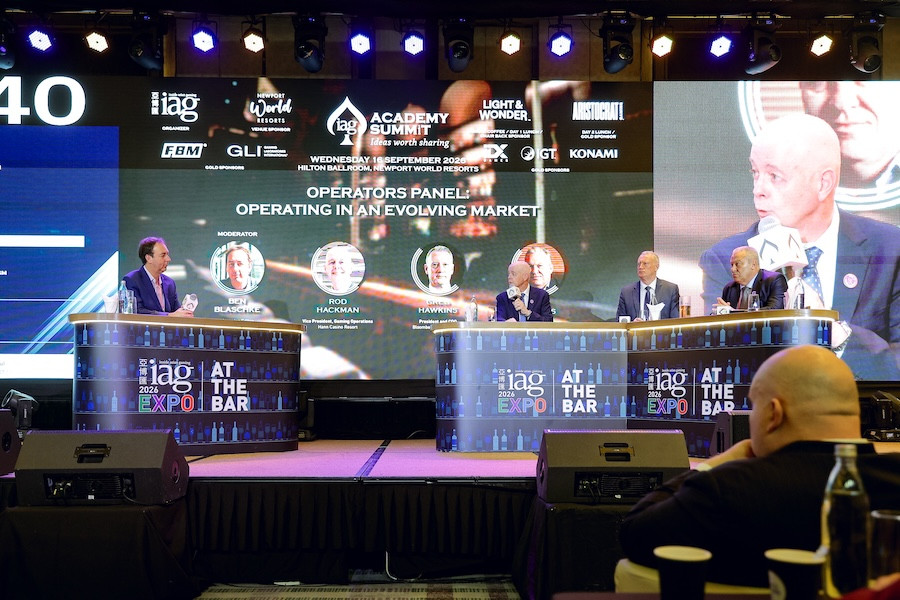
Philippine integrated resort operators are taking distinctly different routes towards their online presence, either going it alone or developing in-house platforms. At a special panel at IAG Academy Summit in Manila, top executives explained their current operations and what’s in store.
Moderated by the Chairman of IAG Academy Summit Day 2, Ben Blaschke, the “Operators Panel” was highly focused, despite the more relaxing “At the Bar” setup for the panel.

When questioned about the group’s online voyage, Bloomberry Resorts Corp President and COO Greg Hawkins noted that “the journey has been quite a long one,” highlighting how the technical platform for a brand to operate from, “which ultimately relates to a very seamless consumer experience, is absolutely fundamental.”
The group eventually opted for an outsourced platform, via Gaming Innovation Group (GiG), on which the group relaunched its mass-market focused platform FUNaloMAX in mid-July, which at the time it noted was “engineered natively for the younger, mobile-first generation of Filipino players.”
But Hawkins noted that it has been keeping a card up its sleeve, with its Solaire Online product, which “has never been marketed” to be actively marketed within “the next month or so.”

Hawkins highlighted how the “legacy online product” is going to also transition onto the platform, given that it has “been quite a solid earnings performer”, noting that in regards to results, “I’d love to get it to around 20% (of GGR) by the end of 2027.”
The COO curbs expectations by noting that “we’re relatively new in the market” and that its “database is under intense competition, which isn’t particularly easy to do,” but the group is bolstered by the “reputation and recognition” of the Solaire brand, which presents a significant opportunity.
While not as expansive regarding the group’s online efforts, Rod Hackman, Vice President of Gaming Operations for Hann Casino Resort, noted that their group initially decided to set up an online studio within Hann Casino Resort, acquiring assets and technology but “then the decision was made to partner with PhilWeb to launch.”

PhilWeb has been aggressively marketing its potential after a recent board reshuffle, rebranding and new investment and Chairmanship from billionaire businessman Lance Gokongwei, with many local operators hearing the clarion call of a reliable platform provider.
Hackman also struck a humble tone, noting that “at the moment, we’re still in our infancy,” in regards to its online segment, however the group is “gaining traction every month,” and that “there’s an increase in GGR and the number of bets online.”
In bad news for PhilWeb, Hackman indicated on the panel that “at some point in time, and that’s yet to be determined,” the platform will “come back in house.” The executive explained that this is due to the assets already being ready to go and that the group wanted to launch the online product quickly, so they opted to “leave it with the professionals.”

In regards to timeline, Hackman noted that “it may be another six months, 12 months, or longer, then we’ll bring the product back in house.”
The third panelist, NUSTAR Resort and Casino COO Sean Knights briefly indicated that the group had also initially chosen to provide its own dedicated platform, but then also opted for PhilWeb support, even though it is running its online platform “as a separate company within the group.”
The executive highlighted that the relationship between Nustar and Nustar Online is “more at the corporate level than at the operational level,” given that Nustar Online is “run as an independent arm within the JG Summit Group,” which is also controlled by PhilWeb investor Lance Gokongwei.

Dig Deeper
Related stories
 2026/06/23: Philippine billionaire Lance Gokongwei assuming personal 15% stake in gaming tech firm PhilWeb
 2026/06/22: PhilWeb unveils new visual identity as “technology-driven infrastructure provider”
 2026/07/09: PhilWeb inks exclusive partnership with Pragmatic Play to provide its games to licensed operators
 2026/09/09: PhilWeb says cross-investment deal with B2B technology firm JKS is a “strategic investment”
2026/06/23: Philippine billionaire Lance Gokongwei assuming personal 15% stake in gaming tech firm PhilWeb
2026/06/22: PhilWeb unveils new visual identity as “technology-driven infrastructure provider”
2026/07/09: PhilWeb inks exclusive partnership with Pragmatic Play to provide its games to licensed operators
2026/09/09: PhilWeb says cross-investment deal with B2B technology firm JKS is a “strategic investment”
The Backstory
Online gaming becomes a strategic test for resorts
The Philippine integrated resort sector is moving deeper into online gaming, but operators are not following a single playbook. Some are outsourcing critical platform functions to move faster, while others are building or preserving internal systems they can eventually control. That split is now shaping how casino groups think about technology, customer ownership, regulatory compliance and the durability of their partnerships.
The debate has intensified as land-based casino operators face a more competitive digital market, where brand recognition is useful but not enough. Operators need platforms that can handle payments, content, player accounts, risk controls and regulatory reporting without interrupting the customer experience. For resort groups accustomed to owning the guest relationship on property, online gaming creates a more complicated operating model: third-party providers can accelerate launches, but they may also sit between the casino brand and the infrastructure that determines margins and product flexibility.
That tension explains why partnerships are proving effective in the short term, while also carrying natural expiration dates. Resort operators can rely on specialist suppliers to enter the market quickly, then bring functions in-house once their own systems, staff and data capabilities are ready. The result is a market in which technology vendors can grow rapidly, but must keep proving they add value after the initial launch phase.
PhilWeb’s reinvention created a ready partner
PhilWeb Corp. has positioned itself at the center of that shift. Once known largely for e-Games outlets, the company has recast itself as a business-to-business gaming technology and platform provider serving licensed operators in the regulated Philippine market. Its transformation accelerated after a change in ownership, a board overhaul and regulatory accreditation that allowed it to provide technology and operational services within the Philippine Amusement and Gaming Corp. ecosystem.
That reset was formalized through a governance shake-up in March, when Inside Asian Gaming reported that PhilWeb replaced its entire board and named new directors. The move gave the company a platform to distance itself from its legacy business model and pursue an asset-light strategy built around systems integration, platform management and online gaming support for licensed operators.
The company later reinforced the repositioning with a new corporate identity. PhilWeb described itself as a technology-driven infrastructure provider serving regulated digital industries, emphasizing compliance, platform capability and investor transparency. The rebrand followed a string of commercial agreements with casino operators and suppliers, including work tied to Hann Online, Okada Play, NUSTAR Online, Newport World Resorts and FBM Philippines’ machine network.
Those deals gave PhilWeb relevance at a moment when integrated resorts were looking for faster routes online. For casino operators, an outside platform partner could reduce execution risk and shorten time to market. For PhilWeb, each mandate created recurring revenue potential and a stronger case that it could serve as connective tissue between land-based brands, game content, compliance systems and player-facing digital channels.
Profitability and capital strengthened the pitch
PhilWeb’s strategic pivot gained credibility after its financial performance improved. Inside Asian Gaming reported that PhilWeb returned to profit in the first quarter of 2026, reversing a year-earlier loss as revenue rose on growth from eGaming Solutions. That segment includes online gaming platform technology, systems integration, content distribution and operational support for licensed operators.
The return to profit mattered because PhilWeb’s new model depends on scale. Platform businesses carry upfront costs in technology, compliance tools and integrations, but can become more attractive if the same infrastructure supports multiple operators. Stronger quarterly results helped show that the pivot was not only a branding exercise, but a commercial transition with measurable revenue contribution.
The company then gained a more prominent backer. Philippine billionaire Lance Gokongwei agreed to take a personal 15% stake in PhilWeb through a subscription involving common and redeemable preferred shares worth about 2.03 billion pesos. The investment was not made through JG Summit Holdings, though the connection drew attention because JG Summit is linked to NUSTAR Resort Cebu through Universal Hotels and Resorts Inc.
Gokongwei’s investment provided capital and market validation at a pivotal time. PhilWeb said the funds would support corporate initiatives and the development of data intelligence, automation and artificial intelligence capabilities. Those functions are increasingly important in regulated online gaming, where operators need tools for fraud detection, customer monitoring, compliance automation and risk management.
Gokongwei later became PhilWeb chairman, completing another stage of the governance overhaul. His appointment came after the company reported a strong second quarter, with revenue nearly doubling year over year and profit replacing a prior-year loss. The leadership change signaled that PhilWeb intended to compete not merely as a vendor, but as a scaled infrastructure company in regulated digital gaming.
Casino deals brought scale and visibility
PhilWeb’s strongest evidence of momentum has been its growing list of operator relationships. The company has supported or announced work with Hann Casino Resort, Okada Manila, NUSTAR and Newport World Resorts, giving it exposure to several of the country’s most visible gaming brands. Inside Asian Gaming reported in April that PhilWeb signed an agreement to provide online gaming platform support for Newport World Resorts, extending its reach in the Manila integrated resort market.
These arrangements illustrate why outsourcing has gained traction. Resorts can bring online products to market while leaning on PhilWeb’s platform, integrations and regulatory support. That can be especially valuable when operators have limited online operating history or want to avoid the delays associated with building a full technology stack internally.
At the same time, the structure of these partnerships leaves room for future migration. If operators already own technology assets or have built internal teams, a third-party platform may function as a bridge rather than a permanent home. That makes execution quality critical for PhilWeb. It must demonstrate that its platform is more efficient, compliant and commercially useful than what a resort could eventually operate on its own.
The company has also moved to deepen its content and supplier relationships. Its exclusive partnership with Pragmatic Play was designed to allow licensed Philippine operators to access the supplier’s games through PhilWeb’s hosted infrastructure and API integrations. Because Pragmatic Play content is already widely used in the market, the arrangement could help PhilWeb strengthen existing operator ties while creating recurring revenue from hosted gaming services.
Control, data and regulation define the stakes
The online shift raises broader questions for integrated resorts. A casino’s digital platform is not just a distribution channel; it controls data on player behavior, product performance, risk patterns and marketing efficiency. Operators that outsource can gain speed, but they must decide how much of that intelligence they are comfortable leaving in a partner-operated environment.
That is why some resort executives describe third-party arrangements as temporary, even when they are satisfied with early progress. Bringing a product in-house can preserve long-term control over data, margins and customer experience. But doing so requires investment in technology, cybersecurity, compliance, content management and staff capable of operating at the pace of online gaming.
Regulation adds another layer. PAGCOR’s framework has opened space for accredited B2B providers, but it also increases the importance of compliance infrastructure. Operators need systems that can satisfy reporting obligations, monitor suspicious activity and support responsible gaming controls. PhilWeb’s strategy leans heavily on that need, particularly through its stated focus on automated compliance, anti-fraud tools and real-time operational monitoring.
The competitive picture is still forming. Bloomberry’s decision to work with Gaming Innovation Group for FUNaloMAX while preparing to more actively market Solaire Online shows that major operators may mix outsourced technology with brand-led digital expansion. Hann and NUSTAR, meanwhile, show how PhilWeb can serve as an entry point for operators that want immediate capability but may later reassess ownership of the platform.
For PhilWeb, the opportunity is significant but not guaranteed. Its partnerships have put it in the flow of the Philippine online casino buildout, and new capital has strengthened its ability to invest. The risk is that its clients may eventually internalize the functions that now make PhilWeb indispensable. The company’s challenge is to make its infrastructure, content access, compliance tools and data capabilities valuable enough that operators keep choosing partnership even after they have the option to go alone.
