


NFHS launches sports betting awareness course for students

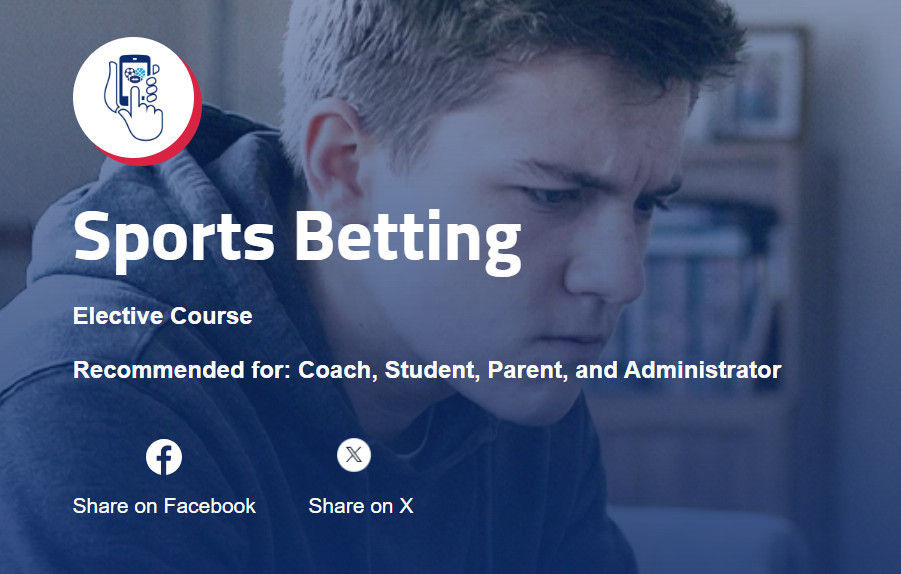
The National Federation of State High School Associations in the US has introduced a free online course to help educate students, parents, coaches, and school administrators about the dangers of sports betting.
Hosted on the association’s Learning Center, the program explores the expansion of the sports betting industry, the dangers of problem gambling, and how to avoid getting involved. It outlines the potential consequences young people face if they engage in betting activities.

“The NFHS Learning Center is pleased to help raise awareness of the mental health challenges and risks sports betting can pose to young people,” Dan Schuster, Director of Educational Services at the National Federation of State High School Associations, said in a press release. “We value the opportunity to educate individuals nationwide on this critically important issue.”
Although gambling is illegal for minors in the US, and high school athletes are banned from participating in it, the prevalence of betting and the easy access to gambling apps have led to increased participation among minors.
Experts have warned that teenagers may be particularly vulnerable as they have not fully developed impulse control, with a national study showing that 68% of people ages 12 to 21 admitted to gambling in the past year.

The course also highlights potential pitfalls, including financial troubles, mental health challenges, and pressure on relationships, that come with online gambling.
Association officials say the goal is to raise awareness early and give communities the tools to identify warning signs and prevent any potential harm.

Dig Deeper
Related stories
 2025/05/14: Rush Street Interactive launches gaming literacy initiative for teens
 2026/01/13: AGA and IGA urge Congress to address sports event contracts
 2025/11/11: Underage online gambling rising in Japan
 2025/02/19: Advertising Standards Council of India signed a memorandum of understanding with gambling trade bodies
2025/05/14: Rush Street Interactive launches gaming literacy initiative for teens
2026/01/13: AGA and IGA urge Congress to address sports event contracts
2025/11/11: Underage online gambling rising in Japan
2025/02/19: Advertising Standards Council of India signed a memorandum of understanding with gambling trade bodies
The Backstory
Why the high school push matters now
The National Federation of State High School Associations’ free course lands amid a fast-growing debate over how to protect young people as legal sports wagering proliferates. Since the Supreme Court cleared the way in 2018, states have opened regulated markets and advertising has surged, normalizing betting for many fans. Educators, regulators and operators are now confronting a harder truth: even where wagering is illegal for minors, exposure is high and access is easy. That makes prevention at the high school level a front-line strategy, not an afterthought.
Colleges have been an early warning system. A 2023 NCAA survey, cited in a new Carnegie Mellon University class, found widespread betting among students, including on campus. The NFHS program extends that concern to younger teens before habits form. It aims to equip parents, coaches and administrators with plain-language guidance on risks, warning signs and how to talk about money, odds and mental health, reframing sports betting less as a game and more as a consumer protection issue.
The stakes are not just financial. Adolescent brains are still developing, which can heighten impulsivity and risk-taking. That makes teen bettors more vulnerable to chasing losses or misjudging probabilities. Digital sportsbooks compress the distance between impulse and action into a tap. A prevention-first message at the high school level is meant to blunt that edge.
Campus case study: lessons from universities
Higher education is already testing countermeasures that echo the NFHS approach. At Carnegie Mellon, a statistician and a neuroscientist are co-teaching an undergraduate course designed to demystify wagering math and explain how addiction can hijack decision-making. The class, which filled quickly for spring 2026, is meant to inoculate students by showing why “the house edge” persists and how platforms retain it. The initiative, detailed in Carnegie Mellon professors launch sports betting awareness course, suggests demand from students for credible, nonmoralizing instruction about the behavior behind the bets.
The college lens also underscores how legality and access collide. Students can place wagers in seconds from dorm rooms, often across state lines on trips or during breaks. The NFHS program anticipates that pipeline by starting earlier, with content tailored to teens, families and coaches who see athletes daily. It’s a bid to insert friction—knowledge, conversation, boundaries—before app prompts and peer challenges fill the void.
Illicit access despite bans
Even in states that restrict mobile wagering, students find workarounds. A University of Mississippi study found that nearly 60% of student gamblers had placed online bets with “legal” sportsbooks, despite a statewide mobile prohibition. Respondents reported using VPNs, friends or family as proxies, and offshore sites, according to Mississippi students bet online despite ban, according to study. Researchers estimated thousands of public university students in the state face serious gambling issues, with a meaningful share at risk of developing a disorder.
Those findings point to a core challenge the NFHS effort tries to confront: rules alone don’t stop youthful betting behavior. Bans can shift activity into harder-to-monitor channels or enlist adults as intermediaries. Education aims to undercut the perceived harmlessness of “just a few bets,” put real numbers on problem-gambling risks and encourage early interventions. The Mississippi data also hint at a policy trade-off. If legalization expands, lawmakers are likely to face pressure to earmark gambling tax revenue for treatment and prevention. Absent that, schools and families shoulder more of the cost.
Industry signals and responsibility
Operators are responding with their own programming, an acknowledgment that reputational, regulatory and political risks rise with youth exposure. FanDuel, one of the largest U.S. sportsbooks, expanded responsible gaming efforts tied to Problem Gambling Awareness Month, adding education content co-developed with nonprofits and highlighting screening and telehealth services. It also pledged donations to national research and prevention groups and launched storytelling content about addiction and recovery, as covered in FanDuel unveils responsible gaming initiatives for Problem Gambling Awareness Month.
Those moves complement, but don’t replace, school-based efforts. Corporate messaging can broaden awareness among adults who influence teens, including coaches and parents. But the NFHS course speaks directly to high school communities where early betting behaviors can start, especially among athletes who may be tempted by inside information or peer dares. Coordinating messages—operators emphasizing tools and limits, schools emphasizing health and rules—could create a layered defense.
Policy crosscurrents from California to India
Policy debates also shape the backdrop. In California, where voters rejected a 2022 online wagering push, industry heavyweights floated a new plan to route sports betting through a single tribal operation and a handful of licenses. The concept, backed by members of the Sports Betting Alliance, drew immediate skepticism from tribal leaders and was labeled dead on arrival by an Indian Gaming Association committee chair, according to Sports Betting Alliance puts forward tribal sports betting plan. The impasse shows how unresolved market structure and control can delay legal options, potentially diverting bettors—young and old—toward gray channels.
Abroad, the conversation is blunter. India’s prime minister warned students that “gambling is ruin,” contrasting esports with money gaming and pointing to a new law that seeks to restrict online gambling while permitting regulated esports under certain conditions. The remarks, detailed in Indian Prime Minister warns students that ‘gambling is ruin’, capture a harder-line stance that still struggles with rapid digitization and youth screen time. For U.S. educators, the message resonance, not the rhetoric, may matter most: separating healthy competition and skill-building from money-based wagering in the minds of students.
What’s next to watch
The NFHS course is an early marker in what could become a wider K-12 prevention framework, akin to digital citizenship or financial literacy programs. Watch for state athletic associations and school districts to adapt the content into mandatory preseason meetings, parent nights or health curricula. Colleges may keep expanding cross-disciplinary classes that mix statistics, neuroscience and consumer education, following the model at Carnegie Mellon.
Regulators and legislators are likely to press for clearer age-gating, data sharing and ad restrictions, especially around campuses and youth programming, as evidence of underage exposure mounts. If more states consider legalization or expansion, expect parallel pushes to reserve funding for treatment, research and school-based interventions—lessons underscored by Mississippi’s survey.
The through line is simple: betting is here to stay, but normalization without education raises risk. The high school play is to get in early, speak plainly and give communities tools before habits harden. Whether that slows the pipeline from teen curiosity to campus betting will be a test of how prevention, policy and industry responsibility line up over the next few seasons.
