


New Jersey lawmakers advance bill to tax prediction markets

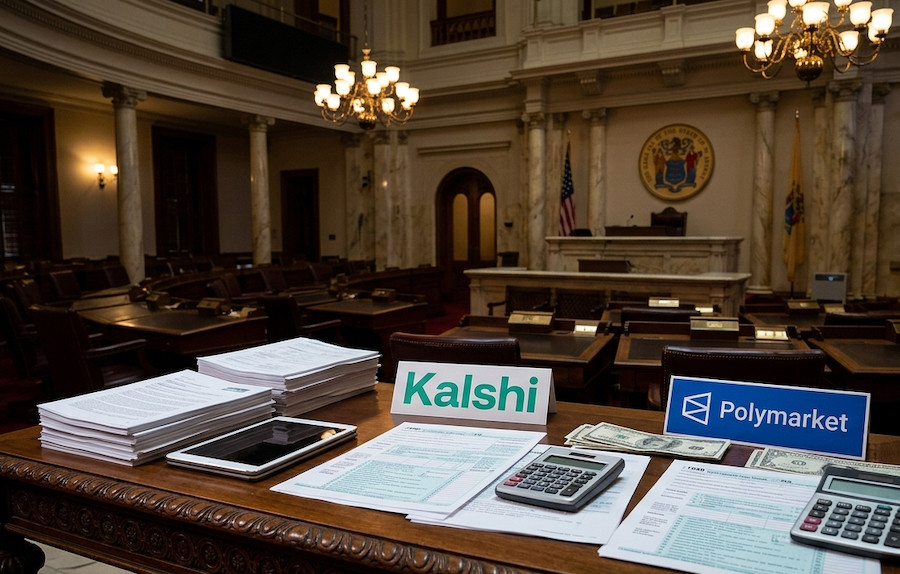
New Jersey is moving closer to a 9% tax on prediction market operators, as legislative committees rally around measures aimed at regulating the sector.
Legislation to impose a tax under either the state’s Corporation Business Tax or as a Gross Income Tax on prediction market operators’ income has already passed through the committee stage of both New Jersey’s legislative chambers.

According to NorthJersey.com, Senator Paul Sarlo, the Chair of the Senate Budget Committee, at a committee meeting on 28 June said that the first step to regulating prediction markets in New Jersey was being taken. The senator noted that lawmakers intend to bring in other measures to create a more level regulatory environment with licensed sportsbooks in the state.
The Senate committee approved the bill, which is sponsored by Senate President Nick Scutari, with nine Democrats in favor and four Republicans opposed. The Assembly Budget Committee also approved the bill.
Opponents of the bill included representatives from the union organization AFL-CIO, the prediction market company Polymarket and the union Unite Here Local 54.

The President of Unite Here Local 54, Donna DeCaprio, said that prediction markets are operating illegally in the state, and taking revenue from casinos, warning that taxing the companies could be seen as legitimizing their operations.
“If the state taxes prediction markets, it appears to legitimize them,” she explained. “Jobs in New Jersey have been lost and will continue to be lost as a result of this.”
According to the nonpartisan Office of Legislative Services, the proposed bill could generate between US$10.3 million and US$15.3 million in new state revenue during fiscal year 2027.

The tax comes as New Jersey has faced recent blows in federal court over the regulation of prediction markets. In April, the third US Circuit Court of Appeals ruled that New Jersey could not block prediction market operator Kalshi from offering its sports-event contracts.
Charlotte Capewell brings her passion for storytelling and expertise in writing, researching, and the gambling industry to every article she writes. Her specialties include the US gambling industry, regulator legislation, igaming, and more.

Dig Deeper
Related stories




The Backstory
States test the limits of federal oversight
New Jersey’s move toward a 9% tax on prediction market operators is the latest attempt by state lawmakers to respond to a fast-growing business that sits uneasily between financial exchanges and gambling. The bill advanced after a federal appeals court setback for the state, underscoring how legislatures are looking for tools beyond cease-and-desist orders to exert control over platforms that offer event contracts tied to sports and other outcomes.
The central dispute is whether companies such as Kalshi, Polymarket and Crypto.com are subject mainly to federal commodities law or state gambling statutes. Prediction market operators have argued that their contracts are regulated by the Commodity Futures Trading Commission, giving them a federal shield against state-level betting restrictions. State officials have countered that sports-event contracts look and function like gambling products, particularly when they allow users to take positions on game outcomes.
That conflict has escalated across several jurisdictions. In Kentucky, the CFTC took the unusual step of suing the state after officials sought to block federally regulated prediction markets and imposed a 14.25% excise tax on operators’ transaction fees. The agency said Kentucky was threatening large monetary penalties and interfering with federal authority, while state Attorney General Russell Coleman characterized Kalshi and Polymarket as illegal sportsbooks. The case, detailed in the CFTC’s lawsuit against Kentucky over prediction markets, shows the stakes for both sides: states want to protect gambling regimes they built after the fall of the federal sports betting ban, while the CFTC wants to preserve a national framework for derivatives trading.
Taxation emerges as a fallback strategy
New Jersey’s legislation reflects a shift in strategy. If states cannot easily exclude prediction markets because of federal preemption arguments, they may try to tax and regulate the revenue those companies earn from local users. That approach could put prediction markets closer to licensed sportsbooks economically, even if courts leave their legal status unsettled.
Iowa is pursuing a more aggressive version of that model. Lawmakers there advanced Senate File 2470, which would require event-based trading platforms to obtain a state permit costing $20 million upfront and $100,000 annually thereafter. The bill also includes a 20% tax on adjusted revenue from Iowa users and a 20% excise tax on the purchase price of each contract. According to the Iowa Legislative Services Agency, the measure could generate about $40 million in fiscal 2027, largely from initial permit fees. The proposal, covered in Iowa lawmakers’ push to tax prediction markets, illustrates how states are packaging consumer regulation with revenue capture.
The Iowa debate also mirrors New Jersey’s legal uncertainty. Kalshi urged Iowa lawmakers to wait, citing pending litigation over jurisdiction. State lawmakers instead moved ahead, arguing that the industry’s growth requires a framework now. New Jersey’s proposal is less costly for operators than Iowa’s, but the rationale is similar: platforms that profit from residents should not operate outside the state’s fiscal and regulatory reach.
Casinos and sportsbooks see a competitive threat
The backlash in New Jersey is shaped by the state’s gambling economy. Atlantic City casinos and licensed sportsbooks operate under detailed rules governing licensing, taxation, integrity monitoring and responsible gambling. Prediction market firms, by contrast, have sought to rely on federal market regulation rather than state gaming approvals. That creates a political problem for lawmakers, particularly in a state where gambling tax revenue and casino employment remain central to local economic policy.
Union opposition to New Jersey’s tax bill highlights a delicate issue: taxing prediction market companies could produce revenue while appearing to legitimize businesses critics say are operating illegally. Unite Here Local 54, which represents casino workers, warned that prediction markets are taking money from casinos and threatening jobs. That argument is likely to resonate in Atlantic City, where online betting growth has not erased concerns about casino employment and brick-and-mortar revenue.
Licensed sportsbooks also face a structural concern. If prediction market platforms can offer sports-linked contracts nationally under CFTC oversight, they may be able to reach customers in states where sportsbooks are heavily taxed, tightly restricted or prohibited. Even in states with legal sports betting, a lighter compliance burden could give prediction markets a pricing or product advantage. New Jersey’s proposed 9% tax would not equalize the field by itself, but lawmakers have signaled that it may be a first step toward broader oversight.
A broader crackdown on betting-adjacent products
The prediction market fight is unfolding alongside a wider state-level reassessment of gambling products that regulators believe blur legal or consumer-protection boundaries. Sweepstakes casinos, prop bets, in-play wagering and event contracts are different products, but they have drawn similar scrutiny because they can expand gambling-like activity outside traditional regulatory channels.
Louisiana lawmakers advanced a racketeering bill targeting online sweepstakes casinos and illegal gambling operations, a measure that would amend the Louisiana Racketeering Act to include gambling by computer, electronic sweepstakes devices and other offenses. The legislation, House Bill 53, would expose violators to fines of up to $1 million and prison terms of up to 50 years if signed into law. While the bill is not limited to prediction markets, it reflects a willingness by states to use harsher legal tools against products they view as unauthorized gambling.
Other states are focusing on specific sports betting formats. Utah lawmakers advanced a bill to ban prop betting, seeking to expand the state’s constitutional definition of betting to cover wagers on individual player performance or in-game events. The Utah proposal, House Bill 243, comes in a state that already prohibits gambling, but the debate has broader significance because prediction markets tied to sports may not fit cleanly within traditional sportsbook bans.
Public health arguments add pressure
The policy debate is also being shaped by concerns about gambling addiction, especially as mobile products make wagering faster and more continuous. Massachusetts lawmakers advanced legislation that would ban in-play and prop bets while raising the online sports betting tax rate to 51% and restricting gambling advertising during sporting events. The bill, Senate Bill 302, known as the Bettor Health Act, is framed less as a revenue measure than as a public health response.
That approach matters for prediction markets because the products can replicate some of the behavioral features that worry public health advocates: rapid trading, constant price movement and events that invite frequent engagement. Even if a contract is legally a derivative, lawmakers may view the user experience through the lens of gambling harm. That makes it harder for operators to rely solely on financial-market arguments in statehouses, even when those arguments carry weight in federal court.
New Jersey’s bill is narrower than the Massachusetts proposal, focusing on taxation rather than product bans or advertising limits. But the political currents are connected. States are reassessing whether the post-2018 sports betting market expanded too quickly and whether adjacent products are exploiting gaps in law. Prediction markets have become part of that reassessment because they offer sports-linked exposure without fitting neatly into either sportsbook or securities categories.
New Jersey could set a template
New Jersey has long played an outsized role in U.S. gambling policy, from its defense of sports betting before the Supreme Court to its mature online casino and sportsbook markets. Its response to prediction markets therefore carries weight beyond the immediate revenue estimate of $10.3 million to $15.3 million in fiscal 2027.
If the state enacts a tax and later builds a broader regulatory system, other gambling-heavy jurisdictions may follow. If courts determine that such taxes or regulations are preempted by federal commodities law, states may have fewer options and the pressure will shift to the CFTC and Congress. Either outcome could reshape competition between exchanges, sportsbooks and casinos.
For now, the states are moving faster than any national settlement. Kentucky is litigating, Iowa is seeking permits and taxes, Louisiana is threatening racketeering penalties for certain illegal gambling operations and Massachusetts and Utah are narrowing the types of sports bets they will tolerate. New Jersey’s tax bill fits into that pattern: a pragmatic effort to capture revenue and assert authority while the courts decide who ultimately controls the rules of prediction markets.
