


Kalshi issues first-ever lifetime ban for insider trading by former US politician George Santos

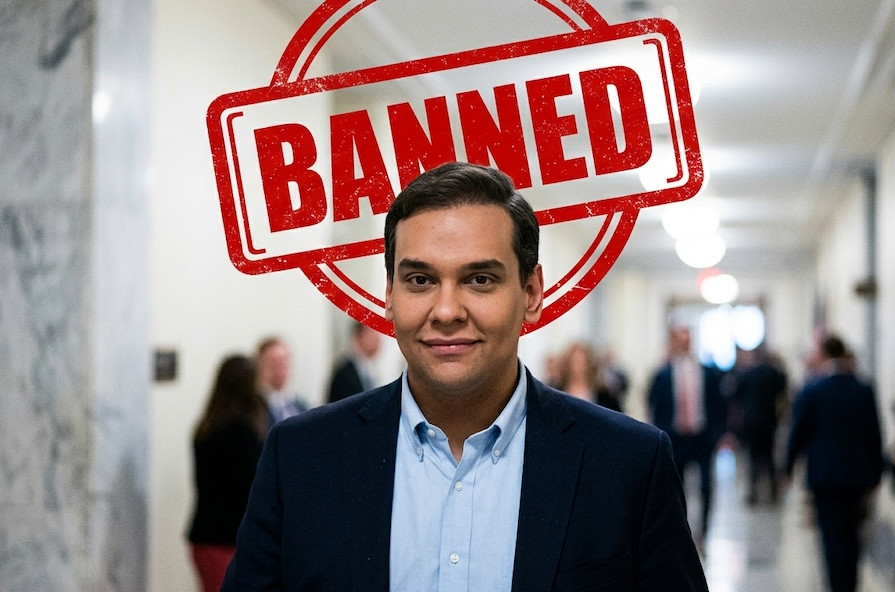
Prediction market platform Kalshi has permanently banned former US Representative George Santos – its first-ever lifetime ban, imposing a US$71,356 penalty after its Compliance Department found reasonable cause to believe he engaged in insider trading tied to his own attendance at the 2026 State of the Union address.
Kalshi said its Compliance Department established that Santos, as someone capable of influencing the outcome of the event, was barred from trading on contracts tied to his own attendance under Kalshi Exchange rules.

The company said that the public figure nonetheless placed a series of trades between 2 and 25 February, then made public statements about his plans “with the intent to manipulate the price” of the related contracts, statements Kalshi said “did in fact manipulate” pricing, netting Santos a US$17,839.57 profit.
Unlike other traders also penalized in Monday’s enforcement actions, Santos received a permanent ban. Kalshi attributed the harsher penalty to his lack of cooperation with the compliance investigation.
Santos responded on X, calling Kalshi “an unserious company” and accusing it of violating “its own notices and deadlines.”

“Hey @Kalshi thanks for the lifetime ban from your gambling platform,” he wrote. “Let’s see how much longer you guys are around for.”
The ban follows a separate July settlement in which Santos agreed to pay the Commodity Futures Trading Commission US$35,000 over the same trading activity, without admitting wrongdoing.
Santos was expelled from Congress in 2023 after pleading guilty to fraud and identity theft. He was released after serving part of a seven-year sentence following a pardon from President Donald Trump.

The former politician’s trade was put on display in Netflix’s documentary on prediction markets.

Dig Deeper
Related stories
 2026/08/03: Former US congressman George Santos to pay US$35,000 over unlawful Kalshi trades
 2026/06/04: George Santos under investigation for alleged insider trading on Kalshi
 2026/08/25: Total Philippines gambling ad ban seen handing market back to illegal operators, data from five countries show
 2026/02/16: Filipino actor Yen Santos signs as Filbet brand ambassador
2026/08/03: Former US congressman George Santos to pay US$35,000 over unlawful Kalshi trades
2026/06/04: George Santos under investigation for alleged insider trading on Kalshi
2026/08/25: Total Philippines gambling ad ban seen handing market back to illegal operators, data from five countries show
2026/02/16: Filipino actor Yen Santos signs as Filbet brand ambassador
The Backstory
Prediction markets move from novelty to enforcement test
Kalshi’s lifetime ban of former Rep. George Santos marks a sharp escalation in the policing of U.S. prediction markets, a sector built on the premise that contracts tied to real-world events can produce useful price signals if traders believe the market is fair. The action did not emerge in isolation. It followed months of scrutiny over whether politically connected figures, government employees and market participants with privileged access can trade on events they can influence or understand before the public does.
The Santos case is especially consequential because it sits at the intersection of politics, public statements and self-referential markets. The contract at issue asked whether he would attend President Donald Trump’s 2026 State of the Union address. Unlike a trader wagering on an external event, Santos was allegedly trading on an outcome tied to his own conduct. That distinction gave regulators and Kalshi a relatively clear theory of harm: a market cannot function if a participant can shape the event, speak publicly about it and trade around the resulting price moves.
Kalshi’s penalty also signals that exchanges are under pressure to show they can police themselves as event contracts expand into politics and public affairs. The company had previously said it reported suspicious activity in Santos’ account to federal authorities, a step detailed when George Santos came under investigation for alleged insider trading on Kalshi. That referral helped frame the episode not as a platform dispute but as a regulatory test for the broader prediction market industry.
From suspicious trades to a federal settlement
The chronology matters. Santos publicly indicated before the State of the Union that he planned to attend, but he did not appear. Kalshi’s market had priced in a high probability of attendance, and the reversal drew attention to whether Santos had taken positions that would benefit from his absence. Kalshi flagged the trading to federal authorities and the Commodity Futures Trading Commission, setting off the sequence that ultimately produced both a federal settlement and the company’s own sanction.
In July, Santos agreed to pay US$35,000 to resolve the CFTC matter, without admitting wrongdoing. As reported in the settlement over unlawful Kalshi trades, the order required him to forfeit more than US$17,000 in profits, pay a US$17,500 civil penalty and accept a three-year ban from trading on the platform. The regulator said Santos traded contracts on whether he would attend the speech while making social media posts about his plans, and that those posts moved prices in a direction favorable to his positions.
Kalshi’s later lifetime ban went further than the federal settlement. That matters because exchanges have rule books that can reach beyond the minimum terms of a regulatory resolution. The platform said Santos failed to cooperate with its compliance investigation, a factor that appears to have transformed a serious violation into its first permanent exclusion. For a market operator seeking legitimacy with regulators, the internal sanction serves a second audience: other politically exposed users who may be tempted to trade around events they can influence.
The self-referential contract problem
Prediction markets are most vulnerable when contracts involve people with direct control over the answer. Sportsbooks have long restricted athletes, coaches and team employees from betting on games because their information and incentives are different from those of the public. Political event markets face a comparable problem, though the boundaries are less familiar. A public official, campaign staffer or political insider may possess information that ordinary traders cannot obtain, while also having the ability to affect the final outcome.
Santos’ case illustrates the highest-risk version of that problem. Attendance at a public event is binary, easily understood and apparently simple to settle. Yet the trader at the center of the market was also the person whose action determined the result. Public statements then became part of the alleged scheme because they could alter market expectations before the outcome was known. In that structure, social media did not merely communicate information; it could become a trading instrument.
That risk has become more visible as political figures use platforms that can move markets in real time. Concerns intensified after Trump introduced Truth API, a service offering faster paid access to posts from high-ranking Truth Social accounts. The backlash, covered in concerns over Truth API and insider trading, centered on whether institutional investors or political traders could gain an unfair timing advantage in markets linked to presidential statements, policy moves or public events.
The comparison is not exact. Truth API raised questions about unequal access to potentially market-moving information, while the Santos matter concerned a trader’s alleged influence over a specific event. But both controversies point to the same structural issue: political information is increasingly tradable, and the rules for who may trade, when and with what information are still being tested.
Compliance becomes a competitive necessity
Kalshi’s response should be read partly as risk management. Prediction markets depend on confidence that prices reflect dispersed judgment rather than manipulation by insiders. If high-profile users can profit from privileged access or direct influence, the market’s core claim weakens. A permanent ban therefore functions as deterrence, but also as a public statement that the exchange will sacrifice user growth when market integrity is at stake.
The industry has moved in that direction as scrutiny has increased. Kalshi recently partnered with compliance technology provider Comply to help identify and prevent inappropriate trading activity, while Goldman Sachs has restricted employees from trading contracts tied to events involving the bank. Those steps reflect a maturing market structure. What began as a consumer-facing venue for event wagers is becoming a compliance-heavy financial marketplace, particularly when contracts touch elections, government decisions and corporate developments.
The Santos enforcement action also clarifies the role of cooperation. Regulators and exchanges often distinguish between misconduct that is remediated and misconduct compounded by obstruction or noncooperation. Kalshi’s harsher penalty suggests it wants to create a cooperation incentive similar to those in securities and derivatives enforcement. Users who trade in sensitive markets may now face not only financial penalties but permanent loss of access if they do not engage with compliance reviews.
A wider debate over regulated visibility
The enforcement posture in the United States has a parallel in other gambling and gaming markets: regulators are trying to keep activity inside licensed channels while tightening controls on conduct that creates harm. The balance is difficult. Excessive restriction can drive users offshore, while lax oversight can undermine trust and invite political intervention.
That tension is evident in the Philippines, where lawmakers have debated a total gambling advertising ban amid rapid growth in licensed online gaming. A recent analysis warned that a blanket prohibition could hand customers back to illegal operators, arguing that licensed advertising helps channel players toward supervised platforms with age checks, responsible-gaming tools and tax obligations. The article on the risks of a total Philippines gambling ad ban used data from several countries to argue that legal visibility can be a consumer-protection tool when paired with strict rules.
The comparison is useful because prediction markets face a similar channelization problem. If regulated platforms are seen as unsafe or easily manipulated, users may migrate to less supervised venues. Conversely, if regulated exchanges act aggressively against insiders, they strengthen the argument that event trading can remain within monitored markets rather than moving to offshore or informal channels.
Celebrity and influencer promotions in the Philippines show the same regulatory trade-off. When Filipino actor Yen Santos signed as a Filbet brand ambassador, the endorsement landed amid PAGCOR pledges to tighten igaming restrictions. The issue was not whether marketing should exist, but whether licensed operators, public figures and platforms could operate under rules that protect consumers without ceding the field to unlicensed rivals.
The stakes for Kalshi and political contracts
Kalshi’s lifetime ban raises the cost of misconduct for politically connected traders and sets a precedent for how the platform may handle future conflicts. The company has fought state-level challenges to its event contracts and continues to argue that regulated prediction markets can operate within a legitimate derivatives framework. Strong internal enforcement supports that case.
The Santos matter also gives regulators a concrete example as they consider how far political prediction markets should extend. Contracts tied to public figures, speeches, elections and official actions can attract liquidity and public attention, but they also create insider-risk scenarios unlike ordinary retail trading. Platforms will need clearer restrictions on self-referential contracts, public officials, campaign personnel, government staff and others who may possess nonpublic information or influence outcomes.
For Santos, the financial penalties are modest compared with the reputational effect of becoming the first user permanently banned by Kalshi. For the industry, the case is larger than one former lawmaker. It is an early test of whether prediction markets can discipline participants whose political status makes them both attractive to markets and dangerous to market integrity.
