


Kalshi ends Donald Trump Jr advisory contract amid US$65 billion valuation talks

Prediction market platform Kalshi has ended its advisory agreement with Donald Trump Jr, as the company reportedly holds talks on a new funding round that could value it at US$65 billion.
A Kalshi spokesperson confirmed to Reuters that the company and Trump Jr had mutually agreed to end the contract, following “his firm’s significant investment in a competitor this past summer.”

Trump Jr’s venture capital firm 1789 Capital led rival Polymarket’s most recent funding round, with discussions about ending the advisory contract beginning in August, according to the spokesperson.
Trump Jr was appointed as a strategic adviser to Kalshi in January 2025, receiving a stake in the company reported by the Financial Times to be worth around US$300,000. The spokesperson thanked him for “helping us market Kalshi to more customers.”
Separately, Kalshi is in talks to raise funds at a US$65 billion valuation to build a platform for trading compute futures, a source familiar with the matter told Reuters. Bloomberg also reported the talks.

These contracts would allow traders to hedge or speculate on the future cost of computing resources, such as cloud and GPU capacity.
The move would widen Kalshi’s range of financial products, placing it in competition with exchanges including CME Group and New York Stock Exchange parent Intercontinental Exchange.
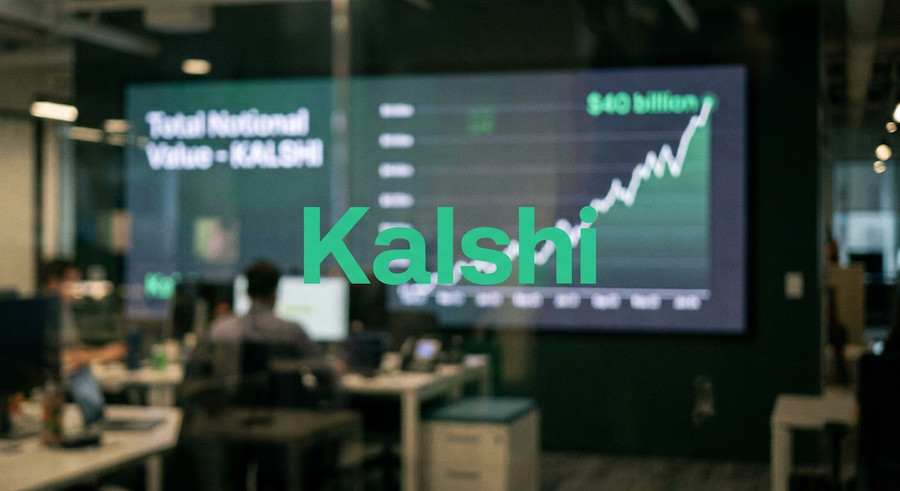
The talks follow Kalshi’s US$1 billion funding round in late October at a US$40 billion valuation, which came around five months after a previous US$1 billion raise at a US$22 billion valuation.

Kalshi’s expansion comes as it faces legal challenges in Arkansas and Utah over whether its sports event contracts fall under state gambling laws or federal financial regulation. It was also accused of providing illegal sports betting in a nationwide class action filed in New York last year.

Dig Deeper
Related stories
 2026/03/23: Kalshi valuation surges to US$22 billion after recent funding round
 2026/09/01: Polymarket value to top US$21 billion following investment from Donald Trump Jr.’s venture firm: report
 2026/08/14: Kalshi pushes investors for US$40 billion valuation but regulators have other plans
 2025/10/13: Kalshi hits US$5 billion valuation after latest financing round
2026/03/23: Kalshi valuation surges to US$22 billion after recent funding round
2026/09/01: Polymarket value to top US$21 billion following investment from Donald Trump Jr.’s venture firm: report
2026/08/14: Kalshi pushes investors for US$40 billion valuation but regulators have other plans
2025/10/13: Kalshi hits US$5 billion valuation after latest financing round
The Backstory
Political ties become a competitive risk
Kalshi’s decision to end its advisory agreement with Donald Trump Jr. lands at the intersection of three forces reshaping prediction markets: a surge in private valuations, intensifying competition with Polymarket and mounting scrutiny over whether sports event contracts are financial instruments or illegal gambling.
Trump Jr. joined Kalshi as a strategic adviser in January, giving the federally regulated prediction market operator a high-profile political connection as real-money event trading moved closer to the mainstream. But that relationship became harder to maintain after his venture firm, 1789 Capital, backed Polymarket, Kalshi’s most direct rival. The split underscores how quickly alliances in the sector have shifted as investors assign exchange-like valuations to platforms that only recently operated in a niche market.
The move also reduces one potential conflict as Kalshi seeks fresh capital at a reported US$65 billion valuation. The company is pitching investors on a broader ambitions beyond political and sports contracts, including markets tied to the future cost of computing resources. That would push Kalshi deeper into territory occupied by established financial exchanges and make its regulatory posture even more central to its investment case.
Valuations outrun the rulebook
Kalshi’s fundraising trajectory has been unusually steep. In October, the company raised US$300 million in a Series D round that valued it at US$5 billion, according to earlier reporting on Kalshi’s US$5 billion valuation. That round followed a Series C that had valued the business at just more than US$2 billion in June. Investors included Sequoia Capital, CapitalG, Coinbase Ventures, Paradigm and Andreessen Horowitz.
The company’s growth metrics helped justify the rapid repricing. Kalshi said it was on pace for US$50 billion in trading volume, compared with US$300 million the prior year. It also signaled plans to market to customers in more than 140 countries, positioning itself not merely as a U.S. event-contract venue but as a global prediction market brand. Data cited at the time showed Kalshi had overtaken Polymarket, with market share above 60%.
That US$5 billion mark soon looked like an early stop rather than a peak. A later funding round raised more than US$1 billion and doubled a prior US$11 billion valuation to US$22 billion, according to Complete iGaming’s report on Kalshi’s US$22 billion valuation. The Wall Street Journal first reported that round was led by Coatue Management, with Kalshi’s annualized revenue said to be about US$1.5 billion.
The current talks at US$65 billion would imply another dramatic increase after a reported US$40 billion valuation in late October. Such figures reflect investor belief that prediction markets could become a new retail-facing asset class. They also assume Kalshi can defend a federal-regulation model against state gambling authorities that argue many of the company’s most popular contracts function like wagers.
State challenges expose the core legal fault line
Kalshi’s central legal argument is that its contracts fall under federal commodities law because it operates through a Commodity Futures Trading Commission-regulated framework. Several states have rejected that view when sports outcomes are involved, saying the products violate local gambling laws.
The tension sharpened as Kalshi pursued higher valuations. In August, the company faced a series of setbacks that complicated investor discussions, including an order from a King County Superior Court judge requiring Kalshi to cease most operations in Washington. The order covered sports, elections, politics, entertainment, culture, technology, science and any markets mentioning Washington. The court found Kalshi most likely violated the state’s Gambling Act and Consumer Protection Act, and required geofencing to block Washington residents from specific contracts.
The same period brought a Baltimore lawsuit against Kalshi and Polymarket alleging illegal sports betting and violations of Maryland gambling law. The city sought to halt access for residents, impose civil penalties, secure restitution and recover profits. In Connecticut, a federal judge rejected Kalshi’s request for an injunction against the state’s Department of Consumer Protection, concluding the company was unlikely to show that Connecticut lacked authority over its sports-event contracts. Those developments were detailed in Complete iGaming’s account of Kalshi’s US$40 billion valuation push and regulatory setbacks.
More recently, Arizona’s attorney general filed criminal charges alleging illegal betting. Kalshi founder Tarek Mansour called the filing a “total overstep.” The accumulation of state actions matters because sports markets are a key driver of retail volume. If states force geofencing or secure injunctions, Kalshi’s addressable U.S. market could fragment even as investors price the company like a national or global exchange.
Polymarket intensifies the race for scale
Kalshi’s break with Trump Jr. is also a Polymarket story. The rival platform has attracted its own wave of institutional and politically connected capital. Intercontinental Exchange, the parent of the New York Stock Exchange, made a major investment in Polymarket that valued it at US$8 billion. That was followed by reports that 1789 Capital, where Trump Jr. is a partner, would lead a US$1 billion Polymarket funding round valuing the company above US$21 billion.
According to Complete iGaming’s report on Polymarket’s expected US$21 billion-plus valuation, 1789 Capital was expected to invest US$300 million in the round, after previously putting US$200 million into the platform. The firm first invested in Polymarket during the 2024 presidential election, when prediction markets drew heightened attention from political traders, media organizations and retail speculators.
That investment created an awkward overlap. Trump Jr. had been retained to help Kalshi market itself to more customers, but his venture firm was committing significant capital to a competitor. Ending the advisory contract removes that conflict, while highlighting how political influence, media visibility and regulatory access have become strategic assets in the prediction market business.
Polymarket’s rise also pressures Kalshi to broaden its product set. If both firms compete primarily on elections, sports and cultural events, state gambling disputes will define the market’s ceiling. Kalshi’s reported interest in compute futures suggests a bid to move into contracts that look more like commercial hedging products than consumer event wagers, potentially widening its investor base and reducing reliance on legally contested sports volume.
Trump-linked ventures move into prediction markets
The political dimension extends beyond individual investments. Trump Media & Technology Group has partnered with Crypto.com to launch Truth Predict, a prediction market product for Truth Social users. The planned service would allow trading on elections, inflation and sports outcomes through Crypto.com Derivatives North America, a CFTC-registered exchange.
As Complete iGaming reported on Trump Media’s Crypto.com prediction market partnership, the companies plan integration testing before a U.S. rollout and eventual global expansion, subject to requirements. The initiative deepens Trump Media’s exposure to digital assets and event trading at a time when the administration has promoted crypto, artificial intelligence and prediction markets as strategic sectors.
That backdrop raises the stakes for Kalshi. Political attention can accelerate mainstream adoption and attract capital, but it can also invite investigations and claims of favoritism. Democrats in Congress have already scrutinized Polymarket’s success following Trump Jr.’s involvement with 1789 Capital, seeking records on investments and communications with the federal government. In such an environment, Kalshi has an incentive to present itself as institutionally independent and focused on regulated market infrastructure.
The company’s next phase will test whether that positioning is enough. Investors are valuing prediction markets as if they can become the next major trading venue category. State regulators are treating parts of the same business as sports betting in another form. Kalshi’s separation from Trump Jr. clarifies one governance issue, but the larger question remains whether its federal model can scale faster than state-level enforcement can constrain it.
