


Hard Rock expands esports streaming offering through launch of Global Gaming League efootball

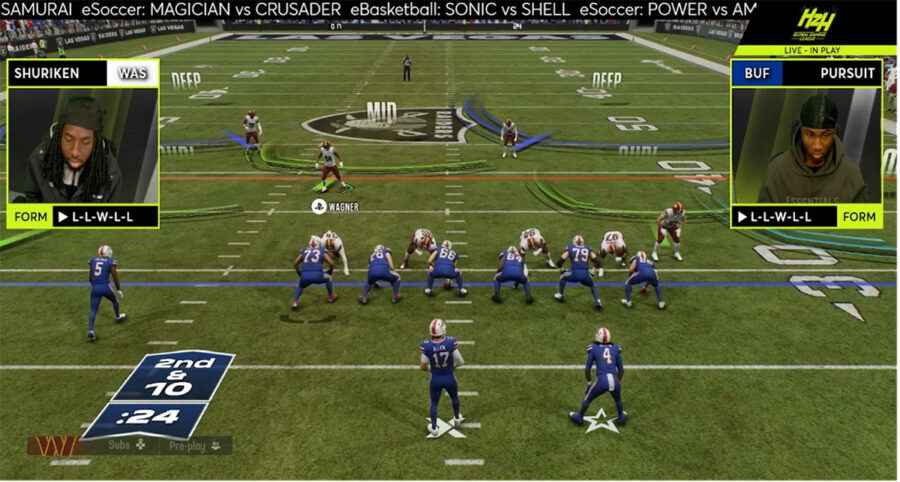
Hard Rock Bet Sportsbook has expanded its offering of content from real-time sports data company Sports Information Services Content Services by launching the company’s H2H Global Gaming League efootball games.
Hard Rock previously launched ebasketball and esoccer games.

Sports Information Services will initially offer two efootball 24/7 live streams, with more than 25,000 events expected to be broadcast each year, increasing the number of live events offered on Hard Rockbet’s Sportsbook to more than 275,000.
Michele Fischer, Vice President at Sports Information Services Content Services, said in a news release that the addition “provides Hard Rock Bet Sportsbook with another compelling, commercially successful product that adheres to the strictest integrity standards synonymous with SIS.”
The league will feature a number of professional gamers, streamed with low latency, allowing pre-game and in-play wagers for bettors.

“We’re excited to expand our partnership with SIS and be one of the first operators to introduce this new, always-on football experience to our players,” Neil Walsh, Senior Vice President of Sportsbook at Hard Rock Digital, said. “Adding H2H Global Gaming League efootball strengthens our markets and esports offering and reflects our ongoing focus on bringing innovative, high-quality content to our players.”
In September, Hard Rock Bet expanded its partnership with sports technology group Genius Sports for its in-play streaming service BetVision to give customers access to BetVision’s low-latency video and real-time statistics, allowing bettors to wager without leaving the stream.
Abi Bray brings strong researching skills to the forefront of all of her writing, whether it’s the newest slots, industry trends or the ever changing legislation across the U.S, Asia and Australia, she maintains a keen eye for detail and a passion for reporting.

Dig Deeper
Related stories



The Backstory
An always-on play for engagement
Hard Rock Bet’s latest push into simulated sports streams fits a clear strategy: keep bettors engaged even when real-world schedules slow. The sportsbook’s adoption of head-to-head esports-style football streams builds on a steady ramp of always-on content and quick-bet markets designed for constant availability and short dwell times. It follows prior additions of similar basketball and soccer feeds and complements Hard Rock’s broader live-betting toolkit built around low-latency video, real-time stats and in-play wagering.
Unlike traditional esports tied to specific leagues and event calendars, these head-to-head formats run continuously, promising tens of thousands of annual matchups and a predictable cadence for betting markets. This “always on” proposition is not simply about volume. It is about meeting customer expectation that odds, streams and micro-markets are accessible at any hour and that bet settlement happens fast. For operators, those traits extend session length and open more inventory for promotions and personalization. For suppliers, they create sticky distribution footprints across multiple states as sportsbooks seek parity on product breadth.
The move also underscores how sportsbooks are using curated, low-latency streaming ecosystems to reduce friction. Bettors can watch, analyze and place wagers without app switching. That integrated path is becoming table stakes in a U.S. market where live handle and micro-bets are rising as a share of total activity.
SIS’s U.S. expansion and the integrity sell
Hard Rock’s content partner, SIS Content Services, has spent the past year widening its American footprint for head-to-head esports streams. In a prior agreement, the company and operator expanded distribution of short-form eBasketball and eSoccer, with SIS touting annual volumes in the hundreds of thousands of matches across multiple jurisdictions. Inside that announcement, SIS framed integrity credentials as a differentiator, highlighting Esports Integrity Commission accreditation and standardized officiating for professional gamers. Read more about SIS’s earlier deal with Hard Rock Bet to add 225,000 eBasketball and eSoccer matches.
The sales pitch matters. Esports and esports-adjacent betting continue to face scrutiny around match-fixing risks, player safeguarding and the mixed-age nature of fan bases. Suppliers are responding by emphasizing controlled studio environments, compliance audits and clear data provenance. For operators, those assurances are now part of a broader risk and brand calculus as they evaluate which content categories to feature prominently on home screens.
Volume alone does not confer trust, but standardized formats make monitoring easier. The industrialization of these matches — consistent durations, rule sets, and stream production — gives sportsbooks cleaner pricing signals and reduces operational variance, an important factor for traders managing rapid-fire in-play markets.
The race to lower latency and bundle streaming with bets
Hard Rock has already moved to tighten the loop between stream and stake. The operator extended its partnership with sports data firm Genius Sports to deploy BetVision for embedded video, live statistics and wager placement without leaving the stream. That integration aligns with the sprint across the industry to cut video lag, synchronize odds with on-screen events and surface context-driven markets the moment they become relevant.
Low latency is not merely a technical bragging right. It is central to micro-betting economics. If the stream trails reality by too much, operators must defensively widen spreads, throttle markets or suspend betting more often, which erodes handle and customer trust. Conversely, paired video and pricing improve conversion and reduce disputes. As sportsbooks scale always-on content, reliability and synchronization become core UX features — as important to competitive advantage as promotional budgets.
Betting’s uneasy overlap with esports brands
The integrity narrative around esports content is arriving as the industry wrestles with a separate but related controversy: team and league sponsorships from wagering companies. Recently, Riot Games drew criticism for enabling betting sponsorships on top Valorant and League of Legends teams. Riot’s president of publishing and esports, John Needham, defended the shift as a way to steer fans toward regulated markets and away from illegal bookmakers. He outlined planned guardrails in Needham’s LinkedIn post, arguing that engagement with licensed operators, done carefully, protects both fans and competitive integrity.
Community reaction skewed negative, reflecting long-standing anxiety over gambling’s influence on young audiences and match integrity. One widely shared reaction on Reddit captured a broader sentiment — “I hate gambling and how pervasive it is” — while one Reddit comment conceded the policy was “inevitable” given teams’ revenue pressures and the dearth of alternative funding models. Another commenter framed the shift as a pragmatic, if uncomfortable, response to industry economics.
For sportsbooks and suppliers, the takeaway is twofold: regulated, high-integrity formats are essential to winning distribution, and brand adjacency to mainstream esports still carries reputational risk. That puts a premium on studio-run competitions with strong compliance frameworks — precisely the niche head-to-head products are designed to occupy.
Omnichannel pressure: casinos and platforms pivot online
The competitive backdrop extends beyond sportsbooks. Land-based casino operators and gaming brands are deepening digital offerings to diversify revenue and meet customers on mobile. In the Philippines, Bloomberry Resorts is preparing a new nationwide digital platform alongside Solaire Online to offset lost VIP spend and capture growth in domestic online play, even as it faces a scaled rival in DigiPlus. See how the operator is positioning itself in Bloomberry’s plan to expand its online gaming offering.
In Mexico, PlayCity Casino is extending a long-standing content relationship with Konami from floors to phones, adding a slate of recognized slot titles through a remote gaming server. That approach leans on brand familiarity and unified wallets to bring retail players into digital ecosystems. Details are in PlayCity’s expansion of its igaming library with Konami slots.
The through line: operators with physical footprints are racing to build omnichannel funnels, while pure-play platforms chase live, data-rich content that keeps users inside their apps. Head-to-head streams and embedded video markets fit both agendas by offering high-frequency touchpoints and straightforward integration.
Blurring lines with prediction markets
The boundary between trading and betting is also softening. Robinhood, which entered prediction markets during the 2024 election cycle, is now layering in parlays and player props for the NFL. The platform’s preset combos and planned custom bundles mirror sportsbook mechanics, bringing mainstream wagering logic into a brokerage-style interface. Read more in Robinhood’s move to offer NFL parlays and prop bets.
For traditional operators, that encroachment underscores why differentiated live content and superior streaming-betting integration matter. If trading apps can replicate core bet types and market depth, sportsbooks need defensible experiences — low-delay video, perpetual match inventory, tailored micro-markets — to hold share. Head-to-head esports content is one lever to do it at scale.
What to watch: state-by-state treatment of esports wagering, the durability of integrity credentials under stress, and whether omnichannel casinos can convert retail loyalty into digital frequency. As lines between content, commerce and wagering blur, the winners will likely be those who collapse more of the experience — viewing, pricing and staking — into one seamless flow without sacrificing trust.
