


Fanatics launches app combining sports bets, casino and event contracts

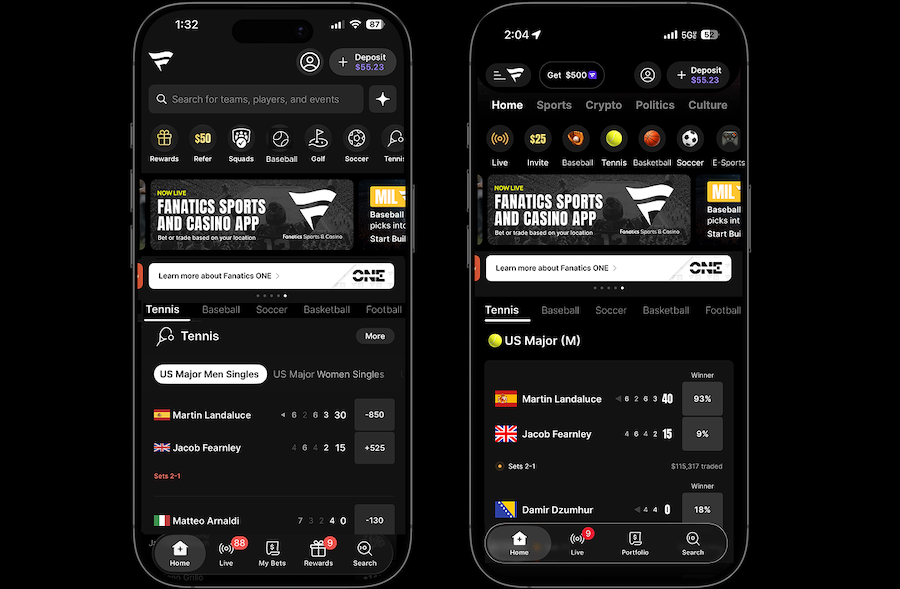
Betting operator Fanatics has launched an app that combines its sportsbook, online casino and event contracts products in one place. Called Fanatics Sports & Casino, the app brings together Fanatics Sportsbook, Fanatics Casino and Fanatics Markets.
According to Fanatics, the three products are all connected to the same rewards and loyalty system, Fanatics ONE, through which customers can earn loyalty points through betting, trading, and casino activity, which it says can be redeemed for merchandise, tickets, and collectibles.

Fanatics Betting and Gaming CEO Matt King said, “Fanatics Sports & Casino gives fans across America one app where the experience travels with them, from betting the game, to trading on its biggest moments, to playing casino games. And because it’s Fanatics, every one of those bets, trades or plays earns FanCash; we can uniquely connect what fans play to what fans love in one ecosystem.”
The app will automatically tailor the products available to each user based on their location and the types of gambling available in their state.
The sportsbook element is currently operating in 23 states, as well as Washington D.C., while the casino is available in New Jersey, Pennsylvania, Michigan and West Virginia.

The brand’s federally-regulated prediction market platform, Fanatics Markets, is available in 22 states and four US territories. It offers event contracts, which allow users to buy and sell based on the outcomes of sports, cultural and political events.
The sector is facing challenges from multiple state gambling regulators over whether sports-related event contracts should be subject to state betting laws.
Prediction market operators, including Fanatics, argue that event contracts are regulated at the federal level, an argument that many analysts believe will eventually be tested in the Supreme Court.

Dig Deeper
Related stories
 2025/06/23: Canadian Gaming Summit: Operators seek retention strategies beyond promotions
 2026/07/28: Fanatics brings prediction market fully in-house with Water Street Labs acquisition
 2026/05/28: Fanatics Markets launches World Cup prediction market hub
 2025/05/05: Fanatics Casino launches in four US states with $2 million sweepstakes competition
2025/06/23: Canadian Gaming Summit: Operators seek retention strategies beyond promotions
2026/07/28: Fanatics brings prediction market fully in-house with Water Street Labs acquisition
2026/05/28: Fanatics Markets launches World Cup prediction market hub
2025/05/05: Fanatics Casino launches in four US states with $2 million sweepstakes competition
The Backstory
Fanatics’ push to make one account carry more weight
Fanatics’ new combined app is the latest step in a strategy built around making sports betting, online casino play and event contracts feel less like separate businesses and more like extensions of the same fan relationship. The company is leaning on a familiar consumer-platform idea: one account, one wallet of rewards and a product mix that changes depending on where the user is located.
That approach reflects a broader shift in online gambling. The biggest operators are no longer competing only on who can spend the most on sign-up offers. They are trying to lower friction, personalize the experience and give customers reasons to return after the promotional window closes. Fanatics has a particular incentive to pursue that model because its parent company already has a large commerce and sports-merchandise ecosystem. FanCash and Fanatics ONE give it a way to connect betting activity to merchandise, tickets and collectibles in a manner most sportsbook-only competitors cannot easily match.
The combined app also arrives as the lines between regulated gambling products and federally regulated event contracts are under mounting scrutiny. Fanatics is packaging sportsbook, casino and prediction-market access in a single consumer interface while still limiting availability based on state rules. That design underscores both the opportunity and the risk: a national brand can offer a seamless app, but the regulatory status of each product remains uneven.
Casino growth gave Fanatics another leg of the stool
Before it moved to put the products under one roof, Fanatics had been building out its casino business in the few states where online casino gambling is legal. In May, the company launched Fanatics Casino in Michigan, Pennsylvania, West Virginia and New Jersey, pairing the rollout with a $2 million sweepstakes promotion.
The launch signaled that Fanatics did not intend to remain primarily a sportsbook operator. Online casino can be more frequent-use and higher-margin than sports betting, but it is available in far fewer states. That makes it strategically useful where legal, especially when tied to the same rewards system as sportsbook activity. Fanatics stocked the casino with games from major suppliers including Light & Wonder, IGT PlayDigital, Evolution, White Hat Studios and Wazdan, while also promoting in-house titles such as Fanatics Fire Roulette and Fanatics Blackjack.
At the time, the company said Fanatics Casino was the fastest-growing casino in the U.S., citing gross gaming revenue growth in late 2024 among operators producing more than $10 million in revenue. That growth claim mattered because it gave the company a stronger basis for bundling casino into a broader app. A sportsbook can drive event-based engagement around games. Casino can fill the calendar between those events. Prediction markets can add another layer of interaction tied to sports, politics, culture and other outcomes.
The challenge is that this wider product set intensifies questions around customer protection, responsible gaming and product clarity. Combining different forms of wagering-like activity in one app may improve convenience, but it also places more pressure on operators to explain what is available, why it is available and under which regulatory framework it operates.
Prediction markets became the most contested growth path
The most disruptive piece of the Fanatics app is Fanatics Markets, the company’s event-contract platform. Its inclusion in the same ecosystem as sportsbook and casino reflects a major industry debate over whether sports-related contracts should be treated as financial products overseen by the Commodity Futures Trading Commission or as sports betting subject to state gambling laws.
Fanatics’ move into prediction markets did not occur in isolation. The sector gained urgency after DraftKings and FanDuel broke from the American Gaming Association over the issue, a split examined in a Complete iGaming analysis of the future of prediction markets. That piece traced how the 2018 repeal of the Professional and Amateur Sports Protection Act opened a wave of state sports betting expansion, but that expansion has slowed. Large states such as California and Texas still do not have legal online sports betting, creating an incentive for national operators to seek federally regulated alternatives.
Fanatics initially entered the prediction-market space through a partnership with Crypto.com’s North American derivatives arm. Unlike DraftKings and FanDuel, it had remained aligned with the AGA at the time, but its entry showed how quickly major betting brands were testing the same thesis: event contracts could offer nationwide reach that state-by-state sports betting cannot.
The stakes are significant. State regulators have warned licensees that sports event contracts may trigger licensing consequences. Operators argue that contracts listed through federally regulated entities fall outside state gambling control. Analysts expect the conflict to move through the courts and potentially reach the Supreme Court. Until then, companies such as Fanatics are trying to build consumer products while preserving optionality in a legal environment that has not caught up to the technology.
Owning the rails raised the stakes
Fanatics deepened its commitment when it acquired Water Street Labs from BGC Group, giving Fanatics Markets ownership of federally regulated prediction-market infrastructure. The deal brought in a derivatives clearinghouse and exchange capability, allowing Fanatics to list and clear contracts without relying on an intermediary.
That acquisition changed the nature of Fanatics’ involvement. A partnership can be exploratory. Owning market infrastructure is a longer-term bet. It gives the company greater control over product development, compliance processes and clearing economics. It also positions Fanatics to connect retail-facing sports and event contracts with institutional-style market data and analytics through BGC’s continued partnership.
The move helps explain why Fanatics would now place Fanatics Markets alongside sportsbook and casino in one consumer app. The company is not merely adding a third-party feature. It is trying to build a regulated exchange business that can benefit from Fanatics’ brand, customer base and data relationships. That integration may make the product more intuitive for sports fans, but it also makes Fanatics more visible to state regulators concerned that event contracts are being used as a workaround for sports betting law.
Fanatics’ location-based tailoring is therefore more than a user-experience feature. It is a compliance mechanism in a fragmented market. The company can show different products in different places, reflecting the patchwork of online casino states, sportsbook jurisdictions and states or territories where federally regulated contracts are offered.
World Cup timing showed the fan-engagement playbook
The company’s prediction-market ambitions also took on a more event-driven shape with the launch of a FIFA World Cup 2026 prediction market hub with ADI Predictstreet. That hub was designed to combine prediction markets, live statistics, tournament news and fan content in one experience through the Fanatics Markets app and website.
The World Cup is a natural test case. It is a mass-market sporting event with national storylines, constant fixtures and casual fans who may not be regular sports bettors. By adding content and live data around contracts, Fanatics and ADI Predictstreet are trying to make prediction markets part of the viewing experience rather than a stand-alone financial product.
That strategy aligns closely with the new combined app. Fanatics is betting that fans do not want a fragmented set of gambling and engagement tools. They want a single destination that follows the sports calendar and rewards their activity. If the company can move a fan from reading tournament content to trading a contract, betting on a game in a legal sportsbook state or later playing casino games in a permitted market, the value of each customer relationship increases.
The risk is that greater ease of movement across products can draw sharper scrutiny from regulators and responsible-gaming advocates. A World Cup hub may be framed as fan engagement, but when paired with real-money contracts and a broader gambling ecosystem, it becomes part of the same policy debate over access, disclosure and consumer safeguards.
Loyalty is the battleground behind the app
Fanatics’ combined-app strategy also reflects a wider industry view that loyalty, not acquisition spending, will determine long-term winners. At the Canadian Gaming Summit, operators discussed the difficulty of keeping users in markets where customers commonly hold accounts with several sites. A panel covered by Complete iGaming found that companies are seeking retention strategies beyond promotions, including personalization, stronger onboarding and emotional connection to teams and local markets.
That context is central to Fanatics’ move. A unified app gives the company more data about what users do across products and more opportunities to personalize offers, content and rewards. It can identify whether a customer prefers parlays, slots, soccer markets or collectibles and then shape the app experience accordingly. The same logic drove summit discussions about moving away from generic bonuses toward more relevant engagement.
The difference is that Fanatics can tie gambling and trading activity to a broader sports-commerce identity. That could strengthen retention if customers see FanCash as useful beyond the app. It could also complicate the policy conversation because rewards earned through betting, casino play and trading may feel less like isolated gambling incentives and more like part of a mainstream sports-shopping ecosystem.
The company’s launch, then, is not just a product update. It is a statement about where large operators see the U.S. market heading: fewer new state sportsbook openings, more pressure to deepen existing relationships, expanding online casino where permitted and a high-stakes fight over prediction markets. Fanatics is trying to connect those pieces before the courts and regulators decide how far the model can go.
