


DraftKings and Delta bring wagering game to the skies, without real money betting

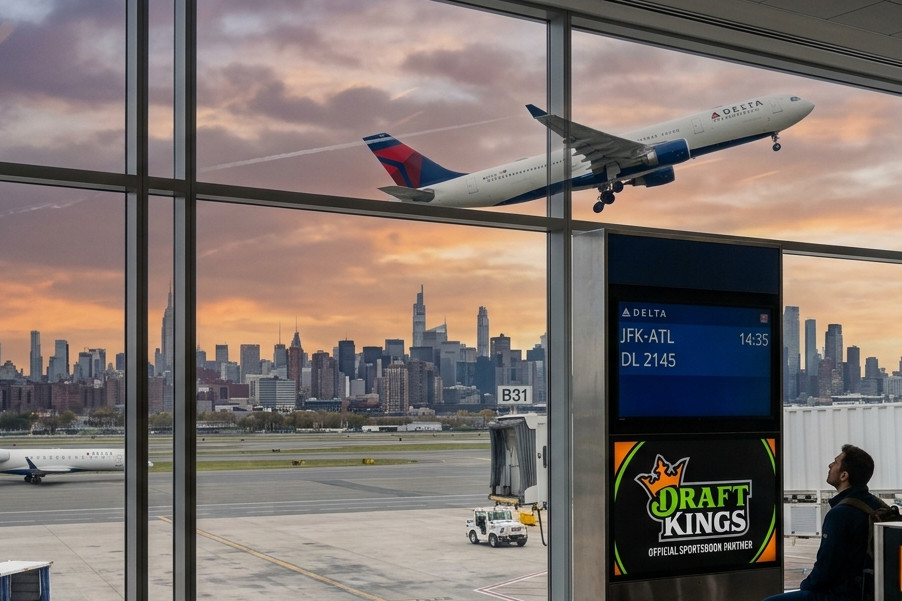
DraftKings and Delta Air Lines have launched a sports prediction game for passengers on domestic US flights. The new game, called SkyPicks, was launched on 29 July and can be accessed via Delta’s onboard Wi-Fi network on all participating flights.
Any passenger over the age of 21 can participate by signing in with their existing DraftKings account or creating a new one.

According to DraftKings, the game does not require players to wager real money. Those who choose to take part answer a series of sports prediction questions, including questions about which team will win a particular match and the final score.
Those who score highest are eligible for Delta gift cards.
DraftKings says that SkyPicks initially focuses on MLB contests, although NFL games are likely to be added later this year. The game is available through passengers’ personal devices, not seatback entertainment screens.

The launch is an expansion of Delta’s in-flight entertainment service, which already includes live sports broadcasts and other sports shows. Speaking about the new game, DraftKings’ Chief Commercial Officer, Jeremy Elbaum, said it was about extending fan interaction.
“At DraftKings, we believe interaction with sports shouldn’t begin and end with the game itself—it should extend to every moment fans care about,” Elbaum noted.
“As we continue elevating the DraftKings Sports experience, we’re also exploring new ways to bring fans closer to the action beyond the traditional settings. Collaborating with Delta gives us the opportunity to reimagine what sports engagement can look like while traveling, bringing innovative ways for fans to stay connected to the games they love—even when they’re in the air,” noted the executive.

DraftKings and Delta first announced their partnership in February 2025, saying it was a move to improve on-flight entertainment by introducing a free-to-play gambling alternative featuring casino-style games. Real-money gaming is currently banned on commercial flights, but that hasn’t stopped lawmakers from introducing legislation to repeal it.
Last year, Connecticut lawmakers introduced HB 6051, which would authorize and regulate in-flight sports betting for flights to and from the state. The bill never gained traction, however, failing to advance during its legislative session.
Charlotte Capewell brings her passion for storytelling and expertise in writing, researching, and the gambling industry to every article she writes. Her specialties include the US gambling industry, regulator legislation, igaming, and more.

Dig Deeper
Related stories
 2025/04/16: Strive Gaming to power Delta in new collaboration
 2025/01/24: In-flight sports betting bill introduced to Connecticut Legislature
 2025/02/03: Monumental Sports Network adds wagering via Play Anywhere and BetMGM partnership
 2025/12/19: DraftKings launches prediction market without Railbird
2025/04/16: Strive Gaming to power Delta in new collaboration
2025/01/24: In-flight sports betting bill introduced to Connecticut Legislature
2025/02/03: Monumental Sports Network adds wagering via Play Anywhere and BetMGM partnership
2025/12/19: DraftKings launches prediction market without Railbird
The Backstory
Airline partnership pushes sports engagement into a restricted space
DraftKings’ launch of SkyPicks with Delta Air Lines sits at the intersection of three forces reshaping U.S. gaming: the spread of sportsbook-style engagement into mainstream consumer channels, the legal limits on where wagering can occur and the industry’s search for products that resemble betting without crossing into real-money gambling.
The in-flight game is not a sportsbook. Passengers on participating domestic Delta flights can answer sports prediction questions through the airline’s Wi-Fi network, with top performers eligible for Delta gift cards rather than cash winnings. That distinction is central. Federal restrictions and aviation rules have long kept real-money gambling off commercial flights, leaving companies to test free-to-play formats that can build brand familiarity while avoiding direct wagering.
For DraftKings, the Delta rollout extends a strategy of meeting consumers in places where sports are already being watched or discussed. The company has moved beyond the traditional sportsbook app toward prediction games, media integrations and event-contract products that broaden its reach. The Delta product is a controlled experiment in that wider push: sports engagement in a captive environment, but without deposits, odds or payouts tied to a wager.
A February deal quickly drew political scrutiny
DraftKings and Delta first signaled the partnership in February 2025, describing it as an effort to add gaming-style entertainment to the airline’s in-flight platform. The timing mattered. Sports betting had already become deeply embedded in U.S. media and professional sports, while public officials were increasingly scrutinizing how gambling brands use promotions, data and gamified experiences to acquire customers.
Within days, the idea of betting-related entertainment on flights helped prompt legislative and political reaction in Connecticut. State Rep. Christopher Rosario introduced a bill that would have legalized in-flight sports wagering on flights linked to Connecticut, with oversight tied to the state’s existing sports wagering framework and proceeds partly directed to public education. The measure did not advance, but it showed how quickly a free-to-play airline partnership could become a proxy for the larger debate over whether real-money betting should be allowed in the air.
Sen. Richard Blumenthal of Connecticut also raised concerns about the DraftKings-Delta tie-up, warning that sports betting companies were expanding their reach at a time when problem gambling had become a public health issue. His criticism underscored a political challenge for operators: Even products that do not involve real-money stakes may be viewed as part of a broader funnel toward gambling participation.
Free-to-play gives operators room to test demand
The legal line around SkyPicks is clear in structure. Players make predictions, but they do not risk money and cannot win cash. That makes the product closer to a loyalty or engagement game than a regulated sportsbook. Still, the commercial logic resembles the playbook used across the gambling industry: capture attention around live sports, build habits and connect the experience to a branded account.
That approach is increasingly common as operators seek lower-friction ways to reach consumers. Free-to-play contests can function as marketing, entertainment and data-gathering tools. They allow companies to test how often users engage, what sports generate interest and whether gamified prompts can keep fans active outside the setting of a live sportsbook market.
The airline context adds a new variable. A flight creates a time-limited setting in which passengers may already be using Wi-Fi, watching live sports or browsing entertainment options. Delta has been building its onboard entertainment offering, and sports content fits that effort. DraftKings gains a brand touchpoint with adults 21 and older in a setting that few sportsbook rivals have entered at scale.
Media and betting have been converging elsewhere
The Delta launch follows a broader wave of integrations that bring wagering information and game mechanics closer to sports viewing. Regional sports networks, streaming services and sportsbook operators have been experimenting with second-screen and in-app features that overlay odds, trivia and predictions on live games.
One example came when Monumental Sports Network added real-time odds and gamification to its Monumental+ app through a partnership with Play Anywhere and BetMGM. That product was built around Capitals and Wizards streams, giving viewers who opted in access to live odds, prompts and interactive features. Actual betting occurred through BetMGM after users left the media app, preserving a separation between broadcast and sportsbook.
SkyPicks follows a similar principle of separation, though it stops short of real-money betting altogether. Both models point to the same industry direction: Sports engagement is no longer confined to the sportsbook interface. It is being layered into flights, streams, broadcasts and digital entertainment products where fans already spend time.
That convergence has commercial upside but also regulatory risk. Operators and partners must distinguish entertainment, marketing and wagering with enough clarity to satisfy regulators, leagues, media partners and lawmakers. The more betting-like the experience feels, the more likely it is to attract scrutiny, even when no real-money wager is placed.
Prediction markets add another layer of complexity
DraftKings’ interest in prediction-style products is not limited to SkyPicks. The company has also been expanding into event contracts, a market that sits outside the traditional state-by-state sports betting model and has drawn attention from regulators and industry groups.
DraftKings recently announced a prediction-market rollout with CME Group, covering dozens of states and the District of Columbia. The launch included sports and finance initially, with other categories expected later. The company said it would apply responsible-gaming-style protections to the product through responsible trading tools, including deposit limits, cooling-off options and self-exclusion.
That move followed DraftKings’ resignation from the American Gaming Association, reflecting a split over prediction markets. Traditional gaming interests have argued that event contracts can resemble sports betting while avoiding the taxes and consumer-protection structures that apply to state-regulated sportsbooks. DraftKings has pointed to federal commodities oversight as a regulatory foundation for the product.
SkyPicks is different from an event contract because it does not involve trading, deposits or financial stakes. But both products show DraftKings testing adjacent categories that use forecasts, outcomes and sports knowledge to engage consumers. The company is trying to expand the definition of sports interaction while navigating a patchwork of rules that were not designed for every new format.
Investor debate centers on growth, risk and substitution
The market has been watching whether prediction products will complement or threaten traditional sportsbooks. Investor concern rose as Kalshi and other prediction-market operators reported large sports-related volumes, prompting questions about whether lower-cost, federally regulated event contracts could pull activity away from state-licensed betting apps.
Some analysts have argued that the concern is overstated. Jefferies analyst David Katz maintained a positive view on DraftKings after a share-price decline, saying prediction markets did not yet match the economics, product depth or technology of online sports betting. His view, described in an analyst note supporting DraftKings despite market volatility, was that sportsbooks retain advantages in margins, in-play betting, parlays and product sophistication.
That debate matters for products such as SkyPicks because it frames how investors and regulators view the company’s experiments. If free-to-play games, in-flight predictions and event contracts are seen as acquisition tools that reinforce the sportsbook business, they may support DraftKings’ long-term growth story. If they are seen as ways to blur regulatory boundaries, they may invite tighter oversight.
For Delta, the calculus is more focused on passenger engagement and brand value. The airline can add a sports-focused feature without operating a sportsbook or allowing real-money betting on board. For DraftKings, the stakes are broader: SkyPicks is a small product, but it signals how the company intends to keep its brand present wherever sports fans are watching, waiting or traveling.
