


DAZN announces three new appointments to leadership team

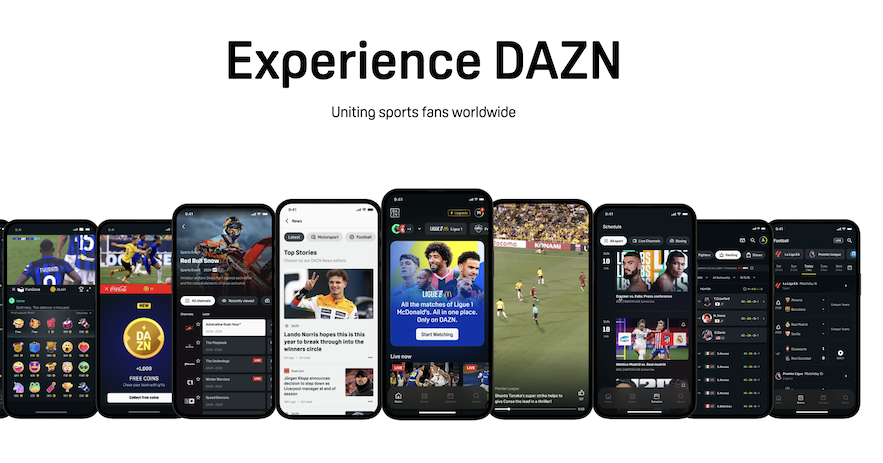
Global sports entertainment group DAZN has announced three new appointments to strengthen its executive leadership team and support the company’s next phase of growth.

The first appointment is Patrick Delany, who will become DAZN’s Chief Operating Officer. According to the group, Delany will be responsible for DAZN’s day-to-day trading performance, focusing on growing subscriber and revenue operations, as well as overseeing DAZN’s operational businesses.

Delany brings with him over three decades of experience across sports and media, following CEO roles at Foxtel Group from 2018 onwards and at Fox Sports Australia from 2011. DAZN added that Delany was essential for leading Foxtel’s integration into DAZN, creating DAZN Australia.
Following Delany, Alex Gersh has been appointed Chief Financial Officer (CFO), succeeding Darren Waterman. He brings over 25 years of experience, holding multiple international financial leadership positions across sectors, including sports betting, technology, and telecoms.

Gersh has held multiple CFO positions, including at the gaming group Sportradar from 2020 to 2022, as well as at the sports betting company Betfair and at Paddy Power Betfair following its merger, from 2012 to 2018. DAZN adds that Gersh will be instrumental in strengthening the company’s financial strategy.

The last of the appointments is Waterman, who will be moving to Chief Business Officer, where he will oversee DAZN’s commercial, partnership, and transformational opportunities. Waterman has been CFO at DAZN since 2022, where, according to the group, he has led its corporate and commercial development during a period of strong growth.
“DAZN is entering an exciting new chapter of profitable growth, during which we will build on the strong momentum we have created in the business,” commented DAZN Group CEO Shay Segev.
“Our built-for-sport platform is now available in more than 200 markets, connecting millions of fans across the world to the sports they love through immersive experiences that go far beyond broadcast. The stage is set for our strengthened leadership team to intensify our mission to build the world’s best sports entertainment platform for fans, rights holders and partners,” he furthered.

The appointments come as DAZN looks to expand its global business. During the FIFA World Cup, DAZN partnered with the prediction-market company ADI Predictstreet to launch a free-to-play prediction market for its users. The company also expanded its sports-betting operations in Canada, launching DAZN Bet in Ontario in June and in Alberta in July.
Charlotte Capewell brings her passion for storytelling and expertise in writing, researching, and the gambling industry to every article she writes. Her specialties include the US gambling industry, regulator legislation, igaming, and more.

Dig Deeper
Related stories
 2026/06/19: DAZN partners with ADI Predictstreet to launch free-to-play World Cup prediction market experience
 2026/01/21: DAZN collaborates with Polymarket to add prediction trading features to its live streams
 2026/06/26: Australia’s Tabcorp and UK’s DAZN launch global sports entertainment platform ahead of World Cup Round of 32
 2025/06/13: Sportradar signs FIFA Club World Cup rights deal with DAZN
2026/06/19: DAZN partners with ADI Predictstreet to launch free-to-play World Cup prediction market experience
2026/01/21: DAZN collaborates with Polymarket to add prediction trading features to its live streams
2026/06/26: Australia’s Tabcorp and UK’s DAZN launch global sports entertainment platform ahead of World Cup Round of 32
2025/06/13: Sportradar signs FIFA Club World Cup rights deal with DAZN
The Backstory
Leadership changes follow a broader platform shift
DAZN’s latest executive reshuffle comes as the sports entertainment group tries to turn years of international expansion into a more disciplined phase of revenue growth. The appointments of Patrick Delany as chief operating officer, Alex Gersh as chief financial officer and Darren Waterman as chief business officer are not isolated management changes. They reflect a company moving deeper into betting-adjacent entertainment, fan engagement products and global rights commercialization while seeking to improve profitability across more than 200 markets.
The leadership choices also point to the operating complexity now facing DAZN. Delany brings experience from Foxtel and Fox Sports Australia, including work tied to Foxtel’s integration into DAZN and the creation of DAZN Australia. Gersh’s background spans finance roles at Sportradar, Betfair and Paddy Power Betfair, giving DAZN a CFO with direct exposure to sports data, betting and scaled digital wagering businesses. Waterman, shifting from CFO to chief business officer, will oversee commercial partnerships and transformation at a time when DAZN is increasingly using major events to test products beyond live video.
That mix matters because DAZN’s growth strategy has become less about streaming alone and more about building a sports platform where subscriptions, rights, data, prediction games and commercial partnerships reinforce one another. The World Cup cycle has become a proving ground for that approach.
World Cup products show the engagement playbook
In the months leading into the World Cup, DAZN has used the tournament to expand interactive products that sit alongside match coverage. Its partnership with ADI Predictstreet created a free-to-play prediction market experience inside DAZN, allowing users to make real-time predictions, compete on leaderboards and win rewards. The companies said the product would begin with the World Cup before extending across DAZN’s wider sports portfolio, including major leagues and competitions.
That initiative built on DAZN’s broader effort to make live sports more participatory. The company has positioned free-to-play prediction products as a way to increase time spent in its ecosystem without immediately requiring users to place bets. The format gives DAZN more touchpoints with fans during matches while creating data and sponsorship opportunities. It also gives the company a lower-risk entry point in jurisdictions where paid wagering and prediction markets face varying rules.
DAZN pursued a similar strategy through a partnership with Tabcorp to launch WorldPlay, a global sports games platform tied to the World Cup knockout rounds. The product, described as a global tipping competition, opened in Australia, the United Kingdom, Germany, Spain and Austria, giving users the chance to predict every knockout match and the final score. In Australia, eligible players could compete for a AU$20 million perfect bracket and final score prize, with a guaranteed AU$500,000 prize pool. In the European markets, eligible players competed through DAZN Bet sites for a £1 million perfect bracket prize and a guaranteed £50,000 pool.
The Tabcorp and DAZN WorldPlay launch underscored how DAZN is trying to turn global sports events into shared digital competitions rather than country-by-country viewing experiences. It also showed the commercial logic behind the new leadership structure: DAZN needs operators who understand media rights, regulated gaming partnerships, consumer acquisition and cross-market execution.
Prediction markets move closer to the broadcast feed
DAZN’s activity around prediction markets has been especially notable because it moves the company into a category that sits between sports media, financial-style trading and wagering. Earlier, DAZN agreed to integrate Polymarket’s real-time data and odds into its streaming product, giving viewers shifting probabilities and outcomes while they watch live events. The companies said the goal was to embed prediction trading into the viewing experience rather than send users to a separate product.
The Polymarket collaboration with DAZN went further than free-to-play mechanics. DAZN said it planned to host Polymarket contracts and let users trade directly on its platform, subject to regulatory approval. The company also said it would apply for relevant licenses from the Commodity Futures Trading Commission with an eye toward a U.S. rollout.
That plan carries significant upside and risk. Prediction markets can deepen fan engagement by giving viewers a constant stream of probabilities around match outcomes, player performance and event narratives. They can also create regulatory scrutiny, particularly when trading resembles betting or when contracts touch events involving sports integrity concerns. DAZN’s choice of Gersh as CFO is relevant in that context. His experience at Sportradar, Betfair and Paddy Power Betfair gives the company financial leadership familiar with the intersection of data, markets and regulation.
Polymarket’s own sports push has accelerated. The platform became the official prediction market of MLS and the Leagues Cup through a deal with Soccer United Marketing, the commercial arm of Major League Soccer. That agreement made MLS the first soccer franchise to integrate prediction market data into live matches, with safeguards including independent monitoring of markets tied to MLS and Leagues Cup events. The Polymarket partnership with MLS and Leagues Cup showed that sports organizations are increasingly willing to test prediction data as a fan engagement format, provided integrity controls are in place.
Data rights and integrity are central to the model
DAZN’s ambitions also rely on the quality and speed of sports data. The company’s agreement with Sportradar around the FIFA Club World Cup 2025 illustrated how broadcast rights can be extended into betting data and media distribution. Sportradar agreed to supply ultra-low-latency betting data and nonexclusive media content from the tournament to 800 betting operators and 900 media companies. DAZN, the official broadcaster for all 63 matches, gave Sportradar access to micro and player markets, enabling coverage of 190 pregame and 200 in-play markets.
The Sportradar rights deal with DAZN highlights the expanding value chain around elite soccer. A broadcaster can monetize rights not only through subscriptions and advertising, but also through data distribution, media content, betting markets and integrity services. Sportradar’s existing FIFA relationship meant the Club World Cup also would be covered by its Universal Fraud Detection System, which uses AI to flag suspicious betting activity.
That integrity layer is increasingly important as sports media companies embed predictive and wagering-adjacent features into live viewing. If DAZN wants to offer interactive markets, it must reassure rights holders, regulators and fans that the products will not undermine competition. Partnerships with established data and monitoring firms can help provide that assurance, but they also add complexity to product design and compliance.
Betting expansion adds opportunity and constraints
DAZN’s betting operations provide another backdrop for the executive appointments. The company has expanded DAZN Bet in Canada, launching in Ontario in June and Alberta in July. Those moves place DAZN in regulated provincial markets where brand trust, compliance and customer acquisition costs are decisive. They also reflect a broader effort to convert DAZN’s sports audience into higher-value digital relationships, whether through betting, prediction contests or premium features.
The challenge is that each market has different rules. A free-to-play bracket contest may travel more easily across borders than paid betting or tradable prediction contracts. A product available in Australia or the U.K. may require a different legal structure in the U.S., Germany or Canada. DAZN’s leadership team must balance speed with local compliance, particularly as major sports bodies evaluate how far they want to go with betting-adjacent products.
This is where Waterman’s move to chief business officer is significant. Having led corporate and commercial development as CFO since 2022, he now takes a role focused on partnerships and transformation. That remit aligns with DAZN’s need to manage relationships with rights holders, betting operators, technology providers and regulators while building repeatable products around global events.
The stakes for DAZN’s next phase
DAZN’s current strategy is a bet that sports streaming alone is not enough to sustain global growth. Rights costs remain high, competition for premium content is intense and subscriber churn can rise outside major events. Interactive products give DAZN ways to keep users engaged between matches, generate new revenue streams and make rights packages more valuable.
The executive appointments therefore arrive at a pivotal time. Delany’s operational background supports the integration of acquired and regional businesses. Gersh’s financial experience fits a company navigating data, betting and capital discipline. Waterman’s commercial role gives DAZN a senior executive focused on turning partnerships into scalable products.
If DAZN can connect those pieces, it could strengthen its position with fans, rights holders and commercial partners. If it moves too quickly, it risks regulatory friction and product fragmentation. The company’s next chapter will test whether its sports entertainment platform can become more than a global broadcaster and whether its leadership team can convert engagement into sustainable, profitable growth.
