


BetHog secures US$10 million to scale AI-dealer live casino feature

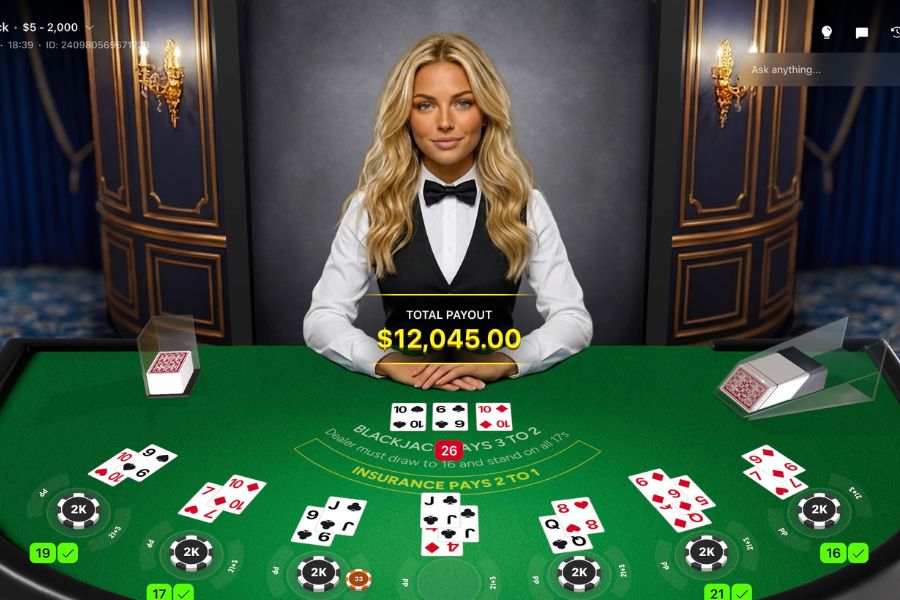
Crypto casino BetHog has raised US$10 million Series A financing to expand its proprietary AI live casino dealer feature into B2B offering, Sentient Studios.
The funding round was co-led by sports and entertainment venture capital firm Will Ventures and multi-strategy digital asset investment firm RockawayX, along with PCV, 6MV, Bullpen Capital, and Advancit Capital, which BetHog reports brings its total funding to US$16 million.

The crypto casino plans to use the capital to expand the AI dealer technology on its own platform and accelerate adoption of Sentient Studios among global gaming operators.
Operating on a pure revenue-share model with no setup fees, monthly minimums, or fixed-term contracts, BetHog says Sentient Studios makes it easier for operators to test, launch, and scale new live casino experiences.
The software-driven alternative to traditional live dealer supply models is intended to give operators greater control, flexibility, and scalability in delivering their live casino experiences.

“We’ve tested our basic AI dealer over the past six months and have discovered that it is 10X more popular than its live dealer equivalent. In addition, we’ve seen better retention and player satisfaction,” said BetHog Co-Founder and Chief Executive Nigel Eccles.
“We’re excited to bring this product to other online casinos where operators can launch and scale their own dealer experiences instantly, operate continuously, and create more personalized interactions for players.”
Operators typically rely on third-party providers to supply live dealer tables, which can limit flexibility around capacity, localization, and differentiation. Sentient Studios aims to remove those constraints by allowing operators to scale table availability, offer more languages and player segments, and adapt experiences in real time without being tied to studio staffing cycles.

The platform also allows operators to create unique dealer personas, branded environments, and bespoke experiences.
The launch of Sentient Studios builds on BetHog’s first AI-powered blackjack dealer, Sunny, introduced in October 2025 and now available in 12 languages, which it says has become one of the most played games on its platform.
BetHog plans to expand its AI dealer capabilities later this year with the addition of baccarat and roulette.

Dig Deeper
Related stories




The Backstory
From prototype to platform
BetHog’s new B2B push builds on the operator’s rapid-fire experimentation with AI at the table. The company framed its approach last fall with the debut of its AI blackjack dealer, Sunny, pitched as more consistent, more memory aware and more engaging than a human host. The launch narrative emphasized always-on availability and personalization, traits traditional studios struggle to deliver at scale because they depend on staffing and fixed studio schedules. BetHog said Sunny could greet players by name, recall past chats and keep up a constant patter while running the game. Those claims previewed today’s ambition: to turn what worked on its own crypto casino into a white-label product other operators can deploy without hiring and training a live staff.
That first reveal also hinted at BetHog’s market-entry strategy. Chief Executive Nigel Eccles, who helped build FanDuel, said then the company was focused on product speed over jurisdictional expansion. He framed regulated markets as attractive but best approached once the technology matured. That stance explained why an AI dealer would first live on an offshore crypto platform and only later seek adoption across mainstream operators. The new B2B offering attempts to bridge that gap by letting incumbents test AI dealers in parallel with their human-run tables.
Crypto’s fast lane meets a familiar playbook
Eccles’ trajectory is a study in finding growth at the edges of regulation. In an interview tracing his path from Hubdub to FanDuel to BetHog, he sketched BetHog’s crypto-first thesis: blockchains cut payment costs and allow faster product iteration than regulated rails. He argued that approvals in licensed markets slow new titles by months, while offshore crypto sites can ship and tweak features in days. That speed advantage set the stage for AI dealers to be born on a crypto casino rather than a licensed one. It also created the data to claim the format is “10x” more popular than human-run equivalents, a stat BetHog cites to sell operators on the economics of switching or supplementing existing studios.
BetHog’s content cadence reinforces the point. The company has rolled out in-house games built for synchronous play and streamer engagement, then layered “meta” rewards on top. The same design logic applies to AI dealers: reduce friction, widen language coverage and localize tone or branding without having to book additional shifts. Those knobs matter most to operators strained by peak-time demand, language gaps or the high fixed costs of human studios. The B2B pivot essentially productizes BetHog’s internal toolset for those pain points.
Incumbents double down on human studios
The counterpoint in regulated U.S. markets is clear: big brands are still investing in live dealer facilities anchored by humans and broadcast tech. Caesars has expanded a network of branded rooms with Evolution. It opened a Philadelphia-area live dealer studio in Pennsylvania to stream blackjack, roulette and baccarat with custom felts and VIP tables. It then extended the format with a third branded live dealer studio in Michigan, mirroring the Las Vegas aesthetic online. These investments are designed to reinforce brand equity, preserve regulatory comfort with human-run tables and serve diverse bankrolls from microstakes to high-limit play.
The contrast highlights why BetHog sees an opening. Traditional studios offer reliability, trust and brand control but can be rigid. Staffing caps concurrency. Localization requires new hires. Table availability flexes with scheduling rather than real-time demand. AI dealers, by design, promise to scale languages, themes and hours instantly while maintaining a consistent persona. If those advantages translate into higher time-on-table or conversion, operators that today rely on third-party studios could test AI without cannibalizing their flagship rooms. For an operator running 24/7 lobbies, an AI tier can also soak up off-peak traffic or seasonal spikes without recruiting surges.
Engagement economics drive the next wave
While Caesars invests in studio footprint, other majors are tuning the software that sits around the table. FanDuel is leaning into jackpot mechanics and social layers as levers for engagement and retention. Its in-house platform now supports a double-contribution option inside its progressive system, an expansion of FanDuel Casino’s progressive jackpots update active in three states. The system, built after acquiring player-engagement firm BeyondPlay, has paid hundreds of thousands of prizes with total winnings above $300 million. That kind of feature velocity shows how fast operators will move when the regulatory path is clear and the ROI is visible.
AI dealers compete for the same KPI wins: session length, repeat visits and bet frequency. Where jackpots add a layer of upside to any spin, AI hosts aim to make every interaction feel bespoke and sticky. If the cost to run an AI table falls below staffing and studio overhead, and if metrics like net gaming revenue per session improve, B2B demand follows. BetHog’s pitch wraps both into a single argument: lower fixed costs plus more personalized tables equals better margins and happier players. The company’s revenue-share model further reduces trial friction for operators wary of capex or long integrations.
Regulatory calculus and what comes next
The sticking point is not technology. It is compliance, perception and labor. U.S. regulators have already blessed large-scale human studios and the vendors behind them. AI dealers represent a new category that touches responsible gaming, data privacy and truth-in-advertising questions. Even BetHog’s leadership has acknowledged in past comments that regulated entries would come only when the product is mature and when rules catch up. That makes today’s B2B move a test of appetite outside crypto: will licensed operators run AI tables as supplements, pilots or only in unregulated markets via affiliates and skins?
Expect early use cases where AI dealers add capacity at the edges rather than replace core rooms. Think late-night overflow, long-tail languages or branded promotions that would be impractical to staff for short windows. If outcomes mirror BetHog’s internal lift claims, pressure will grow on incumbents and vendors to build or buy similar capabilities. Evolution-scale providers could integrate AI personas as another “game show” format or as tooling inside their studios. Operators with strong brand identities may prefer proprietary AI hosts to keep look-and-feel consistent across jurisdictions.
The stakes go beyond table ops. If AI dealers prove to reduce churn or increase cross-sell into slots and jackpots, they become part of the broader economics of iGaming growth in states that allow it. For crypto-native platforms, success validates the thesis that the frontier is where new categories harden before migrating into licensed markets. For regulated brands, controlled pilots will test whether AI hosts can live alongside human dealers without undermining trust or attracting regulatory heat. Either way, the line between live and simulated will blur as operators chase scale, localization and margin. The next quarters will show if AI at the felt is a feature or a format.
