


BETER enters 10th US state with Virginia Vendor Registration license
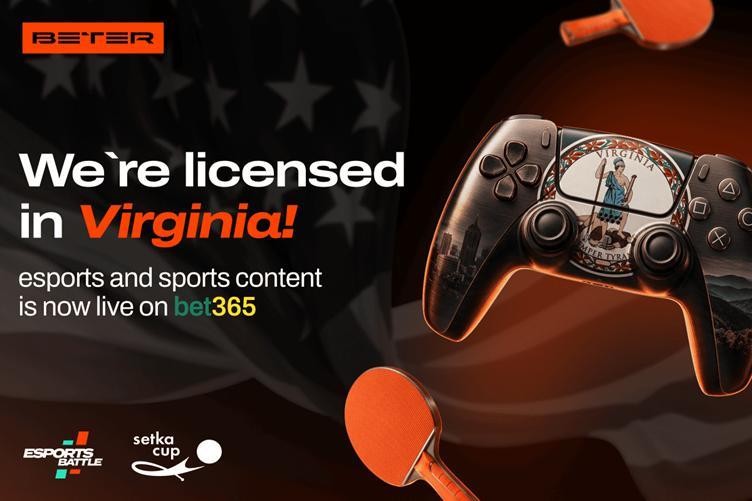
Sports betting data provider BETER has secured regulatory approval to supply its exclusive content to sports betting operators in Virginia, bringing its US presence to 10 states.
The operator’s vendor registration license from the state’s gambling regulator, the Virginia Lottery, enables BETER to provide operators with live streams and real-time betting data from its Setka Cup table tennis and ESportsBattle competitions.

Both of the products are already available to bettors in Virginia through the company’s established partnership with gambling operator bet365.
Virginia is BETER’s 10th US state, following its recent launches in 2026 in North Carolina in January, Arizona in March and Illinois in June. The company’s exclusive content is also available in Colorado, Florida, Iowa, Indiana, Kentucky and New Jersey.
“Virginia is one of the most competitive sports betting markets on the East Coast, and reaching a tenth US state gives BETER a regulated footprint that very few fast-betting content providers can match,” commented BETER’s CEO Gal Ehrlich.

“The US remains the single most strategically important market in BETER’s global plans. With ten states now approved, our team is continuing to progress applications across further jurisdictions, and we fully expect to add to that number in the months ahead,” added BETER’s Chief Legal Officer Valeriia Tarchynska.
BETER also recently increased its presence in Latin America, partnering with Colombian sportsbook operator Wplay in March this year to distribute its eSportsBattle content.
The company’s expansion into Virginia comes as the state’s online gambling industry continues to develop. While online sports betting has been legal since 2021, lawmakers failed to reach an agreement on online casino legislation during the 2026 session, with the proposals deferred to 2027.
Charlotte Capewell brings her passion for storytelling and expertise in writing, researching, and the gambling industry to every article she writes. Her specialties include the US gambling industry, regulator legislation, igaming, and more.

Dig Deeper
Related stories




The Backstory
A state-by-state strategy reaches a bigger test
BETER’s approval in Virginia marks more than another incremental state launch. It shows how the company has turned a niche fast-betting portfolio into a regulatory expansion strategy across the U.S., where suppliers must clear market-by-market reviews before their content can reach licensed sportsbooks.
The Virginia vendor registration gives BETER the ability to supply operators with live streams and real-time betting data tied to its Setka Cup table tennis and ESportsBattle competitions. Those products are already available in the state through bet365, a partner that has become central to BETER’s U.S. rollout. The latest approval brings the company to 10 states, a milestone that gives it a wider regulated footprint than many suppliers focused on high-frequency sports and esports content.
The timing is also significant. Virginia has developed into a competitive online sports betting market since legalization in 2021, but lawmakers have not yet expanded into online casino. That leaves sportsbook operators competing heavily on product depth, in-play engagement and retention. BETER’s portfolio is designed for that environment: events that run around the clock, short match formats and data feeds built for fast wagering cycles.
New Jersey provided the first regulatory proof point
BETER’s U.S. push began with New Jersey, one of the country’s most scrutinized gambling markets. The company received vendor registration from the state’s Division of Gaming Enforcement, allowing it to offer real-time data and live streams to licensed operators. That approval was a key early signal that its products could pass regulatory review in a major U.S. jurisdiction.
As BETER’s New Jersey launch showed, Setka Cup was the first product to go live, appearing on bet365’s New Jersey platform. The approval put BETER into a market with established online casino and sports betting operators and gave the supplier a base from which to pursue further applications.
The New Jersey entry also framed the commercial case for the company’s U.S. expansion. BETER said at the time that Setka Cup generated more than 11,000 matches a month across 16 arenas globally, with more than 30 betting markets per event. It also pointed to an in-house integrity operation to monitor matches, an important consideration for regulators and operators assessing content that is not tied to traditional league calendars.
That combination of scale, betting frequency and integrity controls became the foundation for later approvals. In a U.S. market where regulators often proceed cautiously with new content categories, New Jersey gave BETER a reference point for subsequent state filings.
Colorado broadened the product mix
The next phase came in Colorado, where BETER received a Vendor Minor License from the Colorado Division of Gaming. Colorado was the supplier’s second U.S. state, but it carried a different importance: It opened the door for U.S. bettors to access ESportsBattle content for the first time, alongside Setka Cup table tennis.
The Colorado approval for BETER demonstrated that the company’s regulatory path was not limited to table tennis. ESportsBattle includes simulated and esports-style competitions such as eFootball and eBasketball, content aimed at bettors seeking continuous markets outside conventional sports schedules.
BETER said around that launch that it generated content on roughly 700,000 events annually, including live streams, real-time data and odds across sports and esports. That volume is central to the company’s proposition, but it also increases the importance of controls around fair play, monitoring and data reliability. Colorado’s approval therefore expanded both BETER’s commercial reach and the regulatory validation of its broader portfolio.
At the time, the company said it was pursuing approvals in other states including North Carolina, Arizona and Indiana. That pipeline later helped turn the U.S. rollout from isolated approvals into a broader multistate expansion.
Momentum accelerated through larger sports betting markets
By the time BETER entered Illinois, the company had moved beyond early-stage market testing. The Illinois Gaming Board added Setka Cup table tennis to the state’s sports wagering catalog, allowing BETER to supply operators with live data and streaming services tied to the product. Illinois became the company’s eighth U.S. state, following launches in Florida, New Jersey, Colorado, Arizona, Indiana, Iowa and North Carolina.
The Illinois entry for BETER underscored the company’s focus on regulated, high-volume sports betting states. Illinois is one of the largest U.S. online sports betting markets, with operators competing for share through pricing, parlay products, live betting and content variety. For a supplier such as BETER, winning approval there strengthened its claim that fast-betting content could gain acceptance in major jurisdictions.
The Illinois launch also reflected a pattern in BETER’s U.S. strategy: secure regulatory approval, activate through bet365, then seek additional operator integrations. That approach reduces friction because the supplier can enter with a known distribution partner while building credibility with other licensed sportsbooks.
The company’s portfolio had also expanded in scope by that point. In addition to Setka Cup, BETER promoted odds for more than 700,000 esports and sports events, including eFootball, eBasketball, eHockey and eTennis through ESportsBattle, along with BSKT Cup basketball content. The broader lineup gave operators more ways to fill betting windows during off-peak hours and between major U.S. sports events.
Latin America and Europe reinforced the demand thesis
BETER’s U.S. progress has unfolded alongside international distribution deals that support the company’s argument that demand for fast-betting content is global rather than confined to one region. In Latin America, the company expanded through a partnership with Colombian operator Wplay, supplying ESportsBattle tournaments with eFootball and eBasketball set to go live first.
The Wplay agreement in Colombia highlighted operator interest in products that offer frequent events, multiple markets and defined margins. BETER said its ESportsBattle tournaments host up to 500,000 annual esports events, with around 50 markets per match and an average operator margin above 7.5%. For sportsbooks in competitive digital markets, those attributes can make the content attractive as both an engagement and revenue tool.
Another partnership, with Meridianbet, broadened BETER’s reach across 18 licensed jurisdictions in Europe, Africa and Latin America, including Peru. The Meridianbet integration with BETER covered ESportsBattle and Setka Cup, extending access to the supplier’s 24/7 live streaming and real-time odds products.
Those international deals matter for the Virginia context because they show how BETER has paired regulatory licensing with operator distribution. The company is not only seeking approvals; it is trying to prove that its content can be embedded into established sportsbook platforms across different regulatory systems and betting cultures.
Virginia adds scale as U.S. regulation remains the gatekeeper
Virginia’s approval gives BETER a 10-state U.S. footprint after a rapid sequence of launches that included North Carolina in January, Arizona in March and Illinois in June. The company now operates in Colorado, Florida, Iowa, Indiana, Kentucky, New Jersey, North Carolina, Arizona, Illinois and Virginia.
The milestone comes as fast-betting suppliers face both opportunity and scrutiny. Operators want content that keeps customers active beyond major leagues and marquee events, especially as acquisition costs remain high and product differentiation narrows. At the same time, regulators expect clear controls around event integrity, data accuracy and market transparency.
BETER’s strategy depends on satisfying both sides. Its products are built to increase betting frequency, but its ability to grow in the U.S. depends on approvals from state regulators that assess suppliers individually. Each new state therefore functions as both a revenue opportunity and a credibility marker.
Virginia also illustrates the broader direction of U.S. online gambling. Sports betting is widely established, but online casino expansion remains uneven and politically difficult. In states where casino legislation stalls, sportsbook operators have more incentive to invest in live betting, micro-markets and alternative event content. That creates room for suppliers such as BETER, provided they can continue clearing regulatory reviews and secure operator integrations.
With 10 states approved, the company has moved from U.S. entrant to a supplier with measurable national reach. The next test is whether it can turn that footprint into deeper operator adoption while maintaining the compliance standards needed to keep expanding in one of the world’s most demanding gambling markets.
