


Bet365 undergoing Enforceable Undertaking by AUSTRAC for AML/CTF shortcomings


Australia’s financial watchdog has ordered online bookmaker Bet365 to “strengthen its anti-money laundering controls after identifying serious gaps in how it manages risk and reports suspicious activity.”
According to a 6 July release by AUSTRAC, Bet365 on Monday “entered into a legally binding enforceable undertaking requiring the company to overhaul its systems.” This includes creating an ongoing risk assessment approach, with “clear methodology and processes”, as well as strengthening “how it detects and reports suspicious transactions as risks evolves.”

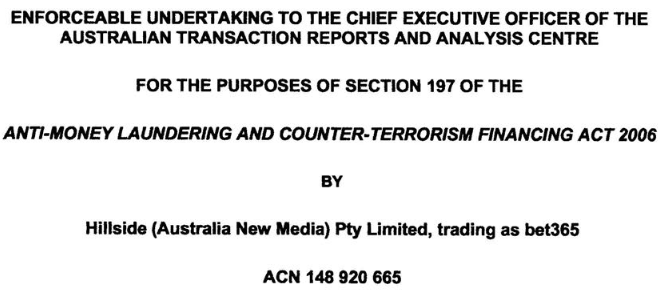
The obligation comes after an AUSTRAC investigation started in March of 2024, triggered by an independent audit of Bet365’s operations. This followed a November 2022 order by AUSTRAC for Bet365 and Sportsbet to hire external auditors to assess their AML/CTF compliance. Then-AUSTRAC CEO Nicole Rose noted at the time that “Sportsbet and Bet365 are amongst the largest operators in the corporate bookmaking sector. AUSTRAC is putting the whole industry on notice to lift their game.”
Last week, AUSTRAC announced that Sportsbet had completed its remediation efforts as part of the “enforceable undertaking,” confirming that Sportsbet “has implemented and operationalized all required remediation.”

In its Monday release, AUSTRAC CEO Brendan Thomas addressed its recent enforcement activities, noting, “The gambling industry processes large volumes of money at high speed, often through anonymous digital channels. This creates opportunities criminals look to exploit.

“This means businesses need to continuously improve their systems to assess risks and monitor for suspicious activity because when controls fall behind, the consequences extend beyond a single company,” noted the executive.
Under its enforceable undertaking, there are “minimum standards Bet365 must meet,” with the obligations being “directly enforceable, with breaches attracting civil penalty consequences under both the undertaking and the Act.”
According to the Enforceable Undertaking, Bet365 will provide a “midway report” detailing its progress on its Remedial Action Plan no later than 31 December 2026. The gaming operator will also provide a final report by 30 June 2027, “confirmed that each of the items set out in the Remedial Action Plan has been fully implemented, operationalized and assured to meet the Expected Minimum Standards.”

Bet365, under the agreement has pledged to provide the AUSTRAC CEO with “any information or documents that AUSTRAC requests for the purpose of monitoring its compliance” within 10 days of receiving a written request.

Dig Deeper
Related stories
 2026/07/03: Australia’s Sportsbet cleared by financial watchdog over prior AML/CTF control deficiencies
 2025/09/12: AUSTRAC drops key allegations in Entain money-laundering case
 2026/05/07: Tabcorp shares take AU$500 million hit amid money laundering investigation
 2025/02/21: Entain Australia executive resigns amid money laundering scandal
2026/07/03: Australia’s Sportsbet cleared by financial watchdog over prior AML/CTF control deficiencies
2025/09/12: AUSTRAC drops key allegations in Entain money-laundering case
2026/05/07: Tabcorp shares take AU$500 million hit amid money laundering investigation
2025/02/21: Entain Australia executive resigns amid money laundering scandal
The Backstory
AUSTRAC’s latest move extends a wider compliance campaign
AUSTRAC’s enforceable undertaking with Bet365 is the latest step in a multiyear push by Australian authorities to force online wagering operators to tighten anti-money laundering and counter-terrorism financing controls. The action follows an investigation opened in March 2024 after an independent audit examined Bet365’s compliance systems. That audit was itself the result of a November 2022 order requiring Bet365 and Sportsbet to appoint external reviewers.
The regulator’s concern has been consistent: large online bookmakers process high volumes of customer funds quickly, often through digital channels that can obscure the source, purpose or pattern of transactions. AUSTRAC has focused on whether operators have adequate risk assessment methods, customer monitoring systems and suspicious matter reporting processes. The Bet365 undertaking requires the company to overhaul those functions, provide progress reporting and meet enforceable minimum standards by 2027.
The significance is not limited to one operator. Bet365 and Sportsbet were singled out in 2022 as major players in corporate bookmaking, and AUSTRAC said at the time that the broader industry was on notice. The agency’s handling of the two companies now shows how that warning has moved from review to remediation and, where needed, binding enforcement.
Sportsbet’s remediation set the benchmark
AUSTRAC’s action against Bet365 landed days after the regulator said Flutter Entertainment’s Australian bookmaker had completed its own remediation program. In clearing Sportsbet over earlier AML/CTF control deficiencies, AUSTRAC said the company had implemented and operationalized all required fixes following an enforceable undertaking accepted in 2024.
Sportsbet’s case matters because it involved similar weaknesses: risk assessment, customer monitoring and suspicious matter reporting. Those are the same areas at the center of the Bet365 undertaking. The difference is procedural posture. Sportsbet has reached the end of its remediation cycle, while Bet365 is entering a longer period of supervised repair, with a midway report due by Dec. 31, 2026 and a final report by June 30, 2027.
The Sportsbet outcome gives AUSTRAC a recent example of what it considers adequate remediation. It also raises expectations for Bet365, which will have to show not only that new policies exist but that they are embedded in day-to-day operations. In financial crime compliance, that distinction is crucial. Regulators increasingly view paper controls as insufficient if they do not produce timely alerts, clear customer risk ratings and defensible reporting decisions.
Entain litigation shows the legal risks remain unsettled
Australia’s enforcement environment is not confined to negotiated undertakings. AUSTRAC is also pursuing civil litigation against Entain, the owner of Ladbrokes and Neds in Australia, over alleged failures involving high-risk customers. In that case, 17 customers allegedly moved more than AU$152 million through their accounts between 2016 and 2020.
The case has become a test of AUSTRAC’s legal theories. The agency recently dropped key allegations in its money-laundering case against Entain after parts of its claim conflicted with published guidance on reporting obligations. The remaining allegations continue, and each transaction at issue could carry significant civil penalties.
For Bet365, the Entain case illustrates both the danger and uncertainty facing bookmakers. Enforceable undertakings can avoid a contested court battle but still impose binding commitments and the threat of penalties for noncompliance. Litigation, by contrast, can clarify the scope of the law but exposes companies to potentially large fines and reputational damage. AUSTRAC has historically relied on negotiated outcomes with major financial and gambling firms, but its willingness to litigate against Entain suggests the agency is prepared to test online betting controls in court when it believes the facts justify it.
The expected Federal Court decision in a separate Star Casinos matter could further shape the landscape. A substantial penalty or strong judicial language on AML/CTF obligations would strengthen the regulator’s hand in wagering cases. A narrower ruling could affect how betting operators assess risk in ongoing disputes.
Offshore threats complicate domestic compliance
Licensed operators are also trying to shift attention to illegal offshore betting sites, arguing that regulated companies face rising compliance burdens while black-market rivals evade Australian rules. Responsible Wagering Australia, whose members include Sportsbet, Bet365 and PointsBet, has called for a national blacklist targeting illegal gambling websites, apps, ads and payments.
The industry push for a national gambling blacklist to curb offshore operators reflects a broader tension in Australian policy. Regulators want licensed bookmakers to improve AML/CTF controls, safer gambling practices and advertising standards. Operators counter that illegal sites can exploit consumers without the same obligations, particularly through social media, search engines, app stores, banks and cryptocurrency channels.
That argument may have political force, but it does not reduce the compliance expectations for licensed firms. AUSTRAC’s position is that high-speed digital wagering creates vulnerabilities regardless of whether the operator is licensed. Customer onboarding, transaction monitoring and suspicious matter reporting remain core obligations. If anything, the rise of offshore competition may make risk assessment more complex, particularly where customers move funds between regulated and unregulated platforms or use payment methods that mask the trail of funds.
The blacklist proposal also shows how anti-money laundering controls are converging with broader online enforcement tools. Blocking websites alone has proved limited, with many platforms remaining accessible despite more than 1,500 blocking requests by the Australian Communications and Media Authority. The industry is now seeking a more coordinated system that would also pressure intermediaries, including banks and technology platforms.
Global cases reinforce regulator scrutiny of betting networks
The pressure on wagering operators is not unique to Australia. Regulators in other jurisdictions are scrutinizing whether gambling companies can ensure consistent compliance across customers, affiliates and partner networks. The Isle of Man Gambling Supervision Commission recently fined Celton Manx, the holding company of Asia-facing SBOBET, £3.9 million for anti-money laundering and counter-terrorism financing failures.
The SBOBET holding company penalty over AML violations centered on failures to ensure network partners applied standards required in the Isle of Man. The regulator also found weaknesses in customer identity verification, enhanced due diligence for high-risk customers, suspicious activity procedures and the expertise of compliance officers. Celton Manx forfeited its Isle of Man license in May 2025, and the fine was reduced after admissions and cooperation.
Those findings are relevant to Australian bookmakers because online gambling businesses often depend on complex systems: payment providers, marketing affiliates, data vendors, trading platforms and customer service operations across jurisdictions. Regulators increasingly expect licensed companies to control those networks rather than treat third-party functions as outside their responsibility. AUSTRAC’s requirements for Bet365 to adopt a clear methodology for ongoing risk assessment align with that global direction.
The Isle of Man case also highlights a key regulatory concern: AML/CTF compliance depends on expertise as much as technology. Automated alerts and monitoring tools are useful only if staff understand risk indicators, escalation thresholds and reporting duties. Weak governance can turn high transaction volume into unmanaged exposure.
Market pressure meets regulatory pressure
The compliance campaign is unfolding as Australia’s wagering sector faces commercial and political strain. PointsBet is in the middle of a takeover contest involving Betr Entertainment and Mixi Australia. The Takeovers Panel recently accepted undertakings from Betr after PointsBet raised concerns about disclosure, valuation and the structure of its offer. The Betr undertaking in the PointsBet takeover battle requires revised documents, independent expert reports and changes to a proposed share buyback.
While that dispute is about corporate control rather than AML/CTF rules, it reflects the same environment: gambling companies are under close review from multiple Australian regulators. Financial crime compliance, takeover disclosure, self-exclusion rules, advertising policy and offshore enforcement are all moving at once. Entain has also faced action by the Australian Communications and Media Authority over self-exclusion breaches, showing that compliance risk extends beyond money laundering controls.
For Bet365, the stakes are therefore broader than satisfying a single undertaking. The company must demonstrate to AUSTRAC, customers and policymakers that its Australian operation can manage financial crime risks at scale. A failure to meet the undertaking’s milestones could lead to civil penalty consequences and intensify scrutiny of the wider sector. A successful remediation, by contrast, would put Bet365 on a path similar to Sportsbet’s and help reinforce the licensed industry’s argument that regulated operators can be held to higher standards than offshore rivals.
The backstory to the Bet365 action is a regulator steadily raising expectations and an industry trying to adapt while defending its market position. AUSTRAC’s message is that online bookmakers can grow quickly, but their controls must keep pace with the speed, anonymity and volume that make digital wagering attractive to criminals.
