
NCAA President calls for CFTC suspension of college sports prediction markets

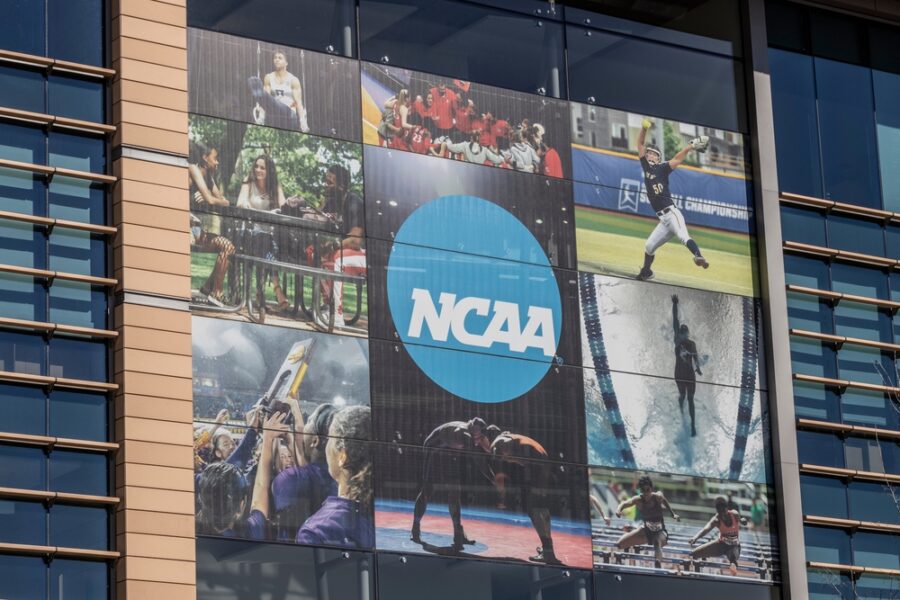
NCAA President Charlie Baker has written to the Commodity Futures Trading Commission requesting that prediction market operators stop offering prediction markets tied to college sports.
Baker requested that additional safeguards be put in place before prediction market platforms can offer contracts on collegiate athletes again, including stronger oversight by the Commodity Futures Trading Commission.

In his letter, Baker cites the unprecedented growth of prediction markets, saying they pose a significant threat to student-athletes and efforts to maintain competition integrity.
“I implore you to suspend collegiate sport prediction markets until a more robust system with appropriate safeguards is in place,” he said. “So-called prediction markets are offering what anyone can see is unregulated betting on college games. We need federal regulators to stabilize this market.”
Baker’s statement contributes to the ongoing controversy surrounding prediction market platforms in the US.
These platforms, such as Kalshi, enable individuals to buy and sell contracts based on whether an event, like the outcome of a game, will occur or not. Unlike traditional sportsbooks regulated by state agencies, these platforms operate under federal commodities law.
Recently, Kalshi has been given a preliminary injunction to continue operating in Tennessee after the state’s sports betting regulator sent a cease-and-desist order.
In his statement, Baker specifically referenced Kalshi offering markets on the transfer portal as an example of why the NCAA needs federal intervention. These markets have not been launched yet, but Kalshi had previously announced its intention to offer them to its customers.
Charlotte Capewell brings her passion for storytelling and expertise in writing, researching, and the gambling industry to every article she writes. Her specialties include the US gambling industry, regulator legislation, igaming, and more.

Verticals:
Sectors:
Topics:
Dig Deeper
Related stories
 2025/11/24: NCAA rescinds decision to allow pro sports betting for college athletes and staff
2025/10/17: Kraken eyes prediction market launch with acquisition of CFTC-licensed Small Exchange
2025/05/05: NBA expresses concerns over sports prediction integrity to CFTC
2025/11/11: ProphetX seeks CFTC approval for sports prediction market
2025/11/24: NCAA rescinds decision to allow pro sports betting for college athletes and staff
2025/10/17: Kraken eyes prediction market launch with acquisition of CFTC-licensed Small Exchange
2025/05/05: NBA expresses concerns over sports prediction integrity to CFTC
2025/11/11: ProphetX seeks CFTC approval for sports prediction market
 2025/11/24: NCAA rescinds decision to allow pro sports betting for college athletes and staff
 2025/10/17: Kraken eyes prediction market launch with acquisition of CFTC-licensed Small Exchange
 2025/05/05: NBA expresses concerns over sports prediction integrity to CFTC
 2025/11/11: ProphetX seeks CFTC approval for sports prediction market
The Backstory
Why the NCAA’s call landed now
NCAA President Charlie Baker’s appeal to the Commodity Futures Trading Commission to halt college sports prediction markets arrives after months of mounting friction between federal commodities rules and state-regulated sports wagering. The NCAA’s request, published by the association on Jan. 14, seeks a timeout while federal safeguards are built for contracts linked to collegiate outcomes and athlete activity. The association argues rapid product expansion and fragmented oversight create integrity risks for campuses and competitions. The move follows a year in which event-contract platforms pressed deeper into sports, even as state regulators asserted that such products look and function like betting.
The NCAA’s public posture has tightened alongside fresh scandals and policy reversals within college sports. In November, Division I schools blocked a plan that would have allowed student-athletes and athletics staff to wager on professional leagues, a retreat from a short-lived rule change adopted in October. The rescission, reached after a two-thirds majority pushback, came amid a wave of gambling probes across pro and college ranks. Fourteen college athletes at seven schools lost eligibility or faced investigations, and federal authorities charged several pro figures in separate cases during the same period. The NCAA’s reversal, detailed in reporting on the rescinded plan to allow athletes and staff to bet on pro sports, underscores how fast the compliance backdrop shifted before the latest call to Washington.
The new request focuses on platforms that list “event contracts” under commodities law rather than state sportsbook statutes. These markets expanded to pro sports first and have increasingly tested the edges around college sports and athlete-related topics. Baker’s letter zeroed in on transfer portal–linked concepts as a bright red line, arguing that athlete-specific speculation risks coercion, harassment and manipulation.
Integrity flashpoints in college athletics
The NCAA’s stricter stance follows a year when game integrity concerns jumped from theory to headline. College investigations and public admissions by athletes about point-shaving or related schemes raised alarms on campuses and in statehouses. Policymakers and university leaders now face a dual challenge: wagering is widespread and legal in most states, yet oversight varies widely across markets, products and regulators.
By urging the CFTC to pause collegiate markets, the NCAA is betting that a federal stopgap can slow product proliferation that state rules cannot easily police when listings sit on federally supervised venues. This strategy also reflects increasing friction between state gaming boards and federally overseen event-contract venues over jurisdiction. In recent months, as platforms tested sports listings, several states pushed back. One federal court allowed a platform to continue operating after a cease-and-desist from a state regulator, illustrating how the legal map remains unsettled.
Against that backdrop, the NCAA’s about-face on athlete betting privileges becomes part of a broader credibility calculus. The association is trying to tighten internal policy while urging federal alignment that limits the riskiest external products. The stakes are not only game outcomes but also recruiting, NIL dynamics and athlete welfare in an environment where social media can amplify rumors into market-moving signals.
Leagues draw a line on event contracts
The NCAA is not alone. The NBA warned the CFTC that sports prediction markets threaten game integrity, drawing a distinction between state-licensed sportsbooks and federally supervised event-contract venues. In a letter to Acting Chair Caroline Pham, the league flagged a fast-growing menu of basketball contracts and cautioned that proposition-style markets tied to officiating, rules or player injuries could follow. The league asked for engagement on rules that could mitigate risks if the CFTC allows continued listing. The concerns are detailed in coverage of the NBA’s letter to the CFTC on integrity risks and event contracts.
State regulators have taken similar positions. In one recent note, a major gaming board said sports event contracts are wagering even when listed on federally regulated exchanges, signaling that state oversight issues will not fade. That patchwork leaves leagues and colleges seeking clearer guardrails. The NCAA’s request, posted in a formal communication urging a suspension of college sport prediction markets, aligns with a growing desire among rights holders to separate sports-betting partnerships from broader event-contract experiments.
A new lane draws crypto and fintech
Even as pressure builds, interest in federally supervised sports contracts is rising. Crypto exchange Kraken set a marker with a US$100 million purchase of the CFTC-licensed Small Exchange, telling Complete iGaming the deal positions it to pursue the prediction market space in the United States. The acquisition gives Kraken a designated contract market and a path to a fully U.S.-native derivatives stack under federal oversight. The move arrives as other firms test the same lane: daily fantasy operator PrizePicks won National Futures Association approval via a subsidiary for a predictions offering, and RSBIX resurfaced with an application to become a designated contract market. The strategic pivot is captured in coverage of Kraken’s $100 million purchase of the CFTC-licensed Small Exchange and its prediction plans.
New entrants are also attempting to build sport-specific clearing and trading venues. ProphetX applied to register both as a designated contract market and a derivatives clearing organization, a dual path that would make it the first regulated U.S. exchange and clearinghouse designed for sports outcome contracts if approved. The firm touts an institutional-style, request-for-quote parlay mechanic for pricing multi-event exposure. ProphetX expects review to run into 2026 while it works through market integrity and customer protection standards. Details are in coverage of ProphetX’s DCM and DCO applications.
Personnel, politics and the rulebook
The regulatory debate will also turn on who writes the rules. President Donald Trump nominated Brian Quintez to lead the CFTC, prompting questions in a June 10 Senate Agriculture Committee hearing about his ties to event-contract platform Kalshi and his crypto advisory work. Quintez said he would divest Kalshi holdings if confirmed and framed event contracts and crypto as part of an evolving economy. Lawmakers pressed on conflicts even with potential recusals. The scrutiny is outlined in reporting on the nominee’s support for prediction markets and his Kalshi directorship, alongside the committee’s hearing docket and his prepared testimony.
Leadership outcomes matter for how quickly and tightly the CFTC may draw boundaries around event contracts referencing sports, especially college athletics. The commission could clarify listing standards, create dedicated supervision for sports-linked markets or defer to state regulators on certain product types. Each path would reshape where firms seek licenses and how leagues assess risk.
What’s at stake next
For colleges and conferences, the near-term question is whether federal regulators agree to pause college-linked contracts while rules are built. For platforms, the calculus is whether to pursue sports exposure under the CFTC umbrella, pivot to non-sports event contracts or double down on state sportsbook models. For leagues, the integrity toolkit will hinge on data-sharing, surveillance and product limits that reduce incentives for manipulation.
The NCAA’s request places the CFTC at the center of a policy collision between a burgeoning event-contract ecosystem and the traditional sports betting regime. With leagues raising alarms, new exchanges filing applications and a potential new chair defending event markets, the next steps in Washington will set the tempo for how and where Americans can trade on sports outcomes — and how college athletes are shielded as that market evolves.

