
James Harden signs with MyPrize in social gaming partnership

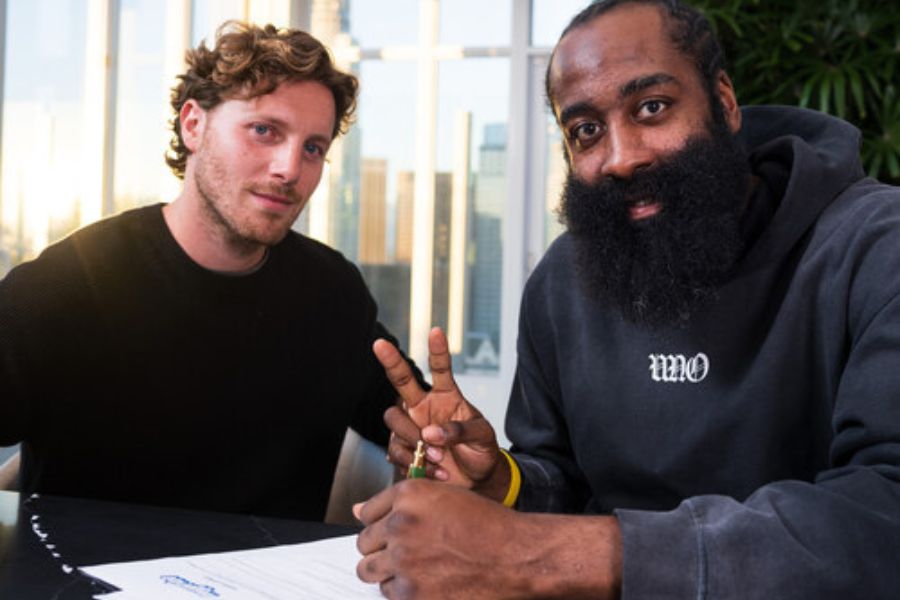
NBA veteran James Harden has entered the world of social gaming, thanks to a new partnership with multiplayer gaming platform MyPrize.
Harden will now be the company’s first ‘Premier Creator’ and the first athlete to regularly stream, play, and interact with fans within a multiplayer gaming environment.
Harden will participate in livestreams, co-develop games, and host interactive sessions that will enable fans to join his virtual gaming rooms in real-time.
MyPrize said that the initiative will attempt to blend traditional spectator experiences with direct participation and give fans a more immersive form of engagement.
The group has reported significant user activity in recent years and describes its platform as a combination of multiplayer gaming, social media, and livestream. Speaking about the partnership with Harden, the MyPrize Chief Executive and Founder Zach Bruch said it added something new to the industry.
“James is a cultural force whose influence spans sports, entertainment, and global fandom. Bringing him into the MyPrize creator ecosystem is a game-changing moment, not just for us, but for the entire social gaming and markets industry,” he said.
The partnership follows the platform’s recent collaboration with cryptocurrency exchange Crypto.com to launch social gaming and prediction market platform, MyPrize Markets.

Verticals:
Sectors:
Topics:
Dig Deeper
Related stories




The Backstory
Why a creator-led bet on social gaming matters now
James Harden’s move into a multiplayer, livestreamed social gaming platform lands at a moment when the lines between sports fandom, interactive media and prediction products are converging. Big-name athletes and creators are increasingly central to how platforms attract and keep users. That shift is visible across fantasy, sweepstakes and social casinos, where engagement is the currency and regulatory clarity is the risk. Harden’s role as a premier creator slots into a broader scramble for attention and trust in an industry navigating product innovation and legal scrutiny.
The crossover between sports stars and gaming infrastructure is not new, but it is accelerating. Matthew Berry’s fantasy startup drew a fresh slate of celebrity backers including LeBron James and several NFL players, underscoring investor interest in tools and content that keep fans inside a single ecosystem from draft prep to game day chatter. The $7 million raise for Fantasy Life’s data-driven advice and alerts platform shows capital concentrating around communities that can activate both casual and power users through media and product loops rather than stand-alone apps.
Harden’s promise to co-develop games and host interactive sessions fits that flywheel. If celebrity-led participation reliably widens the top of the funnel, platforms that can turn viewership into participation — and participation into prediction — stand to gain share. The stakes: own the audience, or watch it fragment across casinos, fantasy apps and emerging sweepstakes markets that operate in a murky legal patchwork.
Prediction markets as the connective tissue
The technical backbone for that audience flywheel is already being laid. MyPrize last month partnered with Crypto.com to launch MyPrize Markets, a social gaming and prediction platform integrated with livestreaming. The collaboration makes Crypto.com the company’s first social gaming partner and is positioned to reach more than one million users across web and mobile through MyPrize.us and MyPrize.com. The pitch is continuity: users watch a stream, see a market on a sports or crypto event, then participate without leaving the environment.
The timing puts MyPrize in the slipstream of a wider push to normalize prediction features across social platforms. Crypto.com also linked with Donald Trump’s social media firm to stand up a prediction market on Truth Social, a signal that these tools are moving from niche product to mainstream engagement layer. For Harden’s new role, the existing prediction rails mean creator content can be monetized not only through eyeballs but through interactive markets — a potential uplift in session length, conversion and recurring revenue.
But technical scale only travels as far as compliance allows. Building toward institutional-grade infrastructure helps court partners and regulators. It does not resolve the central question facing social gaming companies: where, exactly, do prediction markets and sweepstakes sit in the evolving U.S. map of gambling law?
Industry seeks a responsible playbook
Operators are attempting to answer that question preemptively. Australian social gaming operator VGW helped launch the Social Gaming Leadership Alliance, a U.S.-focused coalition designed to educate policymakers and standardize guardrails for sweepstakes-style, casino-themed games. Members include Playstudios, Yellow Social Interactive, ARB Interactive, B-Two Operations and payments provider Nuvei, with former U.S. Rep. Jeff Duncan as executive director. The alliance emphasizes free-to-play access, responsible gameplay tools, strict age checks and data security.
The coalition’s message is clear: treat social gaming as entertainment with consumer protections, not as a backdoor to unregulated gambling. That framing aims to influence the regulatory debate while differentiating social games from real-money casinos. It also seeks to reassure payments partners and advertisers that the category can police itself while lawmakers catch up. For platforms courting creator talent and mainstream brands, the SGLA’s standards are not just optics. They could be prerequisites for distribution and payment acceptance in key markets.
If MyPrize and its peers can point to a codified set of best practices, they may be better positioned to navigate new rules without breaking their growth engines. Still, voluntary standards will be stress-tested as states move from inquiry to enforcement.
State lines harden, definitions blur
The first shot across the bow came from Montana, which enacted Senate Bill 555 to effectively prohibit sweepstakes. The Social and Promotional Games Association condemned the law after Gov. Greg Gianforte signed it on May 12, arguing the language is so broad it fails to distinguish between sweepstakes casinos and routine digital promotions. The group warned that imprecise definitions around digital currency and gambling could chill legitimate marketing programs alongside gaming promotions.
Montana’s move signals a tougher posture that could spread, even as other states weigh tax revenue from regulated igaming. California raised the temperature earlier this summer when its attorney general said certain fantasy products violate state law, placing daily fantasy and lookalike offerings under a microscope. The patchwork leaves social gaming companies juggling varying standards for age gating, currency and prize structures. For a creator-driven strategy, that means programming schedules, product availability and monetization can swing on a state-by-state basis.
The risk is not only prohibition. It is uncertainty, which complicates product design and investor confidence. That uncertainty will shape how aggressively platforms push into prediction and sweepstakes mechanics and how they present those features to regulators and users.
Market headwinds and the fight for share
Even without legal shocks, market data show a tougher operating backdrop for social casinos. A Jefferies report found a “tough month” in June, with the category down 23% and specific titles under pressure. Aristocrat Leisure outperformed peers but still slipped 2.5% as Heart of Vegas and Big Fish Casino lagged, while Lightning Link and Mighty Fu offered some offset. Light & Wonder’s operations fell 9% amid a steep drop at Jackpot Party, though Quick Hit Slots and 88 Fortunes Slots posted gains. The firm’s SciPlay unit was flat in the second quarter after a slight first-quarter decline. Jefferies cautioned that growing sweepstakes offerings could add pressure even as legal questions mount. Read the full analysis in Jefferies’ social casino snapshot.
The takeaway for creator-led platforms: the battle is not only about legality, it is about differentiation. If social casinos struggle to sustain growth, the edge may come from content that feels live, communal and participatory. That is the bet behind embedding prediction markets into streams and recruiting celebrities who can convene fans at scale. It also nods to a potential endgame where social gaming revenue is fungible with regulated igaming as legalization expands, a dynamic Jefferies said could be an earnings boost for operators positioned to convert users across categories.
Meanwhile, investor enthusiasm around fantasy and advice ecosystems — evident in Fantasy Life’s funding round backed by sports and media figures — shows capital continuing to chase sticky, utility-based engagement. For MyPrize, hardening the product spine through its Crypto.com-powered prediction markets and aligning with industry norms promoted by the SGLA could be as important as Harden’s star power.
The next phase will test whether creator-driven, prediction-enabled social gaming can scale under uneven rules while converting fandom into sustainable economics. The platforms that win will likely be those that can turn live moments into persistent communities — and do it in ways regulators can live with.


