

IGT announces two US$1 million jackpots awarded in March

IGT has announced that it has awarded two jackpots exceeding US$1 million after two players won on its slots.
The two slot titles were Powerbucks and Whitney Houston Slots. The first jackpot, which totaled CA$1 million (US$725,334)1 CAD = 0.7253 USD
2026-04-13Powered by CMG CurrenShift, was won on the online version of Powerbucks Bounty O’ Bucks by a player in Manitoba.

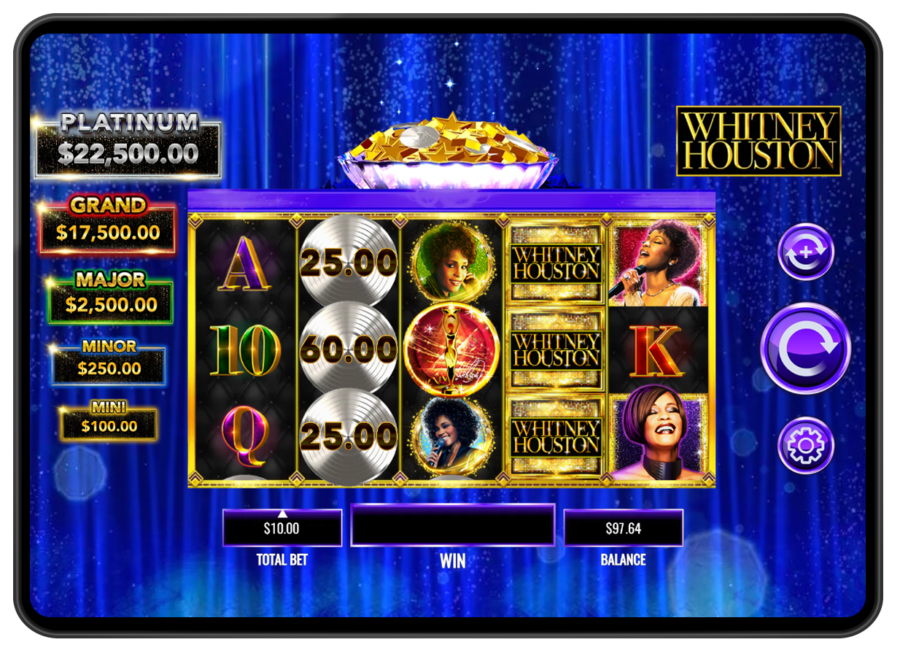
The second was won by a Connecticut player at Mohegan Sun on the Whitney Houston Slots game. They were awarded US$1.8 million.
The Whitney Houston title, developed by IGT, debuted in North America in August last year after a European release. The game launched at Hard Rock Bet Casino in New Jersey before expanding to Connecticut, Michigan, Pennsylvania, West Virginia, and Ontario.
The game features some of Whitney Houston’s most iconic songs, including I Wanna Dance with Somebody (Who Loves Me) and Greatest Love of All. The slot has four jackpot levels with images of the singer present throughout.

IGT isn’t the only company in the regulated market to announce big jackpots in recent months. Operator BetMGM revealed that it had awarded more than US$122 million in jackpots throughout 2025, including a CA$1.6 million (US$1.2 million)1 CAD = 0.7253 USD
2026-04-13Powered by CMG CurrenShift jackpot awarded on MGM Grand Million.
Charlotte Capewell brings her passion for storytelling and expertise in writing, researching, and the gambling industry to every article she writes. Her specialties include the US gambling industry, regulator legislation, igaming, and more.

Dig Deeper
Related stories
 2026/01/23: BetMGM awards over US$122 million from progressive jackpots in 2025
 2025/01/13: BetMGM awards players more than $128 million in progressive jackpots
 2025/08/06: Caesars Entertainment announces launch of IGT’s Kitty Glitter Grand slot game
 2025/01/27: Hard Rock Bet player from New Jersey hits US$518,000 jackpot
2026/01/23: BetMGM awards over US$122 million from progressive jackpots in 2025
2025/01/13: BetMGM awards players more than $128 million in progressive jackpots
2025/08/06: Caesars Entertainment announces launch of IGT’s Kitty Glitter Grand slot game
2025/01/27: Hard Rock Bet player from New Jersey hits US$518,000 jackpot
The Backstory
Why this jackpot news matters now
IGT’s twin seven-figure payouts in March spotlight the intensifying competition to use headline jackpots as a growth engine in regulated online and land-based casinos. The company’s Powerbucks network and branded Whitney Houston title underline a familiar playbook: combine recognizable IP with wide-area progressives to drive engagement across jurisdictions. The strategy has grown more potent as operators and suppliers race to scale exclusive networks, deepen content portfolios and expand into newly regulated markets where jackpots can be a customer acquisition wedge.
The broader backdrop is a maturing North American iGaming landscape in which progressive pools have become a key differentiator. Rival operators have treated jackpots as a signature feature to keep high-value customers loyal while converting casual players drawn by social buzz. Taken together with IGT’s latest wins, a string of recent disclosures from major operators and suppliers shows how jackpots, licensing and market entries are converging to determine who captures share in 2025 and beyond.
Rival networks keep raising the ceiling
BetMGM has set the pace on publicity and scale, reporting that it paid out $128.5 million in progressive jackpots in 2024 across its state-by-state exclusive network. The operator touted what it called “historic jackpot wins” as part of a push to anchor its online casino around exclusives and marquee events. The company highlighted record opportunities in individual states, with outsized interest in New Jersey and West Virginia, and said it kept investing in exclusive titles that feed those pools. The transparency is deliberate: publicizing totals helps validate network liquidity and draws attention to flagship games.
That positioning carried into the current cycle. BetMGM said it awarded over US$122 million in progressive jackpots in 2025, led by Michigan and Pennsylvania, and opened 2026 with another six-figure Michigan hit on MegaJackpots Cash Eruption. The operator also pointed to standout wins like a CA$1.6 million prize on MGM Grand Million in Ontario and a near US$1 million payout on Independence Pays in New Jersey. The cadence of disclosures suggests a feedback loop: bigger pools beget more play, which funds larger jackpots that become the next marketing moment. For suppliers and rivals, it underscores the need to seed fresh branded content and wider networks to match consumer expectations shaped by these totals.
These escalating benchmarks help explain why IGT is leaning into branded experiences such as the Whitney Houston game and online-linked progressives like Powerbucks. Consumers now expect multi-jurisdiction liquidity, licensed soundtracks and visible meters that move fast. If BetMGM popularizes the scale, suppliers must deliver content that converts that demand into sustained session times and repeat play across markets.
Licensing sets the stage for the next wave
Jackpots travel only as far as regulation allows. Recent approvals show how suppliers and studios are building the pipes for broader distribution. Aggregator QTech Games secured an online gaming license from Peru’s Ministry of Foreign Commerce and Tourism, clearing the way to deploy its catalog and its QTech Hybrid solution, which helps land-based operators launch online. As Peru’s market takes clearer regulatory shape, aggregation plus hybrid tools could lower the barrier for retail-first brands to bring progressive-ready content to mobile audiences.
On the studio side, Incentive Games obtained a license from the Alcohol and Gaming Commission of Ontario, enabling distribution of real-money titles tailored for the province’s standards through its Incentive Studios division. The Ontario market remains one of the largest competitive arenas in North America, with strong jackpot participation and a growing content pipeline. A local license lets emerging developers plug into operators hungry for differentiated games that can sit inside larger progressive frameworks or event-driven promos.
These moves expand the addressable base for jackpots and branded content. As more aggregators and studios win approvals, operators get flexibility to mix exclusive titles with licensed IP, then tie them into state or province-limited progressive pools that mimic national liquidity without crossing regulatory lines. For IGT and its peers, that means more potential endpoints for branded slots and more venues to syndicate progressive mechanics aligned with local rules.
Latin America’s rules rewire sportsbook and casino play
Brazil’s formalization of fixed-odds betting in January 2025 opened a high-growth channel that suppliers are racing to serve. Pragmatic Play’s certification to supply its sportsbook technology to Brazilian operators positions it to bundle betting with its existing regional casino footprint. The offering spans pre-match and in-play markets, player props and a bet builder, with managed services like risk and 24/7 support aimed at operators seeking turnkey scale. Localized features tailor the experience to Brazilian preferences, which could deepen cross-sell into slots and table games.
The regulatory tailwind extends beyond Brazil. QTech’s Peru license and pending LatAm approvals indicate that multiple South American jurisdictions are moving toward clearer frameworks. Each new approval adds distribution for online casino content and increases the likelihood that progressive-style mechanics will proliferate, even where liquidity must remain ring-fenced. For suppliers, certification is not just compliance; it is a commercialization strategy that aligns product road maps with the rhythm of local rulemaking.
As these markets mature, branded content and jackpots become competitive levers just as they did in North America. Operators that can stitch sportsbook engagement to casino jackpots—via unified wallets, cross-promotions and shared loyalty—stand to lift player value without relying solely on bonusing. That dynamic raises the stakes for suppliers to deliver IP-rich titles and flexible jackpot infrastructure that can be localized and audited.
The stakes for IGT, operators and players
IGT’s March windfalls validate a thesis: branded slots with wide-area progressives are potent acquisition and retention tools when paired with expanding regulated access. But the bar is higher. BetMGM’s disclosed totals in 2024 and 2025 recalibrated player expectations for jackpot size and frequency, pressuring content pipelines to offer recognizable themes, fast-accumulating meters and cross-market availability. Suppliers that can pair IP with compliant tech stacks in newly open jurisdictions will shape the next leg of growth.
For operators, the calculus is shifting from acquiring any content to curating mixes that maximize time on device and share of wallet. Network-exclusive jackpots, hybrid on-property and online tournaments, and sportsbook-casino crossovers are becoming standard. Licenses like QTech’s in Peru and Incentive Games’ in Ontario broaden the catalog options, while Brazil’s certification for Pragmatic Play’s sportsbook signals that integrated, localized platforms will win out over siloed products.
Players benefit from more choice and richer themes, but also face faster-evolving products that can blur lines between entertainment and high-variance play. Regulators will keep pressing for responsible gaming tools baked into jackpot ecosystems—reality checks, spend limits and transparent odds—especially as liquidity grows. The winners in this cycle will be those who can market the spectacle of life-changing jackpots while engineering sustainable play patterns.
Against that backdrop, IGT’s latest million-dollar results are not an endpoint but a marker of intensifying rivalry. With competitors publicizing nine-figure annual payouts and Latin American markets opening wider, the momentum around progressives and branded content is likely to accelerate. The question is which mix of licenses, partnerships and IP will convert visibility into durable share in 2026.
Related coverage: BetMGM’s 2024 progressive jackpot tally is detailed here, while its 2025 totals and early 2026 wins are outlined here. Market expansion updates include QTech Games’ Peru license approval, Incentive Games’ Ontario license announcement and Pragmatic Play’s Brazil sportsbook certification.