


BMM Testlabs and eCOGRA announce appointment of Global CEO and Executive Chairman of the Board

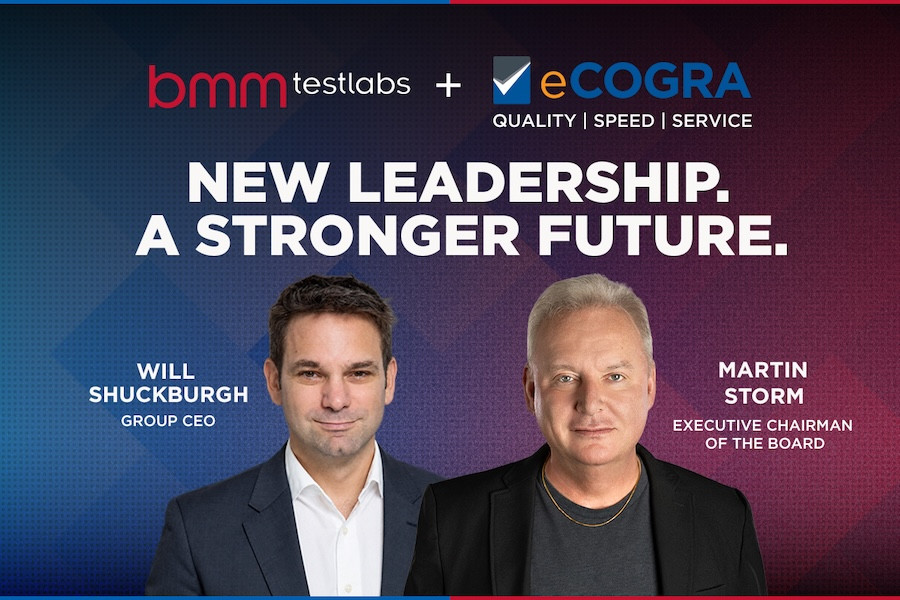
BMM Testlabs and eCOGRA have announced changes to the leadership of the combined business, with Martin Storm named Executive Chairman of the Board and Will Shuckburgh named Group CEO.
Storm was previously the President and CEO of BMM, while Shuckburgh was previously CEO of eCOGRA.

The move follows the summer announcement that BMM Testlabs parent company The Visualize Group was acquiring eCOGRA from Hanover Investors Management to boost its digital gaming segment.
At the time of the merger, it was indicated that the two companies would continue to operate as independently accredited businesses, with eCOGRA continuing under the leadership of Will Shuckburgh.
In a Wednesday release, the combined firms noted that “the appointments mark the next step as the two companies combine into one global business.”

Speaking of the shift, Martin Storm noted “Bringing BMM and eCOGRA together creates a stronger company for our customers, our regulators, and our people, BMM’s success has always come from our people, our integrity, and the trust placed in us, and those strengths will carry this business forward.”
Will Shuckburgh noted, “This is an exciting new chapter for BMM and eCOGRA […] By bringing our people, knowledge, and resources together, we will give customers broader expertise, a larger portfolio of services, and greater global and regulatory reach.”
The Visualize Group Founder and Managing Partner C.C. Melvin Ike noted “Martin and Will are exceptional leaders who bring different strengths and a shared commitment to excellence, and they are the right leaders for this next chapter.”

The group indicates that, between BMM and eCOGRA, it holds licenses or accreditations in more than 800 jurisdictions. It assured that both companies “will continue to operate under their existing brands, with no immediate changes to customer account teams, service delivery, or accreditations.”

Dig Deeper
Related stories
 2026/07/02: BMM Testlabs parent company Visualize acquires igaming testing group eCOGRA
 2025/03/13: eCogra extends US presence with West Virginia launch
 2025/04/24: EvenBet Gaming: Tackling Recruitment Challenges
 2026/03/25: BetMGM fined US$100,000 in Pennsylvania for failure to prevent fraudulent behavior
2026/07/02: BMM Testlabs parent company Visualize acquires igaming testing group eCOGRA
2025/03/13: eCogra extends US presence with West Virginia launch
2025/04/24: EvenBet Gaming: Tackling Recruitment Challenges
2026/03/25: BetMGM fined US$100,000 in Pennsylvania for failure to prevent fraudulent behavior
The Backstory
Consolidation reaches the governance stage
BMM Testlabs and eCOGRA’s move to name Martin Storm executive chairman and Will Shuckburgh group CEO marks the point at which a recent acquisition begins to look less like a financial transaction and more like an operating model. The appointments formalize the leadership structure for a combined testing, inspection, certification and compliance business that is seeking to serve both land-based and digital gaming markets at global scale.
The leadership change follows The Visualize Group’s purchase of eCOGRA from Hanover Investors Management, a deal that placed one of the best-known online gaming testing laboratories alongside BMM Testlabs under the same parent company. At the time, Visualize framed the transaction as a way to expand capacity in a market where regulators, operators and suppliers increasingly need faster certification across more jurisdictions. The company also stressed that BMM and eCOGRA would remain independently accredited businesses, a key point for clients that depend on recognized lab approvals to launch games, platforms and compliance systems.
That earlier deal, detailed in Visualize’s acquisition of eCOGRA, set the commercial logic for the current reshuffle. BMM brought a broad testing and certification footprint across gaming verticals, while eCOGRA added a digital-first specialization built around online casino, platform audit and regulatory assurance. The new appointments suggest Visualize is now trying to turn those complementary strengths into a unified business without disrupting accreditations, client relationships or service delivery.
Why certification has become more strategic
The transaction came amid a wider expansion of regulated online gambling, particularly in North America, Latin America and parts of Europe. As more jurisdictions legalize or formalize online casino and sports betting, independent labs have become gatekeepers for market entry. Operators cannot launch certified products without testing. Suppliers cannot scale quickly if game approvals are delayed. Regulators rely on outside specialists to confirm that systems meet technical, fairness, security and responsible gambling standards.
That demand has increased the value of companies with recognized credentials in multiple markets. eCOGRA’s approvals in U.S. states including West Virginia, Colorado, Connecticut, Indiana, Michigan, New Jersey, Pennsylvania and Virginia illustrate the importance of being licensed where operators are actively expanding. Its West Virginia launch in February 2025 was another step in that U.S. buildout, giving the company access to a state that has embraced regulated online casino and sports wagering.
The U.S. market is particularly demanding because regulation is fragmented by state. A supplier seeking national reach cannot rely on one approval. It must satisfy separate state requirements, often with different documentation, technical standards and timelines. That structure creates recurring work for testing laboratories but also puts pressure on them to maintain enough staffing, technical expertise and regulatory familiarity to keep clients moving.
Visualize’s wager is that a larger platform can do that more efficiently. By combining BMM’s broader certification spectrum with eCOGRA’s digital gaming focus, the parent company can offer clients a wider licensing umbrella and potentially shorter turnaround times. But the business also must preserve the independence and credibility that make laboratory approvals valuable in the first place. The balance between scale and regulatory trust is central to the stakes of the integration.
Leadership continuity limits integration risk
The choice of Storm and Shuckburgh reflects a preference for continuity rather than a clean break. Storm had led BMM, while Shuckburgh had led eCOGRA. Keeping both executives in senior roles gives Visualize a way to reassure two important audiences: customers that rely on existing account teams and regulators that recognize each company’s accreditations.
That matters because testing laboratories sell confidence as much as technical work. A merger that disrupts certification timelines, changes audit teams abruptly or raises questions about independence can create risk for operators and suppliers. Gaming companies plan product road maps around regulatory approvals. Delays can mean missed launches, lost revenue and strained relationships with state or national regulators.
The company’s statement that there will be no immediate changes to customer account teams, service delivery or accreditations is therefore more than a transition detail. It is a commercial assurance. In a market where certification capacity is tight, clients want more resources but not more uncertainty. The governance structure appears designed to signal that BMM and eCOGRA will gain scale while maintaining recognizable brands and processes.
That approach also fits a broader pattern in regulated gaming suppliers. Leadership transitions are often structured to avoid disruption in markets where government relationships and institutional knowledge are critical. Scientific Games, for example, said it would maintain continuity when Pat McHugh moved toward retirement and Kevin Schneider was named interim CEO, a change described in Scientific Games’ leadership transition. The contexts differ, but the underlying concern is similar: regulated gaming businesses must show customers and regulators that strategic change will not interrupt execution.
Compliance pressure is rising on operators
The case for stronger testing and compliance infrastructure has been reinforced by enforcement actions against operators. Regulators are scrutinizing know-your-customer systems, fraud controls, anti-money laundering procedures, responsible gambling safeguards and technical integrity. Failures can bring penalties and reputational damage, especially in U.S. states where gaming boards publish enforcement decisions and expect operators to correct deficiencies quickly.
In Pennsylvania, the Gaming Control Board approved a $100,000 fine against BetMGM after finding insufficient procedures to prevent fraudulent behavior on its BetMGM and Borgata wagering platforms. The case involved fraud rings that allegedly used other people’s identifying information to create accounts and fund them with stolen or fraudulently obtained payment devices. The enforcement action, outlined in BetMGM’s Pennsylvania fine, showed how weaknesses in account controls can persist across long periods and involve hundreds or even thousands of accounts.
For testing and certification providers, such cases underline the expanding definition of compliance. The work is no longer limited to random number generators, return-to-player calculations or game math. Regulators increasingly expect assurance around identity, payments, platform access, geolocation, responsible gambling triggers, reporting and cybersecurity. That widens the technical burden on laboratories and creates incentives for providers to build deeper multidisciplinary teams.
It also raises the consequences of falling behind. A state approval is not only a market access document; it is part of the risk-management system for regulated gambling. If fraud, underage access or product failures occur, regulators will examine the operator, the supplier and, at times, the certification processes that supported launch. Larger lab groups may be better positioned to invest in specialized tools and personnel, but they also face more scrutiny because their work touches more markets.
Talent becomes the constraint behind growth
The biggest practical challenge for the combined BMM-eCOGRA business may be people. Testing and certification require specialized technical employees who understand gaming systems, regulatory frameworks, data security and audit discipline. As more markets regulate and more suppliers seek approval, the demand for those workers rises. Capacity expansion depends not just on acquisitions but on recruiting and retaining enough qualified staff to deliver work at speed.
That constraint has been visible across the igaming sector. In an interview on EvenBet Gaming’s recruitment challenges, executives described intense competition for specialized talent in North America, shortages linked to education gaps in Latin America and regional differences in what employees value. The discussion highlighted a shift away from salary alone and toward culture, flexibility, development opportunities and purpose-driven work.
Those dynamics apply directly to certification providers. A broader global footprint can attract talent by offering varied work and clearer career paths, but it can also make integration harder. Employees accustomed to smaller, specialized teams may resist changes in process or reporting lines. Younger technical workers may judge the combined company not only by compensation, but by whether it offers meaningful work, modern systems and a credible culture.
Visualize’s stated plan to expand capacity and improve responsiveness will therefore depend on execution after the leadership announcement. Storm and Shuckburgh inherit a business with strong market logic: regulation is spreading, compliance demands are rising and customers need faster approvals from trusted labs. The test now is whether the combined company can convert those conditions into scale without sacrificing the independence, technical rigor and service consistency that made BMM and eCOGRA valuable in the first place.
