


Binance hit with record crypto hack, company says US$6.3 billion involved


Crypto trading platform Binance has been hit with what’s being called the world’s largest cyber heist, with the firm indicating that “the estimated total impact sits at around US$6.3 billion.”
In a “Security Incident Update” published by the group on Friday, Binance noted that “the security incident may involve a compromised DevOps engineer’s laptop, which allowed an attacker to gain access to a service container and submit unauthorized withdrawal transactions.”

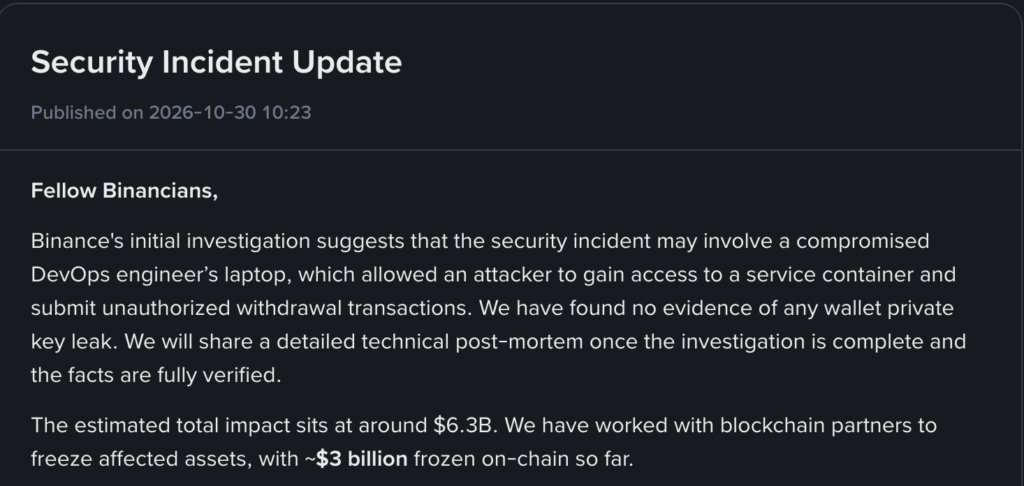
Binance furthered that “We have found no evidence of any wallet private key leak. We will share a detailed technical post-mortem once the investigation is complete and the facts are fully verified.”
While the hack obviously raises significant concerns, the firm noted that (at the time of its post) around US$3 billion was frozen on-chain so far.
“Binance will cover all losses from the SAFU (Secure Asset Fund for Users) and the company’s funds. User funds are safe. We will also publish an updated Proof of Reserves once the remediation is complete,” noted the world’s largest crypto exchange.

The platform has also temporarily suspended deposits and withdrawals, revoked the affected address authorization and “engaged law enforcement and blockchain intelligence partners to trace and recover funds.”
According to Forbes, Tether and Circle (USDT and USDC) have frozen funds related to the hack amounting to US$1.56 billion and some 800 million USDC, respectively.
Binance has yet to indicate the group behind the hack.

Dig Deeper
Related stories
 2025/01/21: Stake General Counsel: It would be “unwise” to ignore crypto
 2026/08/20: SEC eases crypto regulations as White House doubles down on support for digital assets
 2026/04/08: Paysafe launches crypto payments for US gambling sector
 2026/07/17: Crypto.com secures US$400 million investment from Citadel Securities
2025/01/21: Stake General Counsel: It would be “unwise” to ignore crypto
2026/08/20: SEC eases crypto regulations as White House doubles down on support for digital assets
2026/04/08: Paysafe launches crypto payments for US gambling sector
2026/07/17: Crypto.com secures US$400 million investment from Citadel Securities
The Backstory
Crypto’s scale has outpaced its safety net
Binance’s disclosure of a security incident involving an estimated US$6.3 billion lands at a moment when cryptocurrency has been moving from a speculative corner of finance into payments, gambling, prediction markets and institutional products. The company said it found no evidence of a wallet private key leak and plans to cover losses through its Secure Asset Fund for Users and company funds. Still, the scale of the event puts fresh pressure on an industry that has spent years arguing that blockchain rails can be cheaper, faster and more transparent than traditional finance.
The central tension is not new. Crypto firms and their backers say distributed ledgers can make transactions easier to trace, reduce payment friction and open new products. Regulators and critics point to hacks, fraud, market manipulation and conflicts of interest as evidence that the market’s plumbing remains fragile. A record theft at the world’s largest crypto exchange sharpens that debate because it tests both claims at once: whether funds can be frozen and traced quickly enough to limit damage and whether users can trust centralized platforms that sit atop decentralized networks.
Regulators have been shifting from enforcement to rulemaking
The Binance incident follows a pronounced change in Washington’s posture toward digital assets. The Securities and Exchange Commission recently proposed “Regulation Crypto Assets,” a package aimed at giving crypto entrepreneurs clearer pathways to raise capital under federal securities laws. The proposal includes exemptions for offerings of up to US$5 million over four years and up to US$75 million in a 12-month period, with disclosure, reporting and anti-fraud obligations attached.
That shift was framed in an earlier report on how the SEC eased crypto regulations as the White House doubled down on support for digital assets. The policy direction marked a contrast with the prior enforcement-heavy era, when the SEC pursued major crypto companies including Ripple, Coinbase and Binance. Supporters say clearer rules could keep activity onshore and subject to oversight. Skeptics say looser capital-raising exemptions could expand risk before supervisory systems are mature enough to handle it.
The hack complicates the political case for liberalization. It gives regulators a fresh example of operational risk at systemically important crypto platforms even as policymakers seek to promote U.S. leadership in digital assets. It also underscores why the details of custody, cybersecurity, disclosures and incident reporting matter as much as broader questions about whether a token is a security or commodity.
Gambling operators have watched crypto move closer to the mainstream
The online gambling industry has been one of the clearest test cases for crypto’s practical appeal. Operators face high payment costs, chargeback risk, cross-border friction and lengthy settlement times. Crypto advocates say blockchain transactions can cut those costs and let customers use assets they already hold. But licensed gambling markets also impose strict obligations around know-your-customer checks, anti-money laundering controls, source-of-funds reviews and responsible gambling monitoring.
That divide was visible when Paysafe launched a product for U.S. operators allowing players to fund gambling accounts through crypto wallets, with deposits converted into dollars. The move, described in a report on Paysafe’s crypto payments launch for the U.S. gambling sector, reflected growing operator demand and consumer interest. Paysafe cited about 70.4 million Americans owning cryptocurrency and said 83% of U.S. players showed interest in using crypto as a payment method.
Yet adoption remains limited by state law. Wyoming became the first state to permit “digital, crypto, and virtual currencies” as a form of payment for wagers under HB 133 in 2021. Other states, including Virginia and Colorado, permit cryptocurrency conversions as deposits, and DraftKings has outlined plans for a crypto-to-cash product in selected states. The Binance hack could slow momentum if regulators use it to question whether crypto payment rails introduce additional security and compliance risks for gambling operators already under scrutiny.
Offshore crypto casinos exposed the demand regulators are trying to capture
The strongest evidence of crypto demand in gambling may be outside regulated markets. Offshore crypto casinos have grown by serving users who want direct blockchain deposits, rapid withdrawals and products that can be launched more quickly than in licensed jurisdictions. Yield Sec figures cited in an earlier profile estimated crypto gambling as an US$81.4 billion industry, with the largest operators rivaling traditional casinos in scale.
That growth was explored in a feature on BetHog and the crypto gambling frontier. Founder Nigel Eccles argued that crypto sharply reduces payment processing costs and allows faster product development than regulated gambling markets, where game approvals and compliance reviews can delay releases. His view reflects a broader industry frustration: regulation can protect consumers but also push innovation offshore when rules are unclear or slow-moving.
Binance’s breach highlights the other side of that trade-off. Offshore and crypto-native platforms may move faster, but their ecosystems depend on exchanges, stablecoins, bridges, wallets and custodial services that can become single points of failure. If a DevOps compromise can trigger billions in unauthorized withdrawals at a major exchange, gambling companies considering crypto integrations will need to show regulators that their controls extend beyond the casino account and into the broader chain of custody.
Institutions were already betting on digital-asset rails
Even before the Binance incident, large financial players were increasing their exposure to crypto infrastructure. Citadel Securities invested US$400 million in Crypto.com at a US$20 billion valuation, supporting the exchange’s push into tokenized securities and derivatives. The deal, detailed in a report on Crypto.com’s US$400 million investment from Citadel Securities, showed how major market-making firms now view digital assets as part of the future market structure.
Crypto.com’s expansion also overlaps with prediction markets, a sector drawing attention from gambling companies, exchanges and regulators. The company entered prediction markets in 2024, launched OG.com and partnered with operators including High Roller Technologies and FanDuel Predicts. Those moves blur lines between financial trading, event contracts and wagering, making cybersecurity and market integrity more important as customer funds and speculative products converge.
A Binance-scale breach can affect that institutional narrative. Investors may still see long-term value in tokenized assets and blockchain settlement, but they will demand stronger proof that exchanges can withstand operational attacks, isolate compromised systems and preserve client assets. The ability of Tether, Circle and blockchain intelligence firms to freeze or trace funds may be cited as evidence of maturing controls. But it also raises questions about how decentralized the ecosystem really is when emergency intervention depends on issuers, exchanges and law enforcement coordination.
The next test is trust, not demand
Crypto’s advocates no longer need to prove that demand exists. Stablecoins rank among major holders of U.S. Treasury securities, consumers hold digital assets at scale and gambling operators are building products to meet customer interest. At ICE Barcelona, Stake General Counsel Jeremiah Ooi warned it would be “unwise” to ignore cryptocurrency’s significance, while pointing to blockchain’s potential to improve know-your-customer, anti-money laundering and responsible gambling processes. His comments, covered in a report on why Stake’s general counsel said it would be unwise to ignore crypto, captured the industry’s ambivalence: the technology creates useful data, but also obligations to manage it responsibly.
That is where the Binance case becomes more than another exchange hack. It arrives as policymakers are crafting friendlier frameworks, payment companies are courting gambling operators, offshore casinos are proving consumer appetite and institutions are funding crypto’s next phase. Each of those developments depends on trust that platforms can protect assets and respond transparently when controls fail.
If Binance absorbs the losses, recovers a meaningful share of the funds and produces a credible post-mortem, the episode may be treated as a severe but contained operational failure. If recovery stalls or new weaknesses emerge, it could harden regulatory resistance just as crypto is seeking broader acceptance in finance and gambling. The industry’s immediate challenge is technical. Its larger challenge is convincing users, regulators and partners that scale has not come faster than resilience.
